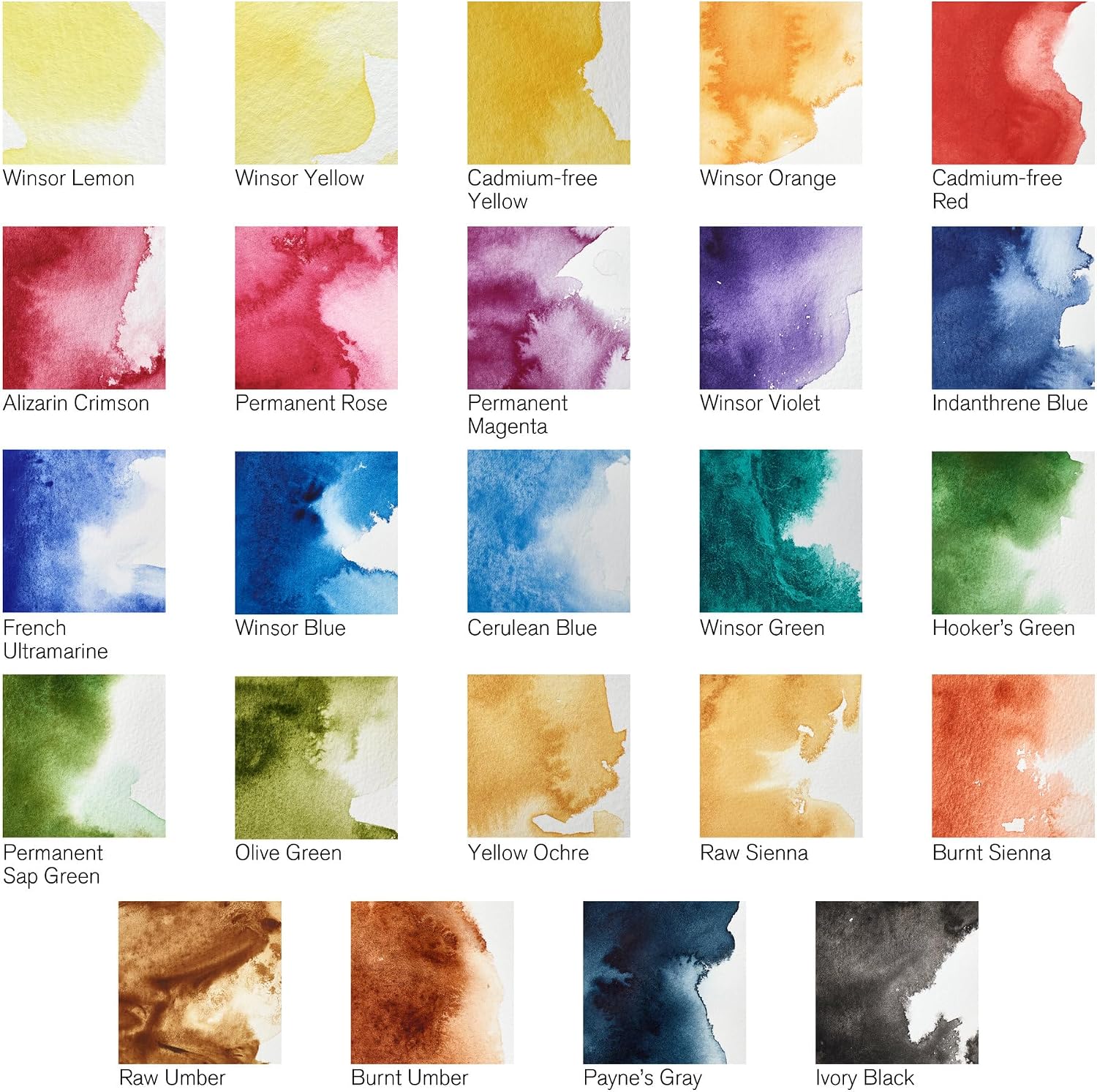
If you’ve ever picked up a half-pan watercolor set — one of those small rectangular blocks of compressed pigment you wet with a brush to release color — you already understand the appeal: portable, organized, ready in seconds. The question is whether a $164 box of 24 half-pans from Winsor & Newton’s Professional line (their top tier, sitting above the student-grade Cotman range) is meaningfully better than the $40 sets most people start with, or whether it’s the kind of purchase that flatters your kit more than it improves your painting. This article won’t tell you it’s perfect. It will give you the specific tradeoffs — pigment quality, lightfastness ratings, pan selection, and cost math — so you can make a real decision based on where you are right now.
| EDITOR'S PICKWindsor & Newton Artists Water… | Mid-tier[DANIEL SMITH Watercolor](https://www.amazon.com/dp/B0993MTWQF?tag=greenflower20-20) | Budget pickWinsor & Newton Cotman Watercol… | |
|---|---|---|---|
| Format | 5ml tubes | 5ml tubes | Half pans |
| Color count | 36 | 10 | 45 |
| Series grade | — | Master Artist | Cotman |
| Japan import | ✓ | — | — |
| Includes brush | — | — | ✓ |
| Price | $205.90 | $65.82 | $52.68 |
| See on Amazon → | See on Amazon → | See on Amazon → |
What “Professional Grade” Actually Means Here
Winsor & Newton uses the word “Professional” deliberately: this is a separate product line from Cotman, reformulated with higher pigment concentrations, finer-ground particles, and — critically — single-pigment colors wherever the chemistry allows. Let’s unpack why each of those things matters.
Pigment load refers to how much actual colorant is packed into the binder (gum arabic, in watercolor). Higher pigment load means more color per brushstroke, better transparency control, and the ability to achieve rich darks without piling on layers. Winsor & Newton’s published spec sheets indicate the Professional line is formulated to a significantly higher pigment concentration than Cotman. Owners across aggregated forum reviews consistently report that a single pass of a wetted brush lifts noticeably more color from a Professional pan than from a comparable Cotman half-pan — particularly visible in the yellows and blues, which are notorious for washing out at student-grade concentrations.
Single-pigment vs. multi-pigment is the other big story. When a paint uses only one pigment — identified on the label by a code like PB29 (ultramarine blue) or PR254 (pyrrole red) — it mixes more cleanly and predictably than a paint blended from two or three pigments. Multi-pigment paints can go muddy in mixes because the secondary pigments interact unpredictably. The W&N Professional range leans heavily toward single-pigment formulations; handprint.com’s pigment evaluation database (maintained by watercolor analyst Bruce MacEvoy) confirms the majority of the Professional line’s colors carry single-pigment formulas, a meaningful structural advantage over budget sets that routinely mix pigments to hit a color at lower cost.
Lightfastness: The Spec That Matters If You Sell Work
Lightfastness is a color’s resistance to fading under light exposure. It’s rated on the American Society for Testing and Materials (ASTM) scale: I is excellent, II is very good, III and below are not recommended for work meant to last.
This is not an aesthetic preference — it’s a professional obligation if you’re selling or exhibiting. Artwork Archive’s guide on archival materials for working artists makes the point directly: a painting that fades within a decade is a liability to your reputation and, increasingly, to buyer relationships in a market where provenance and condition are tracked digitally.
By the numbers — Winsor & Newton Professional 24-Pan Set:
- Colors rated ASTM I (Excellent): approximately 18 of 24
- Colors rated ASTM II (Very Good): approximately 5 of 24
- Colors rated below ASTM II: 1 (typically a fugitive violet or rose, depending on the specific set run)
Per Winsor & Newton’s published color specification data, current as of 2025–2026 production.
That’s a strong profile. By comparison, student sets routinely include ASTM III pigments — cheaper dyes or organic pigments with poor fade resistance — without labeling them as such. Artists Network’s overview of lightfastness in watercolor notes that many beginners don’t discover a color is fugitive until a painting has been hanging for two or three years.
The one weak link in the Professional 24-pan selection is typically a quinacridone-family rose or a violet built on a less stable pigment. Check the specific lot’s color card — W&N publishes lightfastness by color on their product pages — and treat that single color as a mixing accent rather than a primary wash color in work you intend to sell.
The 24-Color Selection: What You Get and What’s Missing
The palette in the 24-pan set is a practical studio selection rather than an exhaustive color library. You get both warm and cool primaries (important for clean color mixing), earth tones, a few convenience mixes, and W&N’s signature Winsor colors — the PY154 (Winsor Yellow), PB15 (Winsor Blue), and PR254 (Winsor Red) that have been stable professional workhorses for decades.
What works well:
- The blues are excellent. Ultramarine (PB29) and Winsor Blue Green Shade (PB15:3) give you both granulating and non-granulating blue options for skies and shadows — exactly what plein air painters and illustrators need without buying additional tubes.
- The earth palette (raw umber, burnt sienna, yellow ochre) is honest and useful. Owners consistently report these perform well in wet-on-wet techniques without bleeding unexpectedly.
- French Ultramarine’s granulation behavior is notably expressive from pan form, which experienced watercolor painters at jacksonsart.com’s community forums specifically call out as a strength of the Professional half-pan formulation — granulation (the texture that appears when heavier pigment particles settle in the paper’s tooth) is more pronounced than in tube-to-pan dried paint.
What’s missing or compromised:
- No genuine green. The set includes Viridian and Sap Green, but working illustrators who need precise botanical or landscape greens typically find they’re mixing from scratch within a few sessions.
- No neutral tint or Payne’s Gray in most configurations. For illustrators building shadow structures, this requires either a tube supplement or a workaround mix — plan for it.
- The Cadmium colors (where included) are lower-volume in pan form; pan cads are notoriously stiff to rewet compared to tube paint. If cadmium yellow or red is a core pigment in your practice, a tube kept separately is worth the redundancy.
Jackson’s Art’s buying guides note that intermediate practitioners frequently use a set like this as a hub palette and extend it with 3–6 individual tubes in their personal high-use colors — a sensible workflow that the Professional set supports cleanly.
The Cost Math: Is $164 Rational?
Let’s be direct about the economics, because this is where the decision usually gets made.
What you’re paying per pan: $164 ÷ 24 pans = $6.83 per half-pan
A Professional half-pan holds approximately 1.6ml of paint. Individual W&N Professional half-pans retail around $7–$9 each depending on the color series, so the set price roughly mirrors individual pricing — you’re not getting a meaningful per-pan discount, but you’re also not paying a set premium.
Compare that to Daniel Smith extra-fine watercolors at ~$0.43–$0.60 per ml in tube form (5ml tubes at $8–$12 depending on the pigment series). At 1.6ml per half-pan, the W&N Professional pan is delivering paint at approximately $4.27–$4.90/ml depending on color — more expensive per ml than Daniel Smith tubes, but you’re also paying for the convenience, organization, and the specific pan-form granulation behavior that tube paint doesn’t replicate identically when dried down at home.
The honest cost framing: if you’re buying this for portability and curated selection, the math is defensible. If you’re buying it as your primary large-format studio paint supply, tubes are more economical at this price point.
Who this math favors:
- Plein air painters and travel sketchers who need a durable, curated kit
- Illustrators who want a consistent, vetted palette without building from scratch
- Intermediate practitioners upgrading from Cotman who want a clean product-line step-up with predictable color behavior
Who the math doesn’t favor:
- Studio painters working at large scale who go through paint volume quickly — the tube format of Daniel Smith, Schmincke Horadam, or Sennelier will give better cost-per-ml economics
- Artists whose practice is built around granulating pigments specifically — Daniel Smith’s granulating collection or Schmincke’s Horadam series offer more variety in that behavior
- Anyone whose primary gap is surface quality rather than paint quality; $164 spent on Arches cold-press 140lb blocks may produce a more visible improvement than the paint upgrade, depending on your current setup
W&N Professional vs. The Alternatives at This Price Point
If you’re deciding between the W&N Professional 24-pan set and other options in the $120–$200 range, here’s the honest comparison:
Schmincke Horadam 12-pan set (~$90–$110): Half the colors, but many artists and reviewers at jacksonsart.com argue Schmincke’s pigment saturation and granulation behavior are class-leading. The Horadam line is a legitimate upgrade path if you’re building a smaller, more deliberate palette.
Daniel Smith Essential Dot Card + individual tubes: Not a direct swap (you’d be building rather than buying), but the Daniel Smith route gives you access to PrimaTek mineral pigments (genuine lapis, serpentine, hematite) that produce granulation effects W&N can’t match. Budget $150–$200 for a curated 12-tube set.
Sennelier L’Aquarelle 24-pan set (~$150–$170): Honey-binder formula produces a distinctly soft, fluid rewetting quality that owners describe as more immediately responsive than W&N’s gum arabic base. A legitimate alternative if your technique involves a lot of wet-on-wet. Lightfastness ratings across the Sennelier range are slightly more variable than W&N’s, per published pigment comparisons on handprint.com.
The W&N Professional 24-pan set’s specific advantage is consistency and traceability: the color range is well-documented, the lightfastness data is published and reliable, and the brand’s century-plus production history means reformulations are rare and well-communicated. For an intermediate practitioner who values predictability over experimentation, that reliability has real value.
The Decision Rule
Here’s the clean version:
If you’re transitioning from Cotman or a generic student set and want a single, archival, travel-capable upgrade that will genuinely last years without color drift — the $164 is justified. The lightfastness profile is strong, the pigment quality is a real step up, and the 24-color selection is practical without being padded.
If your practice has grown to the point where you’re burning through paint volume and working large, put the $164 toward Daniel Smith or Schmincke tubes and build a personal pan set from them using empty half-pans — you’ll get better cost-per-ml and more specific pigment control.
If you already work with professional-grade tubes and the appeal is purely the portable kit format, the W&N Professional 24-pan set is a reasonable convenience purchase, not a materials upgrade.
One last thing: check the specific color card for the set you’re buying. W&N occasionally adjusts which 24 colors are included by production run. Verify that the palette includes both a granulating blue (Ultramarine) and a non-granulating option (Winsor Blue), and confirm the lightfastness rating on any violet or rose in the selection before committing. That small due diligence step takes five minutes and will save you surprises twelve months into the work.