A watercolor sketchbook is not the same thing as a watercolor block — a stack of sheets glued on all four edges so paper cannot buckle while drying — or a sheet pad of loose individually pulled pages. A sketchbook is bound: spiral wire, sewn signatures, or glued hardcover. It is designed to stay intact while you work page after page, session after session. That distinction matters because daily practice creates different demands than finishing a single painting. You need something that opens flat, travels without complaint, and survives real washes without turning into a soggy wrinkle map. If you are trying to figure out which format — spiral, hardcover, or compact square — belongs in your bag or on your desk, this article maps the tradeoffs, names the products that keep coming up in aggregated buyer feedback, and ends with a clear decision framework.
| EDITOR'S PICKArches Watercolor Paper Block | Mid-tierARTEZA Watercolor Sketchbook 2-… | Budget picktumuarta Watercolor Journal | |
|---|---|---|---|
| Format | Block | Spiral-bound | — |
| Pages | — | 128 | 48 |
| Size | 8"x10" | 9x12 | 5.5x5.5 |
| Cotton paper | — | — | ✓ |
| Price | $39.79 | $26.99 | $13.99 |
| See on Amazon → | See on Amazon → | See on Amazon → |
Why Format Actually Matters for Daily Watercolor Work
The implicit hierarchy that surfaces across hundreds of buyer reviews is hard to miss: artists tend to use sketchbooks for practice and save premium 300gsm cotton-press blocks for pieces they plan to sell or frame. That hierarchy is completely sensible, but it creates a trap. If your practice sketchbook handles water badly, your brushwork suffers, your washes do not behave the way they would on good paper, and the “practice” you are building is actually muscle memory for compensating around a bad surface. The sketchbook you use every day shapes your intuition more than the premium sheet you touch once a month.
Three format decisions define the daily-practice sketchbook:
-
Paper composition — cotton fiber versus wood pulp (cellulose). Cotton paper, also called rag paper, is made from textile fibers rather than wood. It absorbs water more slowly, releases pigment more predictably during lifting and scrubbing, and stays dimensionally stable through wet washes. Wood-pulp paper is cheaper, absorbs water faster, and is far more likely to buckle or pill under aggressive technique.
-
Weight and sizing — paper weight measured in grams per square meter (GSM) and internal sizing, a gelatin or starch treatment that slows water absorption, interact to determine how much water the surface can hold before warping.
-
Binding format — spiral allows the book to open completely flat and lets you tear pages cleanly; hardcover case bindings protect pages but can create a gutter shadow near the spine; pocket and square formats trade paper area for portability.
Handprint.com, in the reference document “Watercolor Supports: Papers and Boards,” explains that cotton-fiber paper is the baseline for predictable watercolor behavior because its longer fibers create a more resilient surface that recovers better after repeated wetting and drying cycles. Jackson’s Art Blog, in the article “Guide to Watercolour Paper,” confirms that paper weight above 300gsm — or a heavily sized lighter paper — is the practical threshold for avoiding serious buckling under sustained washes.
Spiral-Bound Sketchbooks: Maximum Flat-Opening Area
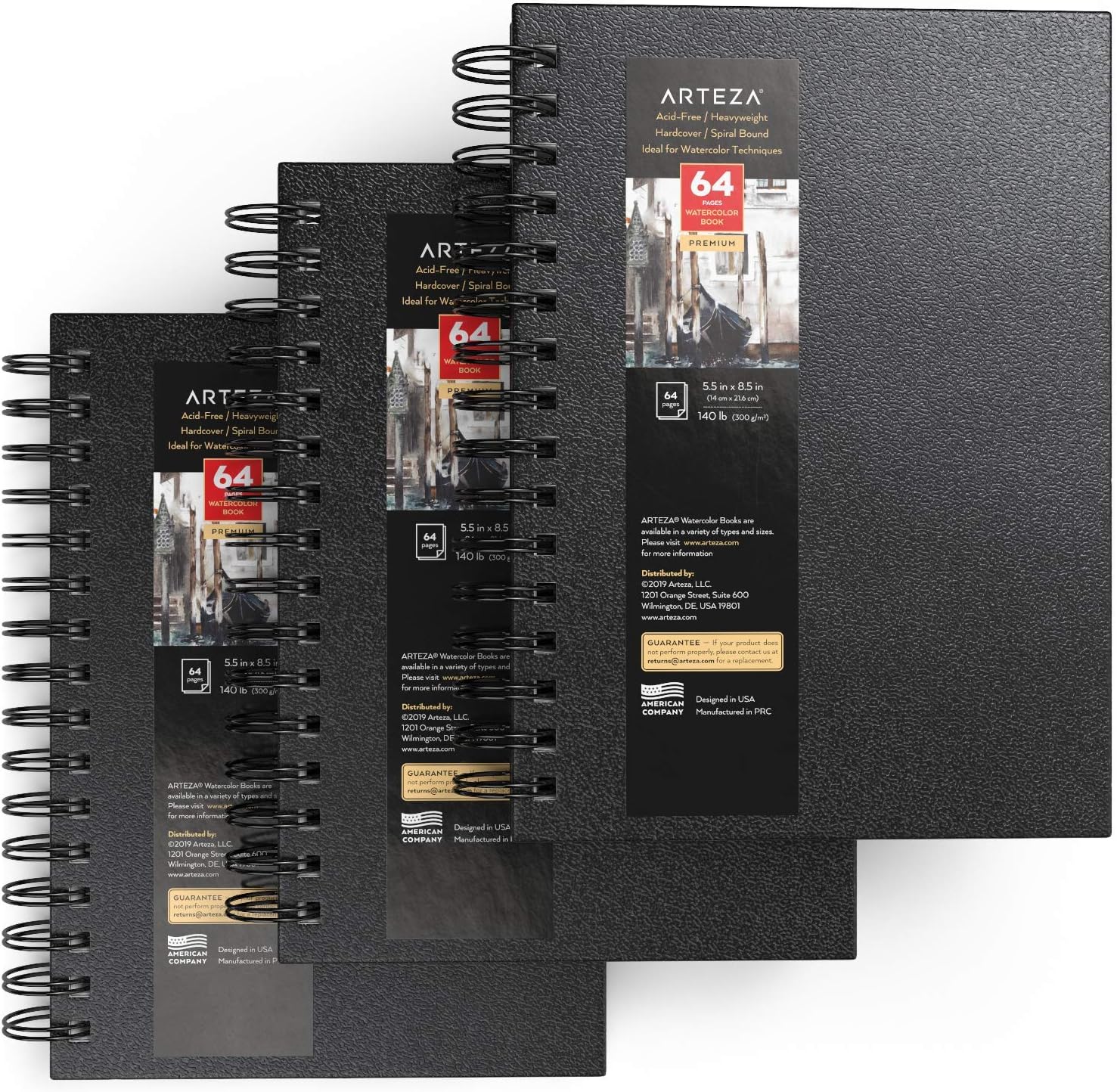
Budget Pick — ARTEZA 9×12 Spiral Watercolor Sketchbook
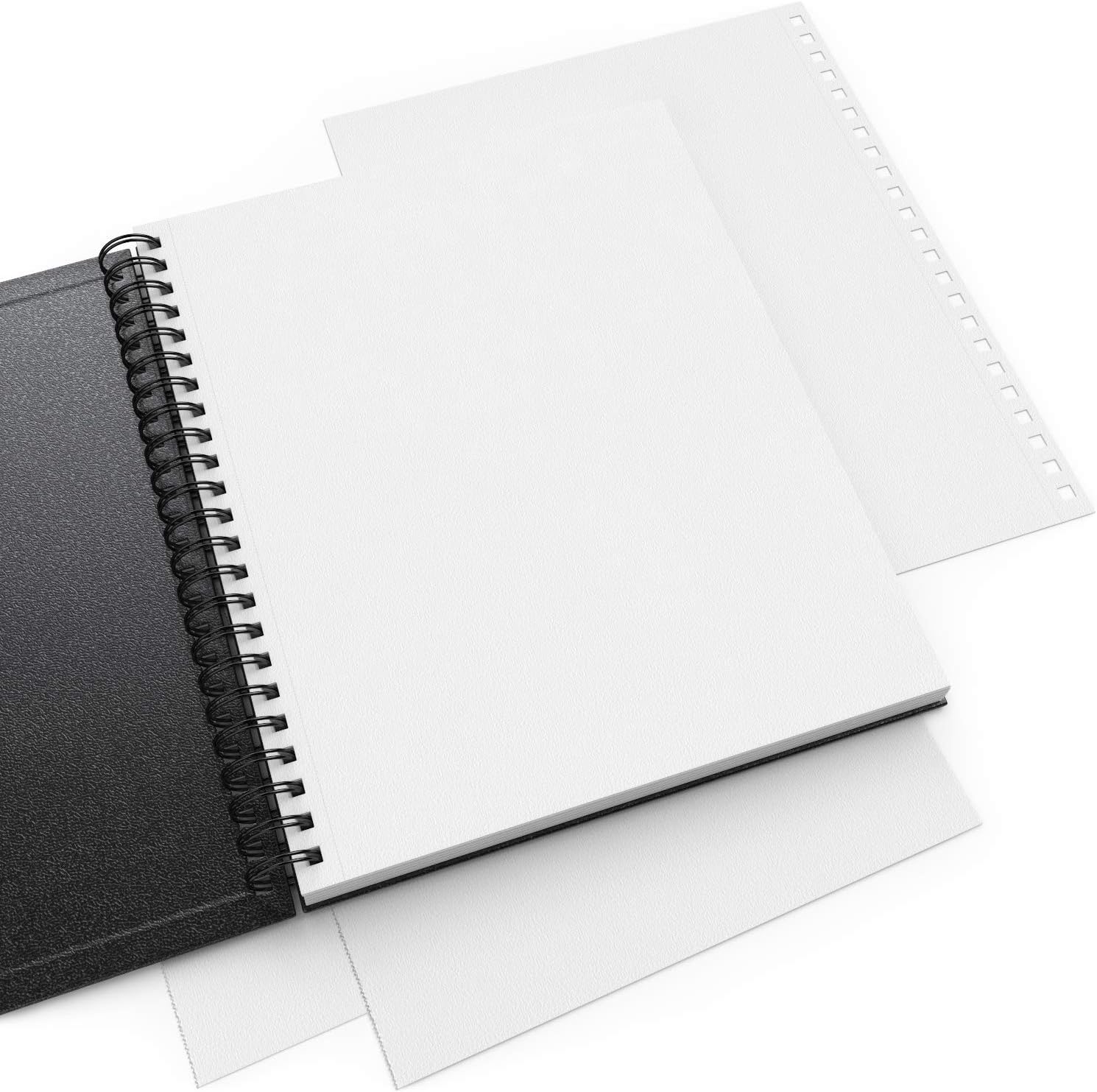
The spiral format is the workhorse of daily practice. The wire coil lets pages fold fully back on themselves, which means no gutter fighting and no finger strain holding a resistant spine open. For wet media specifically, the flat-opening matters: you can tilt the whole book to control wash flow without the paper trying to spring closed.
ARTEZA watercolor sketchbooks in the 9×12 spiral format generate a consistent pattern in aggregated reviews worth taking seriously. Multiple owners contrast the ARTEZA paper against generic multimedia paper, with one frequently cited comment noting the paper “can take water — I mean water” — a practitioner’s benchmark that signals real wash performance rather than mere wet-media tolerance. Artwork Archive, in the article “How to Build a Daily Art Practice,” notes that consistency of surface matters for skill-building; if your practice sketchbook fails under real washes, the feedback loop that builds technique breaks down.
The honest limitation: ARTEZA sketchbook paper is wood pulp, not cotton. For lifting and scrubbing techniques — dragging a damp brush back across a dried wash to recover light areas — wood-pulp fiber pills and shreds faster than cotton. Artists Network, in the article “Choosing the Right Watercolor Paper,” points out that cold-press texture and internal sizing are the two factors that most affect wash behavior on any given sheet; the ARTEZA’s sizing performs well for wet-on-wet and wash flow, but it does not replicate the resilience cotton provides for repeated reworking.
Best for: Wet washes, wash flow practice, wet-on-wet technique, high-frequency daily sessions on a budget. Limitation: Heavy lifting and scrubbing will pill the surface; not a cotton-paper replacement.
tumuarta
$13.99
In stock on Amazon
Check price on AmazonHardcover Case-Bound Sketchbooks: Permanence and Protection
Mid-Tier Pick — Moleskine Watercolor Album
The Moleskine watercolor album has an unusual review signature. Rather than the expected transparent watercolor use, a substantial portion of buyers describe using it primarily for gouache — the opaque, chalky cousin of watercolor. The pattern in aggregated feedback is consistent enough to be meaningful: reviewers praise the lack of bleed-through and the slightly harder, less textured surface. Several note it as the product that ended years of cycling through cheaper sketchbooks. One reviewer’s framing — overcoming notebook reluctance after spending money on inferior options — captures the psychological shift that happens when a sketchbook actually earns trust.
Why gouache over transparent watercolor? Gouache is applied in more opaque, often thicker layers that do not rely on the paper’s translucency or its ability to hold a long wet wash. A slightly harder, less textured surface works well here. For traditional transparent watercolor — where pigment suspends in water and the paper’s white provides luminosity — the Moleskine’s surface is less forgiving of heavy washes. Multiple owners report that sustained wet washes cause some cockling, the wave-like buckling that happens when paper gets wet unevenly. Jackson’s Art Blog, in the “Guide to Watercolour Paper,” explains that both cold-press texture and internal sizing affect wash behavior; the Moleskine prioritizes portability and protection over either of those properties.
The case binding also limits how flat the book opens. Near the gutter — the center fold — you will always lose a sliver of working space. For full-spread compositions, this is genuinely limiting. The real strengths are structural: the hardcover protects pages from corner damage in a bag, the elastic closure keeps everything secure, and the overall object is pleasant to carry and to own.
Best for: Gouache, ink-wash, opaque layers, artists who want page protection during commutes. Limitation: Sustained transparent watercolor washes cause cockling; gutter limits full-spread work.
ARTEZA
$26.99
In stock on Amazon
Check price on AmazonPocket and Square Formats: Portability as Practice Strategy
Premium Pick — Tumuarta Cotton Watercolor Journal
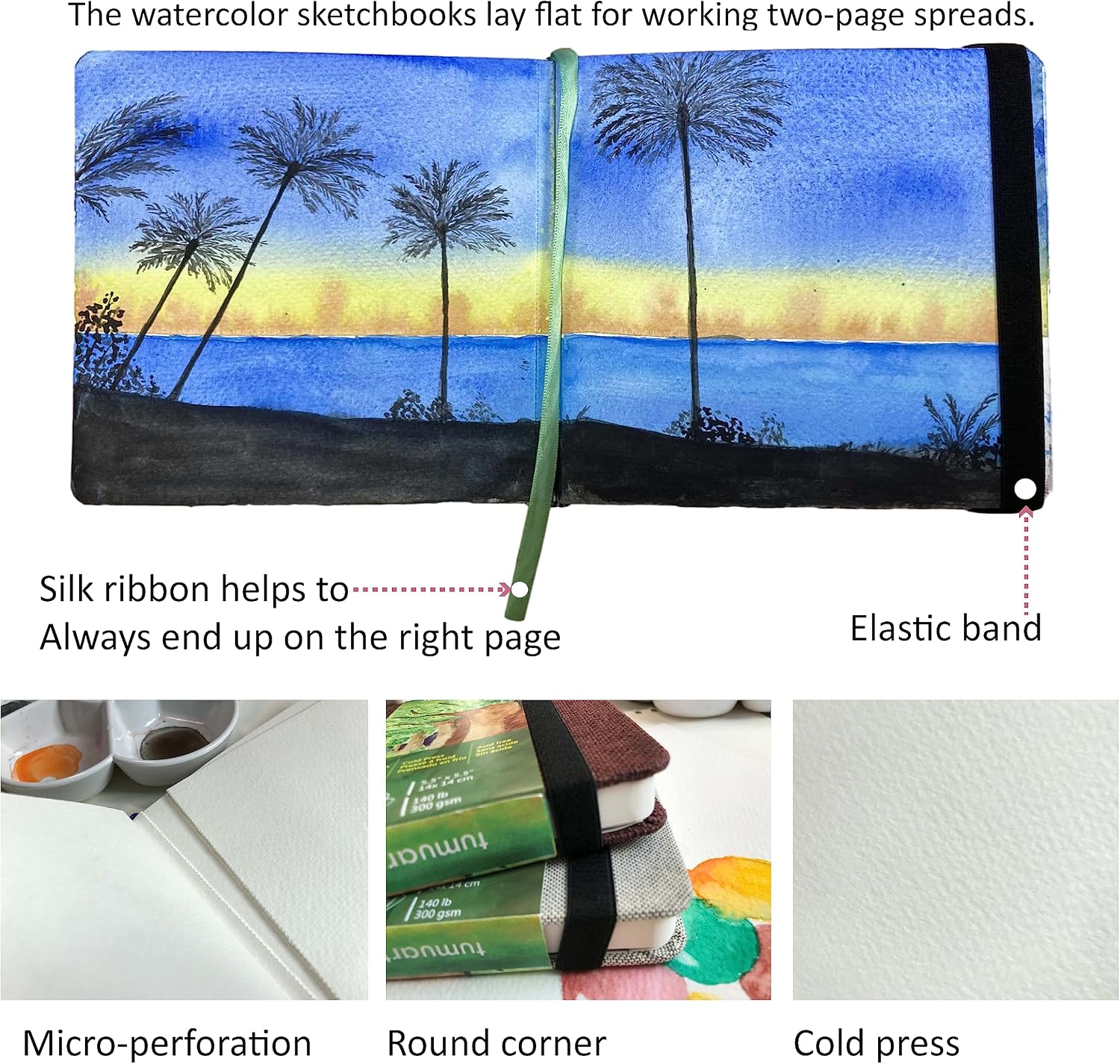
The tumuarta cotton watercolor journal occupies a niche that its most enthusiastic reviewers describe with remarkable specificity: it fits in a purse alongside a small travel palette. That is not a throwaway detail — it describes a complete portable practice setup. Multiple reviewers explicitly call out the cotton paper’s behavior with granulating watercolors, pigments such as those in the Daniel Smith extra-fine line that settle into paper texture in visible, textured deposits rather than lying flat. Cotton fiber holds granulation more vividly than wood pulp, and the tumuarta’s 100% cotton composition delivers that behavior in a pocketable format.
Handprint.com, in “Watercolor Supports: Papers and Boards,” explains that cotton-fiber paper’s longer, more resilient fibers are the reason it performs better than wood pulp for lifting and scrubbing — the surface can be reworked without pilling. Owner-reported behavior for the tumuarta is consistent with genuine cotton paper: slow absorption, granulation retention, and pigment recovery during lifting. Manufacturer specifications describe the paper as 100% cotton rag. No independent fiber analysis has been published, but the surface behavior owners describe aligns with genuine cotton rather than a cotton-surface wood-pulp blend.
The tradeoff in any small format is obvious: you cannot practice large-scale wash flow, wet-on-wet diffusion across a wide area, or compositions that require visual breathing room. But for value studies, color mixing notes, thumbnail composition work, and the quick observational sketches that keep hand-eye coordination sharp between studio sessions, the pocket cotton book does what a 9×12 spiral cannot — it goes with you everywhere.
Artists Network, in “Choosing the Right Watercolor Paper,” notes that cotton fiber is non-negotiable for practitioners whose technique depends on lifting and repeated reworking. For those artists who want that cotton performance in a format small enough to carry daily, the tumuarta journal is the practical answer at its price point.
Best for: Granulating pigments, lifting and scrubbing technique, urban sketching, travel practice with a real cotton surface. Limitation: Small working area; not suited for large wash flow or full composition practice.
Arches
$39.79
In stock on Amazon
Check price on AmazonFormat Comparison at a Glance
| Format | Typical GSM | Fiber | Opens Flat | Primary Strength |
|---|---|---|---|---|
| ARTEZA 9×12 Spiral | ~300gsm | Wood pulp | Yes | Wet washes, flat-open practice sessions |
| Moleskine Watercolor Album | ~200gsm | Wood pulp | Partial | Gouache, ink-wash, page protection |
| Tumuarta Cotton Journal | ~300gsm | 100% cotton | Yes | Granulation, lifting, true cotton performance |
| Standard mixed-media spiral | ~170–200gsm | Wood pulp | Yes | Dry media; struggles with heavy washes |
Decision Framework: Matching Format to Practice Type
The choice is not “which sketchbook is best” — it is which format serves what your daily practice actually requires.
If your practice is primarily wet-on-wet wash work and brush technique assessment: The ARTEZA 9×12 spiral’s flat-opening format and water-tolerant paper make it the right tool. The wood-pulp fiber limits lifting, but for wash flow and wet-on-wet behavior, aggregated owner reports consistently confirm it performs well above its price bracket.
If you work primarily in gouache, ink-wash, or opaque layers: The Moleskine watercolor album’s harder surface, lack of bleed-through, and protective hardcover make it a strong match. As Artists Network explains in “Choosing the Right Watercolor Paper,” surface texture and sizing interact with paint type; the Moleskine’s surface suits opaque media far better than it suits sustained transparent watercolor washes.
If granulation and lifting are central to your practice: Cotton paper is non-negotiable. The tumuarta journal is the pocket-format option that delivers genuine cotton performance. Artwork Archive, in “How to Build a Daily Art Practice,” observes that the consistency of your surface determines the consistency of your skill development — and cotton paper’s behavior is simply more consistent and more forgiving across techniques than wood pulp.
If portability is the primary constraint: Both the tumuarta journal and smaller pocket sketchbooks fit in a coat pocket or purse alongside a travel palette. The tumuarta is the stronger choice if cotton performance matters; a standard pocket sketchbook is acceptable if the practice is lighter — quick studies, color notes, observational sketching without heavy reworking.
Frequently Asked Questions
Is the ARTEZA watercolor sketchbook paper cotton or wood pulp? Based on manufacturer specifications, ARTEZA watercolor sketchbook paper is wood pulp, not cotton. It is internally sized to handle washes better than standard multimedia paper, which is why owners report strong water performance — but it does not have the fiber resilience of cotton for lifting and repeated scrubbing.
Can the Moleskine watercolor album handle heavy washes without warping? Light to medium washes are generally fine per aggregated owner reports. Heavy, sustained wet washes — the kind that keep large paper areas saturated for extended periods — do cause some cockling. Owners who use it primarily for gouache or ink-wash report far fewer warping issues.
Is the tumuarta cotton journal truly 100% cotton or a blend? Manufacturer specifications describe it as 100% cotton, and owner-reported behavior — granulation retention, slow absorption, lifting recovery — is consistent with genuine cotton paper. No independent fiber analysis has been published. If the distinction matters for archival use, treat all sketchbooks as practice tools regardless; even confirmed cotton sketchbook paper is rarely acid-free certified to the same standard as Arches or Fabriano Artistico sheets.
Can you use gouache in a spiral-bound watercolor sketchbook without bleed-through? Gouache applied in normal working layers does not bleed through watercolor sketchbook paper the way ink can. The heavier surface weight common in watercolor sketchbooks — 280 to 300gsm — absorbs gouache’s pigment load without strike-through. Multiple reviewers note using gouache successfully in spiral-bound books, though the Moleskine hardcover remains the most-cited option praised specifically for zero bleed-through.
Does the ARTEZA 9×12 sketchbook hold up to lifting and scrubbing techniques? Owners report the paper handles washes and wet-on-wet work well. For lifting — re-wetting a dried wash and pulling pigment back out — and scrubbing, results are more limited than cotton paper. Wood-pulp fiber pills under aggressive brush pressure. For practitioners whose technique depends heavily on lifting, the step up to a cotton-fiber book is worth the additional cost.