If you’ve ever watched a wet wash buckle and warp a sketchbook page into a landscape of ridges, you already know the binding isn’t just cosmetic. A watercolor sketchbook — a bound book made specifically to handle water-based paint — needs to manage two things at once: paper that absorbs moisture without self-destructing, and a spine that lets the page lie flat while you work. The binding type determines everything from how you scan finished spreads to whether you can paint on a park bench without a clipboard. Spiral wire, sewn hardcover, and square-format glued bindings each solve different problems — and create different ones. This article lays out what reviewers and published sources reveal about specific sketchbooks across those binding categories, so you can stop guessing and pick the one that matches how you actually paint.
Why Binding Type Is a Real Workflow Decision, Not an Aesthetic One
The watercolor community tends to evaluate sketchbooks purely on paper quality — GSM (grams per square meter, the standard measure of paper thickness and weight), cold-press versus hot-press surface texture, and cotton content. Those factors matter enormously. But binding shapes your daily habit in ways paper specs alone don’t predict.
A spiral binding lets each page lie completely flat without resistance, which sounds ideal until you realize the wire snags your sleeve every fifteen minutes and the pages can’t be displayed in sequence without removing them. A sewn hardcover binding gives you a beautiful object you’ll want to carry everywhere, but most hardcover spines create a gutter — a valley where two pages meet — that makes painting across a spread awkward unless you press down firmly on the inside margin. Square formats, meanwhile, challenge the assumption that portrait orientation is neutral: they force compositional decisions from the first mark.
Jackson’s Art Blog, in their guide titled “The Best Watercolour Sketchbooks,” notes that paper weight is one of the strongest predictors of buckling under wet washes, with anything below 140 lb (300 gsm) likely to warp without additional stretching or taping. Crucially, the same source observes that even well-weighted paper behaves differently depending on how tightly the spine constrains the page — a variable that paper specs alone cannot capture.
Spiral Binding: Maximum Flat, Real Trade-Offs
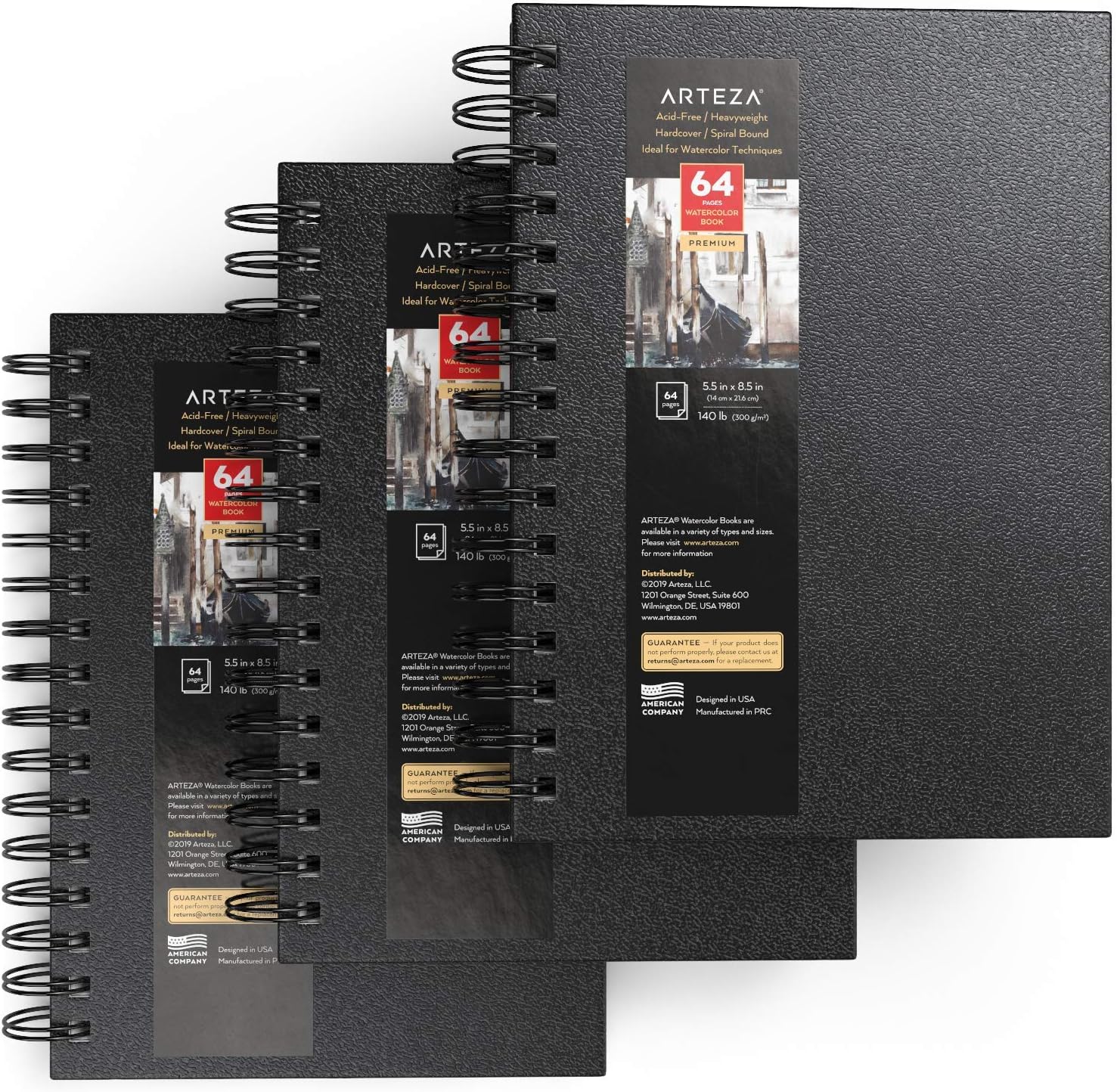
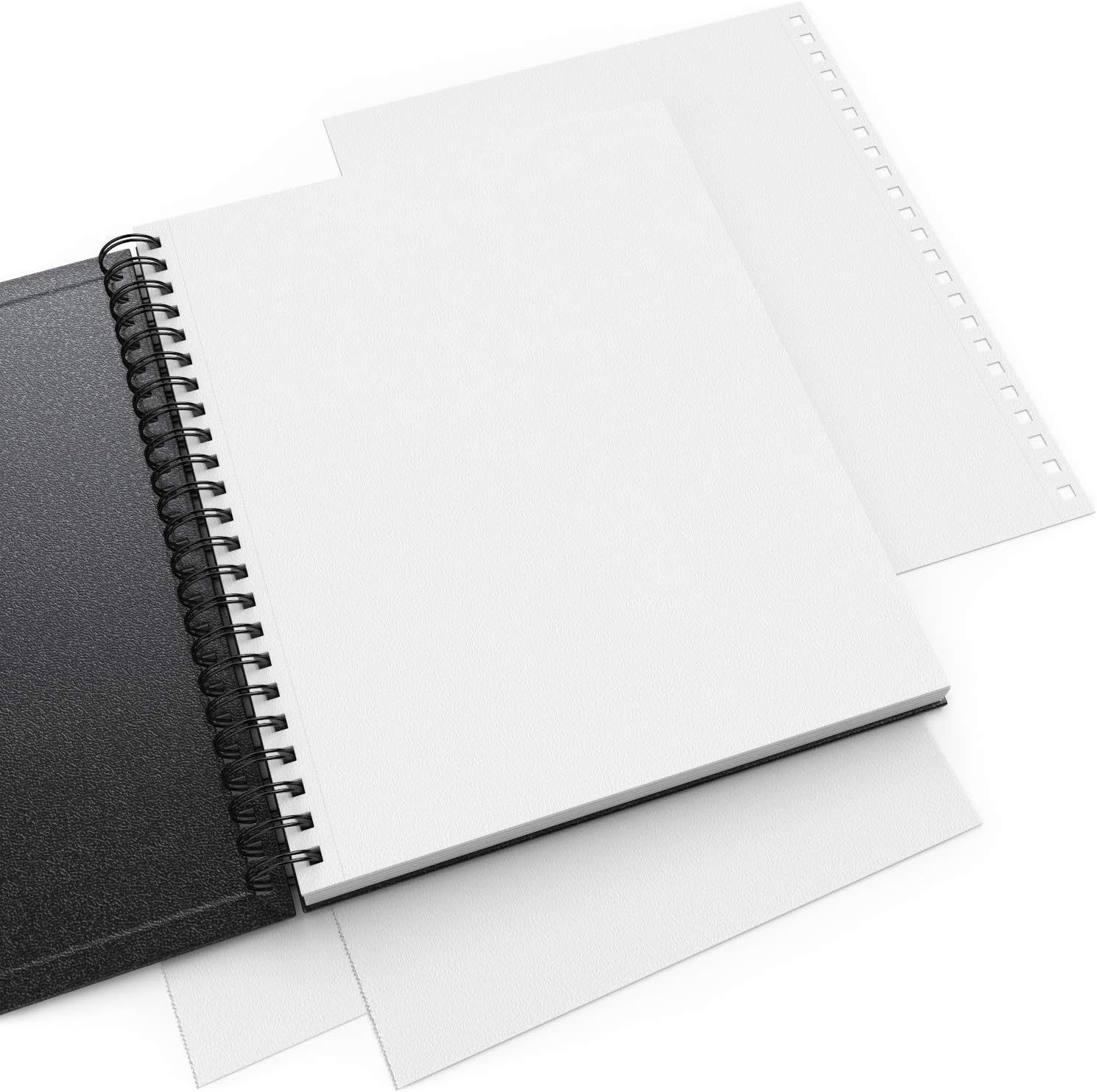
ARTEZA Spiral-Bound Watercolor Sketchbook
Reviewers consistently return to one argument that goes beyond surface aesthetics when discussing this category: practicing on multimedia paper can obscure how your brushes actually perform, because the surface doesn’t respond to water the way dedicated watercolor paper does. That’s a pedagogical point worth taking seriously. If your practice sketchbook has a surface that’s too absorptive or too slick relative to your final working paper, the muscle memory you’re building is calibrated to the wrong feedback loop.
Aggregated reviewer reports on the ARTEZA spiral describe paper that holds up reasonably well to medium washes, but heavy scrubbing — the kind used to lift color or re-wet a drying glaze — risks pilling on the surface. The spiral itself opens flat without a fight, which makes it genuinely useful for wet work on a desk or propped against a bag outdoors. The trade-off is portability friction: the wire coil catches on everything in a bag, and because the pages lack a hardcover backing, outdoor use without a hard surface underneath means the paper flexes as you paint.
Jackson’s Art Blog, in their article “Watercolour Paper Weights and Textures Explained,” confirms that papers under 300 gsm require additional support — stretching, taping, or a rigid backing board — to resist buckling under heavy washes. The ARTEZA spiral’s lack of a rigid back cover places it squarely in this category for outdoor sessions.
The honest decision frame: if you’re in a phase where daily practice volume matters more than archival quality — sketching through compositional problems, testing pigment mixes, building brush confidence — a spiral binding that opens flat and doesn’t resist the page is a legitimate tool choice. If you’re building toward finished work you’ll sell or exhibit, treat the spiral sketchbook as a warm-up venue rather than a destination.
tumuarta
$13.99
In stock on Amazon
Check price on AmazonHardcover Sewn Binding: Portability With Caveats
Two sketchbooks in this category reveal how differently “hardcover watercolor journal” can behave in practice.
Moleskine Watercolor Album
The Moleskine watercolor album has developed a reputation in reviewer communities that runs counter to its name. The prevailing assumption is that a watercolor sketchbook should be optimized for — watercolor. Yet across aggregated reviews, a significant portion of Moleskine watercolor album owners report preferring it for gouache rather than transparent watercolor. The surface texture, described consistently as smooth with a slight tooth, suits gouache’s opacity and the way it sits on top of a surface rather than sinking in. For granulating watercolors — pigments that produce visible texture as they dry by settling into the microscopic cavities of a paper surface — reviewers describe the Moleskine surface as slightly less cooperative than a more openly textured cold-press paper.
Artists Network, in their article “Understanding Watercolor Paper,” draws a useful distinction between sizing (the coating applied to paper to control how quickly it absorbs water) and surface texture. The Moleskine album’s sizing appears — based on consistent reviewer pattern — to hold gouache on the surface confidently, but doesn’t provide the microscopic hills and valleys that allow granulating pigments to settle and separate into their characteristic cloud-like patterns. If your practice leans toward layered gouache illustration, the Moleskine hardcover is a strong match. If granulation is part of your visual language, the surface works against you.
The hardcover binding also creates a specific ergonomic issue: the gutter. Most hardcover spines don’t open past 180 degrees without stressing the binding. The practical workaround used by experienced sketchbook painters — binder clips placed along the outer edges of the facing page to hold it flat and out of your working zone — is a real fix, not just a forum hack.
ARTEZA
$26.99
In stock on Amazon
Check price on AmazonTumuarta Cotton Journal
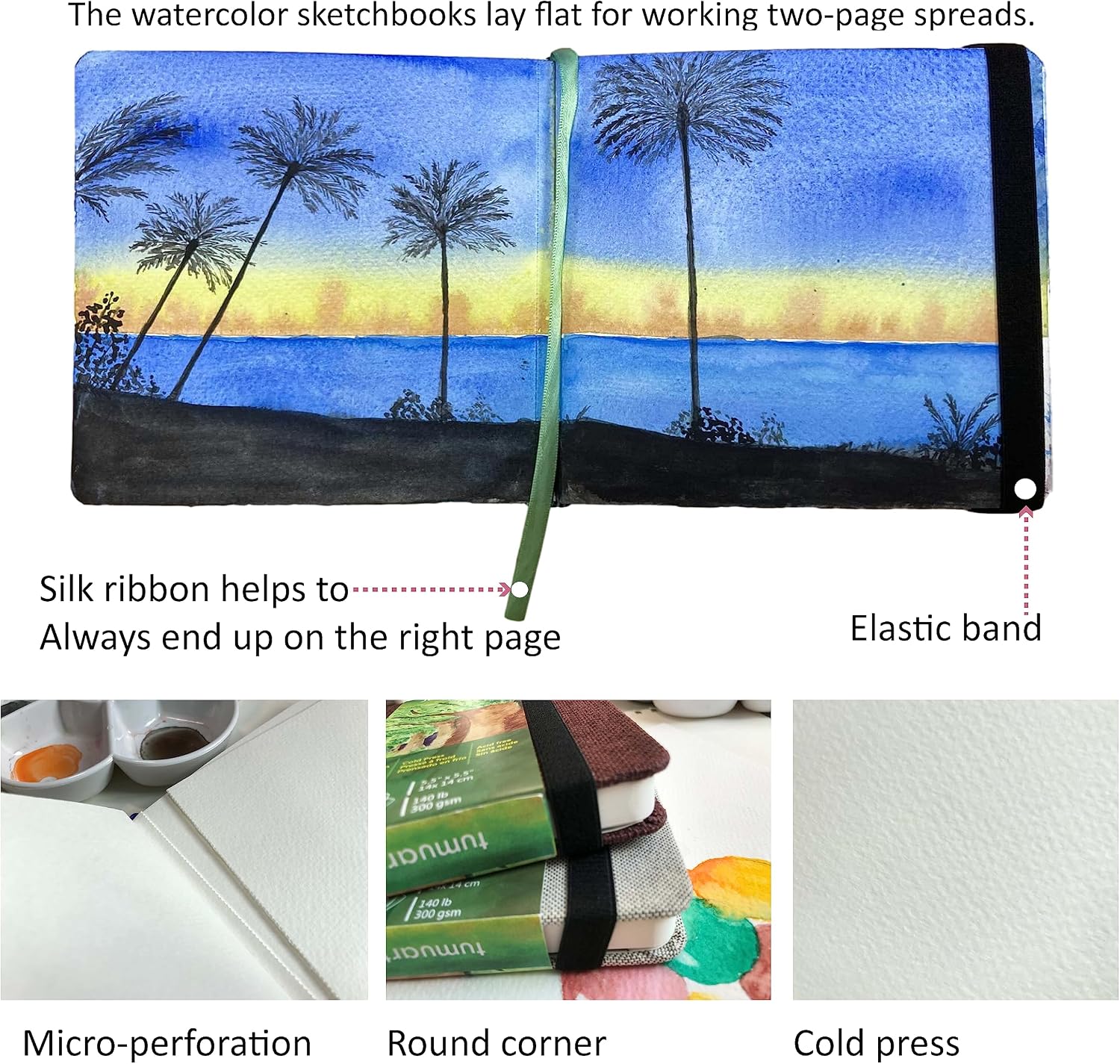
The tumuarta cotton journal earns a different kind of trust in reviewer communities, specifically from painters working with heavy pigment loads and granulating watercolors. Cotton-rag paper (paper made from cotton fiber rather than wood pulp) handles water differently than wood-pulp paper: it expands and contracts more uniformly, which is why it resists buckling under heavy washes. Handprint, in their reference document “Watercolor Supports: Paper,” confirms that cotton-rag papers exhibit significantly better wet strength and dimensional stability than wood-pulp alternatives — which is the technical basis for why papers like Arches 140 lb cold-press became the default for serious watercolorists.
Reviewers of the tumuarta cotton journal consistently report no warping even under heavy water application, which aligns with what published specs predict about cotton fiber behavior. One use case appears repeatedly in reviews: keeping the journal in a purse with a small palette and a waterbrush as a daily carry. That’s a meaningful data point about the binding’s real-world robustness. A hardcover that survives daily bag life without the spine cracking or the covers warping is not a given in this category.
If granulating watercolors are central to your practice and you need a book that handles serious water application without structural complaint, the tumuarta cotton journal is the most technically defensible choice in this comparison group.
ARTEZA
$27.09
In stock on Amazon
Check price on AmazonSquare and Pocket Formats: Compositional Constraint as a Feature
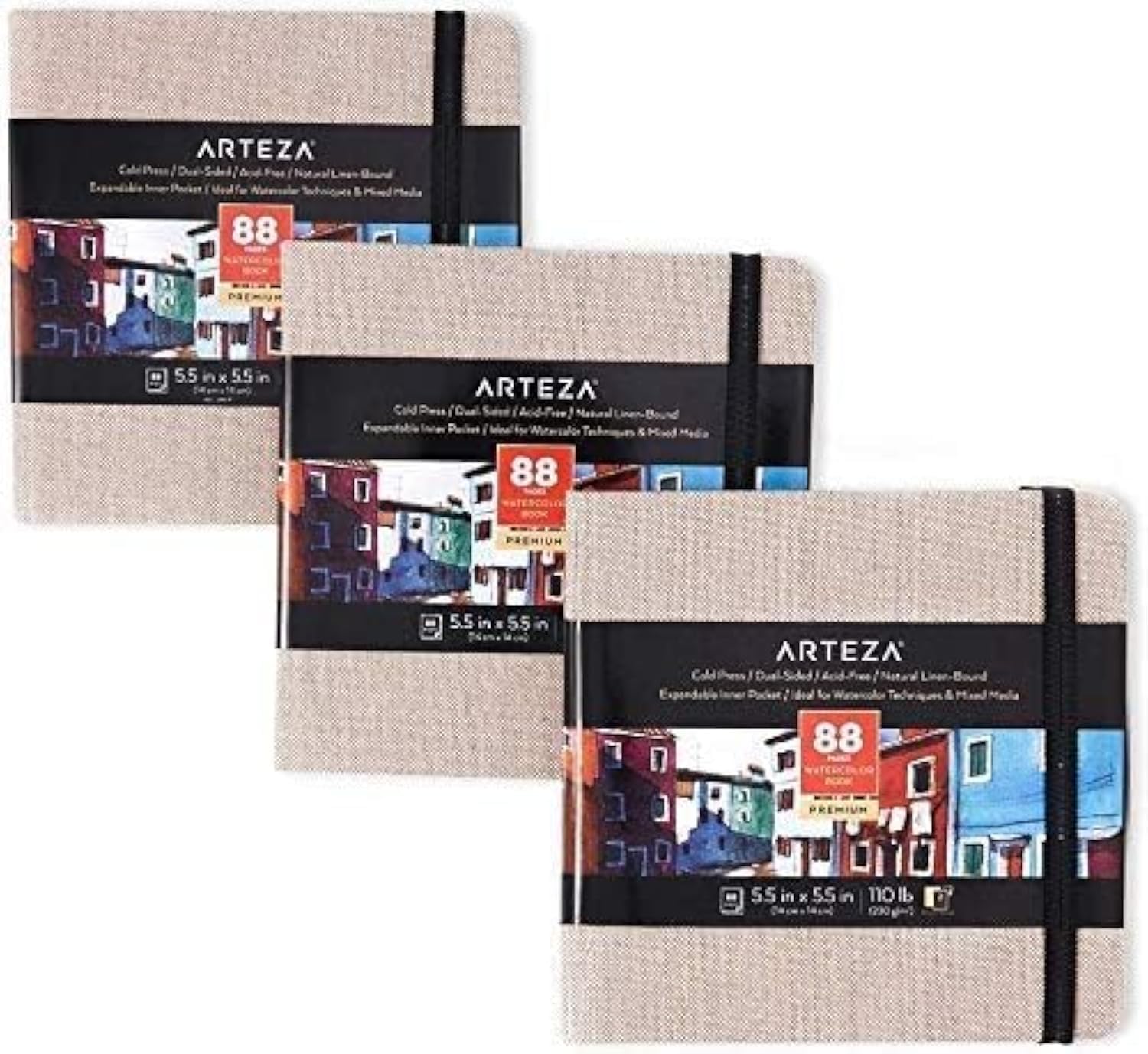
ARTEZA Square Hardcover Sketchbook (5.5 × 5.5 in)
The ARTEZA square hardcover sketchbook generates an unusual pattern in aggregated reviews: a significant number of buyers purchased it for non-painting purposes — vow exchanges, guest signing, keepsake books. That detail matters for two reasons. First, it signals that the aesthetic presentation of the object reads as premium enough to pull buyers outside the art supply audience. Second, it suggests the square format carries cultural weight as a gift object, not just a painting format.
For working watercolorists, the square format is a compositional forcing function. The 5.5 × 5.5 inch square removes the default vertical or horizontal orientation decision and asks you to solve that problem explicitly every time. Compared to a standard 5.5 × 8.5 sketchbook — which gives you a clear portrait or landscape option — the square demands that composition be active rather than assumed. Reviewers who paint regularly in the square format describe building a different kind of spatial intuition, particularly around negative space and central subject placement.
Jackson’s Art Blog, in “The Best Watercolour Sketchbooks,” notes that format choice influences not just what fits on a page but how a painter approaches subject selection and cropping — observations that square-format reviewers consistently echo in practice.
ARTEZA
$26.99
In stock on Amazon
Check price on AmazonFunto Pocket Journal (4.7 × 4.7 in)
The Funto pocket journal occupies a category almost entirely defined by one specification: the 4.7-inch form factor fits in a bag without dedicated sketchbook storage. Reviewers are nearly unanimous in their motivation — size, not paper quality. That’s a usable signal: if your primary constraint is carry friction, the Funto answers it directly. If your primary concern is paper behavior under wet media, the pocket format’s paper specs are secondary to the size benefit reviewers are actually buying for.
Jackson’s Art Blog’s “The Best Watercolour Sketchbooks” notes that pocket-format sketchbooks consistently involve trade-offs on paper weight and cotton content, because the economics of a very small book don’t support premium paper at competitive price points. That pattern holds here. The Funto is a capture tool for visual ideas, not a surface for finished watercolor work.
tumuarta
$13.99
In stock on Amazon
Check price on AmazonFormat Comparison at a Glance
| Format | Page Area (sq in) | Orientation Default | Bag Portability | Tier |
|---|---|---|---|---|
| ARTEZA Spiral, 9 × 12 | 108 | Landscape/portrait obvious | Moderate | tumuarta — $13.99 |
| Moleskine Watercolor Album | varies | Portrait default | Good | ARTEZA — $26.99 |
| Tumuarta Cotton Journal | varies | Portrait default | Good | ARTEZA — $27.09 |
| ARTEZA Square 5.5 × 5.5 | 30.25 | Neither — must decide | Easy | ARTEZA — $26.99 |
| Funto Pocket 4.7 × 4.7 | 22.09 | Neither | Very easy | tumuarta — $13.99 |
Making the Decision: An “If X, Then Y” Framework
If your primary practice is high-volume daily sketching to build technical skill, a spiral binding that opens completely flat removes page-resistance from your workflow. Accept that heavy scrubbing will test its surface limits, and accept that outdoor sessions require a rigid backing board underneath the page.
If you work primarily in gouache or opaque illustration and want a book you’ll carry daily, the Moleskine watercolor album matches your surface needs. Budget for binder clips to manage the gutter on spread paintings.
If granulating watercolors are central to your practice and you want a book that handles serious water application without buckling, the tumuarta cotton journal is the most technically appropriate choice in this group. Handprint’s “Watercolor Supports: Paper” provides the material science basis for that recommendation: cotton-rag fiber handles dimensional stress from moisture at a level wood-pulp paper cannot match.
If compositional exploration in a square format interests you — and you want a book with enough aesthetic presence to double as a keepsake — the ARTEZA square hardcover earns that role.
If daily carry without friction is your deciding constraint and you’ll accept a smaller working space and a surface not optimized for heavy watercolor technique, the Funto pocket journal solves that problem specifically and nothing more.
Frequently Asked Questions
Does the ARTEZA spiral sketchbook paper hold up to heavy washes and scrubbing? Reviewers report it handles medium washes reliably, but aggressive scrubbing risks surface pilling. Jackson’s Art Blog’s “Watercolour Paper Weights and Textures Explained” confirms that papers in this weight range require backing support to perform well under heavy water — treat it as a practice-volume tool rather than an archival surface.
Is the Moleskine watercolor album better for gouache than watercolor? Based on aggregated reviewer patterns and the distinction Artists Network’s “Understanding Watercolor Paper” draws between sizing and surface tooth, yes — the surface appears better matched to gouache’s opacity than to granulating watercolor techniques.
Can I use the tumuarta cotton journal for granulating watercolors without buckling? Reviewers consistently report no warping under heavy water application. Handprint’s “Watercolor Supports: Paper” confirms cotton-rag papers exhibit significantly better wet strength and dimensional stability than wood-pulp alternatives — the material science supports what reviewers observe.
What’s the practical difference between a 5.5 × 5.5 square and a standard portrait sketchbook for daily practice? The square removes the default orientation decision and forces active compositional problem-solving on every page. The standard portrait format offers roughly 55% more page area at the equivalent dimension. Choose based on whether compositional constraint is a feature or a friction for your current practice stage.
Do I need binder clips to keep a hardcover watercolor journal flat while painting? For most sewn hardcover bindings, yes — the spine resists opening fully past 180 degrees. Placing binder clips on the facing page’s outer edge is the standard workaround in sketchbook painting practice and requires no modification to the book itself.
Is the Funto pocket journal actually small enough to carry in a bag without dedicated storage? Reviewer motivation is overwhelmingly size-driven — the 4.7-inch format fits where larger sketchbooks don’t. That’s the primary reason this book gets purchased, and it should be the primary reason you buy it. Paper performance under heavy watercolor technique is a secondary consideration the format’s economics don’t support.