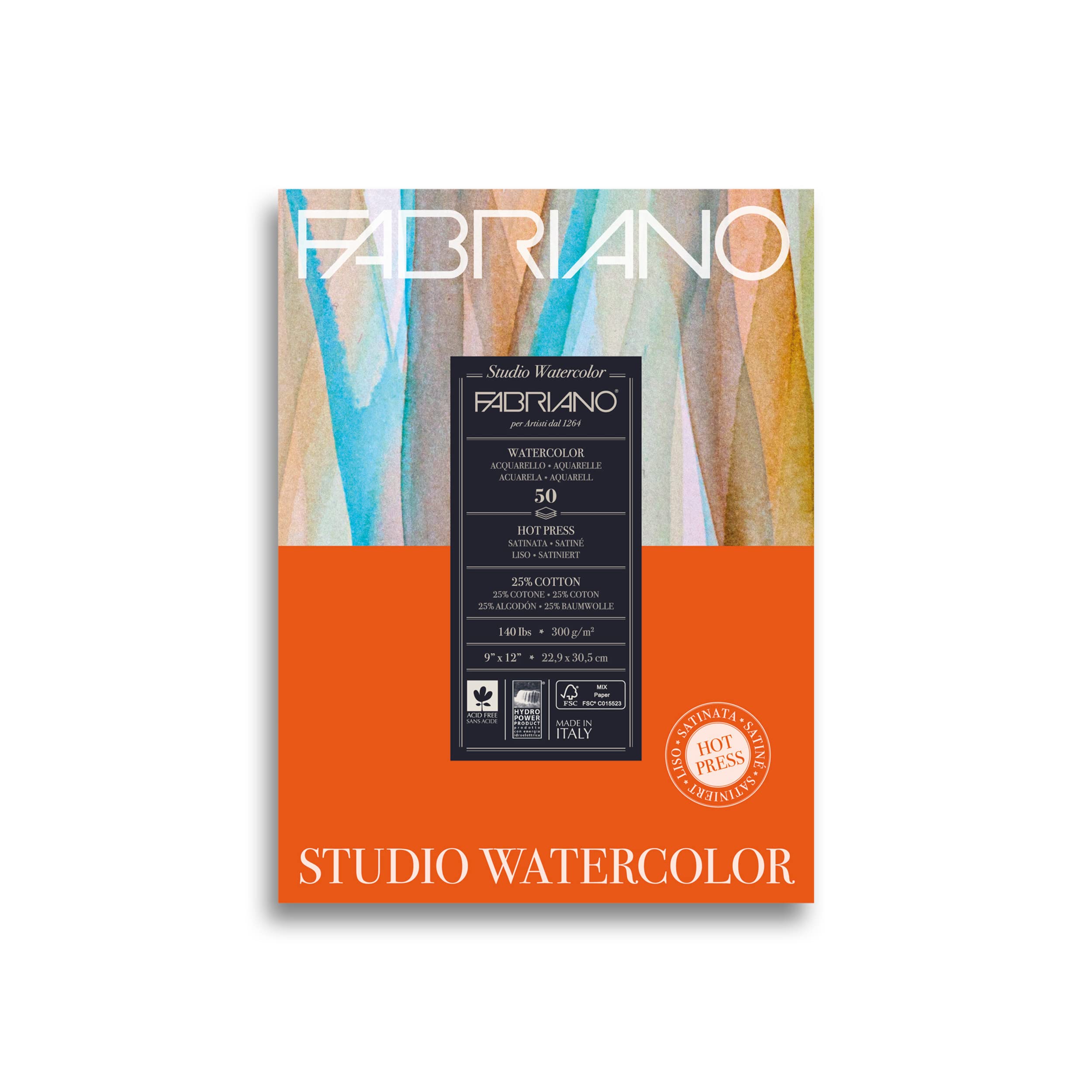
If you have ever stood in an art supply aisle holding two pads of paper that look nearly identical and wondered which one handles more than just watercolor washes — this article is for you. Watercolor paper comes in three main surface types: cold press (slightly textured, the most common), hot press (smooth, made by pressing sheets between heated rollers), and rough (heavily textured, used mostly for expressive wet techniques). Most beginners default to cold press, and with good reason — it grips paint beautifully. But a growing number of practitioners working across disciplines have discovered that hot press watercolor paper — particularly 100% cotton rag sheets rated 140 lb / 300 gsm or heavier — functions surprisingly well as a single unified surface for stamping, ink calligraphy, cyanotype printing, and layered colored pencil work. This guide breaks down which papers hold up to each technique, what the tradeoffs look like, and how to make one smart paper choice that covers multiple practices without restocking four separate sketchbooks.
| EDITOR'S PICKFabriano Studio Watercolor Pad | Mid-tierFabriano Artistico 140 lb. Hot… | Budget pickArches Aquarelle Watercolor Pad | |
|---|---|---|---|
| Sheet Count | 50 sheets | 20 sheets | 12 sheets |
| Paper Weight | 140 lb. | 140 lb. | 140 lb./300gsm |
| Sheet Size | 11" x 14" | 9" x 12" | 9" x 12" |
| Fiber Content | — | — | 100% cotton |
| Format | Pad | Block | Pad |
| Price | $45.00 | $39.39 | $21.94 |
| See on Amazon → | See on Amazon → | See on Amazon → |
Why Hot Press Is the Starting Point for Multi-Technique Work
The surface texture of a paper is not just an aesthetic choice — it determines how every tool from a rubber stamp to a dip pen to a UV-sensitive emulsion interacts with the sheet. Cold press paper, with its “tooth” (subtle texture), scatters fine details and bleeds ink into micro-valleys that make crisp stamp impressions or hairline calligraphy strokes nearly impossible to control. Hot press eliminates that variable. Its smooth, tightly calendered surface gives inks, graphite, colored pencils, and light-sensitive chemistry somewhere flat and stable to settle.
Bruce MacEvoy’s extensive watercolor support analysis at handprint.com is one of the most cited independent references on this topic, and it makes the surface interaction clear: the smoothness of hot press changes not just how paint sits, but how quickly it dries, how much sizing (the gelatin or starch coating that controls absorbency) the surface retains, and how the paper responds to mechanical stress like erasing, burnishing, and solvent application. For anyone working across disciplines, those variables matter more than they do for a pure watercolorist.
The three papers that come up most consistently in cross-discipline discussions are Fabriano Studio hot press, Fabriano Artistico hot press, and Arches Aquarelle hot press. Each occupies a distinct position.
Paper by Paper: What Practitioners Actually Report
Fabriano Studio Hot Press
Fabriano Studio is positioned as an accessible entry into cotton-blend paper — it uses a mix of cotton and cellulose rather than the 100% cotton of Artistico. For practitioners who have primarily used it for watercolor, the multi-technique performance is a consistent surprise.
Owners doing calligraphy report, across aggregated reviews at artistsnetwork.com and Jackson’s Art Blog reader discussions, that Fabriano Studio hot press handles dip pen and brush lettering with almost identical behavior to Artistico — the ink sits on the surface, dries without feathering, and holds fine hairlines cleanly. The meaningful practical advantage they describe: the Studio pad format means you do not need to cut down a full Artistico sheet to working size, which saves material and time. For a calligrapher working through ink studies or practice sheets rather than archival-quality finished pieces, the Studio pad at its lower price point is a rational choice.
Cyanotype use is where the Studio paper earns an enthusiastic following that its name would never predict. Cyanotype printing is a photographic process where you coat paper with light-sensitive iron salts, expose it to UV light (sunlight or a UV lamp) under a negative or object, and then rinse the sheet in water to develop a Prussian blue image. The rinsing step is aggressive — the paper gets fully saturated, sometimes multiple times — and lighter or wood-pulp papers frequently buckle, soften, or lose their surface integrity. Studio hot press owners report it survives this rinsing cycle well, emerging flat enough to press-dry and work into further. The cotton content, even partial, provides meaningful wet strength that pure cellulose papers lack.
Fabriano Artistico Hot Press
Artistico is Fabriano’s 100% cotton, mould-made flagship, and its behavior under mechanical stress is where it separates itself for practitioners. Botanical colored pencil artists — who layer wax- and oil-based pencil in dozens of passes, apply odorless mineral spirits or blending solvents to melt layers together, erase back to the surface, and repeat — consistently call out its erasability and solvent resilience as exceptional. Fabriano’s own technical documentation for Artistico notes its “extra-white” surface and sizing treatment, and practitioners confirm that the sheet accepts multiple solvent applications without shredding, pilling, or developing soft spots that tear under a kneaded eraser.
This matters for a specific decision: if your colored pencil work involves solvent blending, Artistico hot press is not just a preference — it becomes a functional requirement. At the standard 140 lb / 300 gsm weight, it resists buckling through multi-session layering in a way that most pad papers cannot match.
Arches Aquarelle Hot Press
Arches occupies the benchmark position in watercolor papers, and its hot press surface draws a niche but loyal community of artists working with unconventional pigment loads. Specifically, practitioners who grind their own paints from rock, earth, and mineral sources — sand, iron oxides, malachite, ochre sourced directly from stone — report that Arches hot press is the only surface that reliably holds those unusually dense, gritty particle suspensions without degrading. As noted in aggregated practitioner reviews synthesized at jacksonsart.com and artists network discussions, the Arches sizing is robust enough that even abrasive pigment loads do not strip or pill the surface over multiple passes.
For stamping specifically, Arches hot press delivers clean impression edges because the sizing is firm and non-absorbent at the surface level. Reviewers who have come to hot press from cold press backgrounds consistently describe it as a recalibration: ink from a rubber stamp sits on top of the surface rather than wicking into it, which means sharper detail but also a longer open time before the impression dries — something to factor into your workflow.
The Tradeoffs in Numbers
| Paper | Cotton Content | Weight | Multi-technique strength | Relative cost |
|---|---|---|---|---|
| Fabriano Studio HP | Cotton/cellulose blend | 200 gsm / 90 lb | Calligraphy, cyanotype, light colored pencil | Lower |
| Fabriano Artistico HP | 100% cotton | 300 gsm / 140 lb | Solvent colored pencil, erasability, archival use | Mid–high |
| Arches Aquarelle HP | 100% cotton | 300 gsm / 140 lb | Heavy pigment loads, stamping, archival mixed media | High |
Per Jackson’s Art Blog’s paper weight guide, 300 gsm is the practical floor for techniques that involve wet rinsing or heavy solvent use without pre-stretching the sheet.
Technique-Specific Decision Rules
Calligraphy and dip pen work: Either Fabriano Studio or Artistico hot press performs here, and the decision is really about whether you need archival longevity. Practice sheets and studies — use Studio and don’t overthink it. Finished pieces destined for framing or client delivery — Artistico’s 100% cotton is worth the step up.
Rubber stamping: Any hot press surface will perform better than cold press for crisp impressions. Cold press tooth breaks up fine stamp detail and causes uneven ink distribution. If your stamp work involves layering watercolor ink washes over stamped linework, Arches hot press keeps the sizing intact longer through wet layers.
Cyanotype printing: Fabriano Studio hot press earns its place here because it survives the rinsing process at a lower cost per sheet than Artistico or Arches, making it rational for experimentation and edition printing. Artists producing archival cyanotypes for sale should consider that 100% cotton papers age more predictably — at which point Artistico becomes the call.
Layered colored pencil (without solvent): Fabriano Studio or Artistico both work. Artistico’s tooth — even on hot press, there is a subtle difference from Arches — grips colored pencil layers slightly better for heavy burnishing work.
Layered colored pencil (with solvent blending): Fabriano Artistico hot press. The resilience under solvent application and repeated erasing is where it distinguishes itself most clearly from the Studio line, based on consistently reported practitioner experience.
Homemade or heavy-particle pigment loads: Arches Aquarelle hot press. The sizing holds up where other surfaces deteriorate.
Frequently Asked Questions
Can Fabriano Studio hot press replace Fabriano Artistico for calligraphy? For practice work and daily use, yes — owners report essentially identical ink behavior on the hot press surface, and the pad format is a genuine convenience advantage. For archival finished work, Artistico’s 100% cotton construction is the more defensible choice long-term. The two papers are not the same formulation, but for calligraphy specifically, the functional gap is narrow enough that many practitioners use Studio for all but their final pieces.
Does hot press watercolor paper hold up to cyanotype rinsing? It depends on the weight and cotton content. At 300 gsm with meaningful cotton fiber, hot press watercolor paper handles cyanotype rinsing well — Fabriano Studio hot press owners doing cyanotype work report the paper survives multiple full rinses without losing surface integrity. Lighter-weight papers or pure cellulose sheets will soften and potentially delaminate. If you are printing cyanotypes for sale rather than experimentation, 100% cotton at 300 gsm is the reliable floor.
Will cold press paper work for rubber stamping, or is hot press required? Cold press paper will technically accept a rubber stamp impression, but the textured surface breaks up fine detail lines and causes uneven ink pickup in recessed areas. For anything beyond bold, simple stamps, hot press delivers noticeably cleaner edges. This is one of the clearest cases where surface texture has a direct functional consequence rather than just an aesthetic one.
Can I do layered colored pencil work on watercolor paper without it buckling? Yes, provided you are at 300 gsm / 140 lb and using dry colored pencil layers without heavy water or solvent application. Lighter sheets will develop curl under sustained mechanical pressure. If you are using solvent blending, Fabriano Artistico hot press at 300 gsm handles multiple applications without buckling or shredding — that specific resilience is one of the reasons botanical colored pencil artists return to it repeatedly.
Is the Fabriano Studio pad the same paper as Artistico in a different binding? No. Fabriano Studio uses a cotton and cellulose blend; Artistico is 100% cotton mould-made paper. They share surface character on the hot press finish — both are smooth, both handle ink cleanly — but the fiber content, wet strength, and archival longevity differ. Think of Studio as the workhorse and Artistico as the investment surface. Many practitioners keep both and allocate by the stakes of the project.
The Bottom Line
If you are consolidating to one paper that performs across stamping, calligraphy, cyanotype, and colored pencil without having to re-stock every time a project shifts medium, hot press watercolor paper at 300 gsm is the clear answer — cold press is optimized for a single use case and works against you in all the others.
The specific call: Fabriano Studio hot press for high-volume, cross-discipline work where cost-per-sheet matters and archival permanence is not the priority. Fabriano Artistico hot press when solvent colored pencil, archival calligraphy, or finished-work longevity enters the picture. Arches Aquarelle hot press when you are pushing the paper hardest — unusual pigment loads, heavy stamping layers, or work you are framing and selling.
One paper, many disciplines. That is the actual offer hot press cotton paper makes, and based on what practitioners consistently report, it more than delivers.