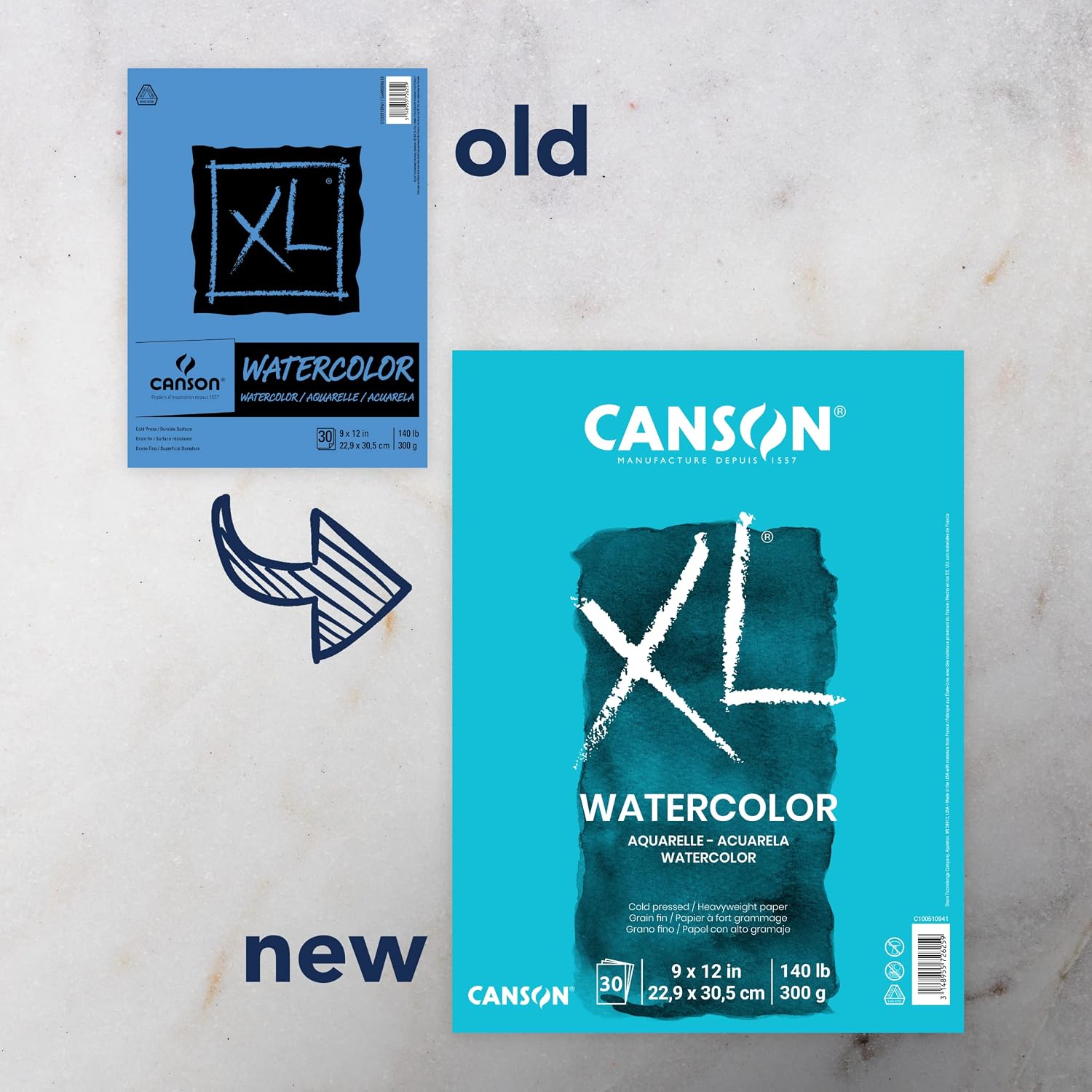
Watercolor paper isn’t one thing. It comes in different weights (how thick and heavy a sheet is, measured in grams per square meter, or GSM), different surface textures, and — often overlooked — different formats: the physical configuration the paper arrives in. A pad is a stack of sheets glued or taped along one edge, like a notepad. A block is glued on all four sides so the sheet stays under tension while you paint, and you release the finished piece with a palette knife once it’s dry. A spiral-bound sketchbook lies flat when open. Each format changes your workflow in a concrete way, and choosing the wrong one is the most common reason a good paper disappoints a good painter. This guide focuses on format and size decisions — the practical, often-skipped half of the paper conversation — so you can match the right configuration to how you actually paint, not just how you hope to paint.
| EDITOR'S PICKArches Watercolor Paper Block | Mid-tierCanson XL Series Watercolor Pap… | Budget pickCanson XL Series Watercolor Pad | |
|---|---|---|---|
| Format | Block | Pad | Pad |
| Sheet Count | — | 30 | 30 |
| Binding | — | Tape Bound | Foldover |
| Surface | Cold Press | Cold Press | — |
| Weight | 140 lb | 140 lb | — |
| Price | $39.79 | $19.69 | $11.37 |
| See on Amazon → | See on Amazon → | See on Amazon → |
The Core Trade-Off: Control vs. Convenience
Every watercolor paper format is a negotiation between two things: keeping the sheet flat while it’s wet, and fitting your actual working habits.
Paper warps when it absorbs water unevenly — the wet areas expand, the dry areas don’t, and you get the characteristic buckling that makes wet washes pool in the valleys. Heavier paper (300 GSM / 140 lb and above) resists this better than lighter stock. But format matters as much as weight. The Arches block format exists almost entirely to solve the warping problem: because the sheet is glued on all four sides, it stays under tension as you work. Owners consistently report that even aggressive wet-on-wet washes stay flat, and the sheet releases cleanly with a palette knife once fully dry. Handprint.com’s watercolor supports reference guide confirms this mechanism — the surrounding sheets act as a tension frame, which is why blocks are the format of choice for painters who work very wet.
The trade-off is rigidity. You’re painting one sheet at a time, in sequence. You can’t flip the block over to dry the back, and you can’t easily work on two sheets simultaneously. For painters who run multiple washes in parallel or like to dart between studies, blocks create a small but real bottleneck.
Pads — tape-bound or glue-bound along one edge — restore that flexibility. You can tear sheets out freely, work on several at once, or prop individual sheets on a board. But without the four-sided tension of a block, pads are more vulnerable to warping on wet washes, especially at lighter GSM. A recurring complaint in reviews of Arches pads (not the block) is that heavy wet washes still buckle the paper — a problem the block explicitly does not have. If you’re painting loosely and wet, a pad without pre-stretching or tape-to-board prep requires extra setup that the block eliminates.
Spiral Bindings and the Travel Case
The Arches travel pad occupies an interesting middle ground. Its spiral binding means the pad lies genuinely flat — reviewers consistently note this, specifically calling out that it doesn’t require a hand to hold it open the way some spiral books do. More practically, reviewers report they can run masking tape along the edges of a sheet without damaging the paper on removal, which gives you the option of a partial stretch-substitute without committing to a full stretching workflow. That’s a meaningful capability for location painters who don’t want to carry a board and bulldog clips.
The travel pad’s size (typically 9×12 inches in its most common configuration) also positions it precisely where a lot of working painters want it: large enough to develop a composition, small enough to fit in a bag. One reviewer pattern that shows up across multiple sources describes using the travel pad specifically to test an idea before committing to a larger Arches sheet — a layered workflow that treats the travel pad as the R&D stage and the larger block or loose sheet as the final surface. That framing is worth internalizing. The travel pad isn’t a budget concession; it’s a planning tool.
Size by Size: What Actually Fits Your Practice
By the numbers: Common Arches and Canson XL formats
| Format | Typical Size | Sheet Count | Best For |
|---|---|---|---|
| Arches block (cold press) | 9×12 in / 12×16 in | 20 sheets | Wet-wash painters; no-tape workflow |
| Arches pad (cold press) | 9×12 in / 12×18 in | 12–20 sheets | Flexible multi-sheet sessions |
| Arches travel pad (spiral) | 9×12 in | 12 sheets | Location work, idea testing |
| Canson XL watercolor pad | 9×12 in / 11×15 in | 30 sheets | High-volume studies; cut-down strategy |
9×12 inches is the workhorse format. Artists Network’s buyer guide notes it as the most common studio size for a reason: it’s large enough to work seriously but small enough to fill without overcommitting. If you’re painting regularly, this is likely your default.
11×15 and 12×16 inches open up breathing room for compositional experiments that need more negative space or looser mark-making. Owners of Arches 12×16 blocks report that the extra square inches make a meaningful difference for landscape work, where sky-to-ground proportion needs room to develop. The cost-per-sheet math rises, but so does the quality of each decision you’re forced to make.
Canson XL and the cut-down strategy. Canson XL reviewers across both the 9×12 and 11×15 formats highlight a consistent behavior: painters buy the larger pad and cut sheets in half or quarters for smaller studies. A 30-sheet 11×15 Canson XL pad yields up to 120 quarter-sheets — a genuinely cost-effective surface bank for color studies, value sketches, and palette tests. Jackson’s Art Blog’s watercolor paper explainer notes that XL paper is wood-pulp based rather than cotton-rag, which affects longevity and water behavior, but for exploratory studies that aren’t going into a portfolio or a sale, the cut-down strategy is hard to argue with financially.
The economics of cotton vs. wood-pulp matter here if you’re working toward archival work. Artwork Archive’s guide on choosing watercolor paper points out that cotton-rag papers (like Arches, rated at 100% cotton) resist yellowing and deterioration in ways that wood-pulp papers don’t. If the work is for sale or long-term portfolio, cotton is the baseline. If it’s for process — color tests, compositional thumbnails, student exercises — wood-pulp like Canson XL makes the cost-per-sheet math significantly more defensible.
Block vs. Pad vs. Spiral: The Decision Frame
Here’s the honest if-then logic:
If you work wet and hate prep, the block is your format. The four-sided glue keeps the paper flat without stretching, soaking, or taping. Owners report the block solves the warping problem the pad doesn’t. The Arches block in 140 lb cold press is the format most reviewers default to when they want to paint and not think about substrate management.
If you want to work on multiple pieces simultaneously or prefer to prop individual sheets, the pad format gives you that freedom — but budget time to tape the sheet to a board or pre-wet it if you’re working very wet.
If you’re painting on location or using your paper as a testing layer before moving to larger work, the Arches travel pad’s spiral binding and masking-tape-compatible surface make it a purpose-built tool rather than a compromise. The reviewer pattern of “test here, commit to full sheet later” is a real workflow, not just a rationalization.
If you’re running high-volume studies or teaching, Canson XL’s sheet count and cut-down potential make it the cost-effective answer. Just be clear-eyed that wood-pulp and cotton behave differently — XL paper is more absorbent and less forgiving of rework than Arches.
Frequently Asked Questions
Does the Arches block format prevent warping better than the pad? Yes, consistently. The block’s four-sided glue holds the sheet under tension while wet, preventing the uneven expansion that causes buckling. Owners report working with very wet washes on Arches blocks without warping. The pad, bound only on one edge, doesn’t provide this tension — and reviewers of Arches pads specifically note that heavy wet washes can still buckle the paper unless you tape it to a board first.
Can you use masking tape on Arches travel pad paper without tearing? Based on reviewer reports, yes. Multiple owners note that masking tape can be applied along sheet edges and removed cleanly without damaging the paper surface. This makes the travel pad a reasonable stand-in for a partial stretch-and-tape workflow when you’re away from the studio.
Is Canson XL large enough to cut down into smaller study pieces? Absolutely, and many painters use it exactly this way. Reviewers across both the 9×12 and 11×15 Canson XL formats describe cutting sheets in half or quarters for smaller color studies, effectively multiplying sheet count. The 11×15 pad in particular yields a lot of usable surface area per dollar.
What is the difference between tape-bound and block-bound watercolor pads? A tape-bound (or glue-bound) pad is glued along one edge, like a legal pad. You tear or peel sheets away individually. A block is glued on all four edges, keeping the sheet under tension while you paint; you release the finished sheet with a palette knife once it’s dry. The block prevents warping without any additional prep; the pad does not.
Is the Arches travel pad worth the price over a cheaper spiral cotton sketchbook? If you want guaranteed Arches 140 lb cotton-rag paper in a flat-opening spiral format that accepts masking tape without damage, yes. The value argument for cheaper spiral cotton sketchbooks depends heavily on the actual paper quality — GSM, cotton content, and surface texture vary widely by brand. Reviewers who use the Arches travel pad specifically cite the paper quality and flat-open binding as the justification over budget alternatives.
How many sheets do you realistically get from an Arches block before the binding loosens? Arches blocks typically come in 20-sheet configurations. Reviewer reports don’t indicate significant binding problems at this count — the glue holds through the standard sheet sequence. The binding is designed for sequential use, not random-access pulling, so working through sheets in order (rather than forcing sheets from the middle) keeps the structure intact through the full block.
The Bottom Line
Format is infrastructure. It doesn’t change the paper, but it changes whether you spend your painting session painting or managing a warping sheet. For serious studio work with wet washes, the Arches block earns its price in prep time saved. For location and idea-stage work, the Arches travel pad’s spiral binding and tape-compatibility make it a genuine working tool. For high-volume studies where cost-per-sheet matters, Canson XL’s cut-down potential is the honest answer — just keep it in the studies pile, not the archival portfolio.
The right format is the one that removes friction between your intention and the paper.