If you carry a sketchbook every day — tossed into a bag, pulled out on a lunch break, used in five-minute bursts rather than studio sessions — the paper inside matters more than most people realize when they’re first shopping. Watercolor paper (paper engineered to absorb water-based paint without buckling or bleeding through) comes in two fundamental categories: cotton rag, made from long cotton fibers that absorb water slowly and evenly, and wood pulp (sometimes called cellulose), made from processed wood that is cheaper to produce but more prone to warping and yellowing over time. At full sheet sizes the difference is obvious; in a 3.5×5-inch pocket book, buyers often assume it won’t matter much. Owners’ reviews consistently say otherwise. This piece breaks down four small-format sketchbooks across both categories — tumuarta, Moleskine Watercolor Album, ARTEZA, and Funto — so you can match the book to how you actually work.
| EDITOR'S PICKArches Watercolor Paper Block | Mid-tierARTEZA Watercolor Sketchbook 2-… | Budget picktumuarta Watercolor Journal | |
|---|---|---|---|
| Paper Type | Block | Sketchbook | Journal |
| Paper Fiber | — | — | Cotton |
| Weight | 140 lb | 140 lb | 300 GSM |
| Size | 8" x 10" | 9x12 inches | 5.5x5.5 |
| Sheet Count | — | 64 Pages | 24 Sheets |
| Price | $39.79 | $26.99 | $13.99 |
| See on Amazon → | See on Amazon → | See on Amazon → |
Why Paper Fiber Choice Still Matters at Pocket Scale
The physics don’t change just because the page is smaller. When you drop a wet wash on wood-pulp paper, the surface fibers swell unevenly, which is what causes that familiar ripple and warp. Cotton fibers, being longer and more dimensionally stable, absorb moisture more uniformly. Jackson’s Art Blog, in their overview titled “Understanding Watercolour Paper: Cotton vs Cellulose,” notes that cotton sheets also hold pigment closer to the surface longer, giving you more working time to push wet paint around — a real advantage when you’re doing fast location sketches.
For daily practice books specifically, there are three variables that matter more than anything else:
- Weight (GSM — grams per square meter): Heavier paper (300 GSM and above) warps less under wet washes. Lighter paper (140–200 GSM) is fine for dry or semi-dry techniques but buckles under heavy wetting.
- Fiber source (cotton vs. pulp): Cotton costs more but handles layering and lifting far better. Pulp can work for quick, light washes.
- Binding: Spiral or sewn bindings tend to lie flat; glue-bound books may fight you at the spine.
Handprint.com’s detailed reference document “Watercolor Supports: Paper” points out that even among papers marketed as “watercolor ready,” the functional ceiling for pulp paper tops out around three to four wet layers before the surface starts to pill or ghost. Cotton paper, by contrast, can typically handle six or more wet-on-wet passes before the surface breaks down. At pocket scale, where you might be doing rapid value studies with granulating pigments like Daniel Smith Lunar Black or Sleeping Beauty Turquoise, that surface endurance is the ballgame.
The Four Books: What Owners Actually Report
The four sketchbooks reviewed here span both fiber categories and two binding styles. Each H3 section below closes with a tier marker so you can scan quickly for the option that fits your budget and practice type.
tumuarta Watercolor Journal
The tumuarta book is the one that generates the most pricing skepticism — it sits in a range where buyers reasonably ask whether “100% cotton” is marketing copy or a real spec. Based on aggregated owner reviews, the answer appears to be the latter: owners consistently report that granulating watercolors (heavy pigments like ultramarine or raw umber that separate from the water as they dry) behave on the tumuarta pages the way granulating pigments are supposed to behave — settling into the paper’s texture rather than sitting on the surface as a flat stain. One reviewer describes fitting the book into a purse alongside a small travel palette and a waterbrush, and specifically notes the pages handled granulating washes without warping. That’s a meaningful real-world data point.
The tradeoff owners note most consistently: the book is compact enough that page count is limited, and the pages are not spiral-bound, which means the book doesn’t lie completely flat on every surface without a little encouragement. For artists whose daily practice centers on sustained wet work or multi-layer studies they intend to keep, this is the small-format cotton option the owner record points to most consistently.
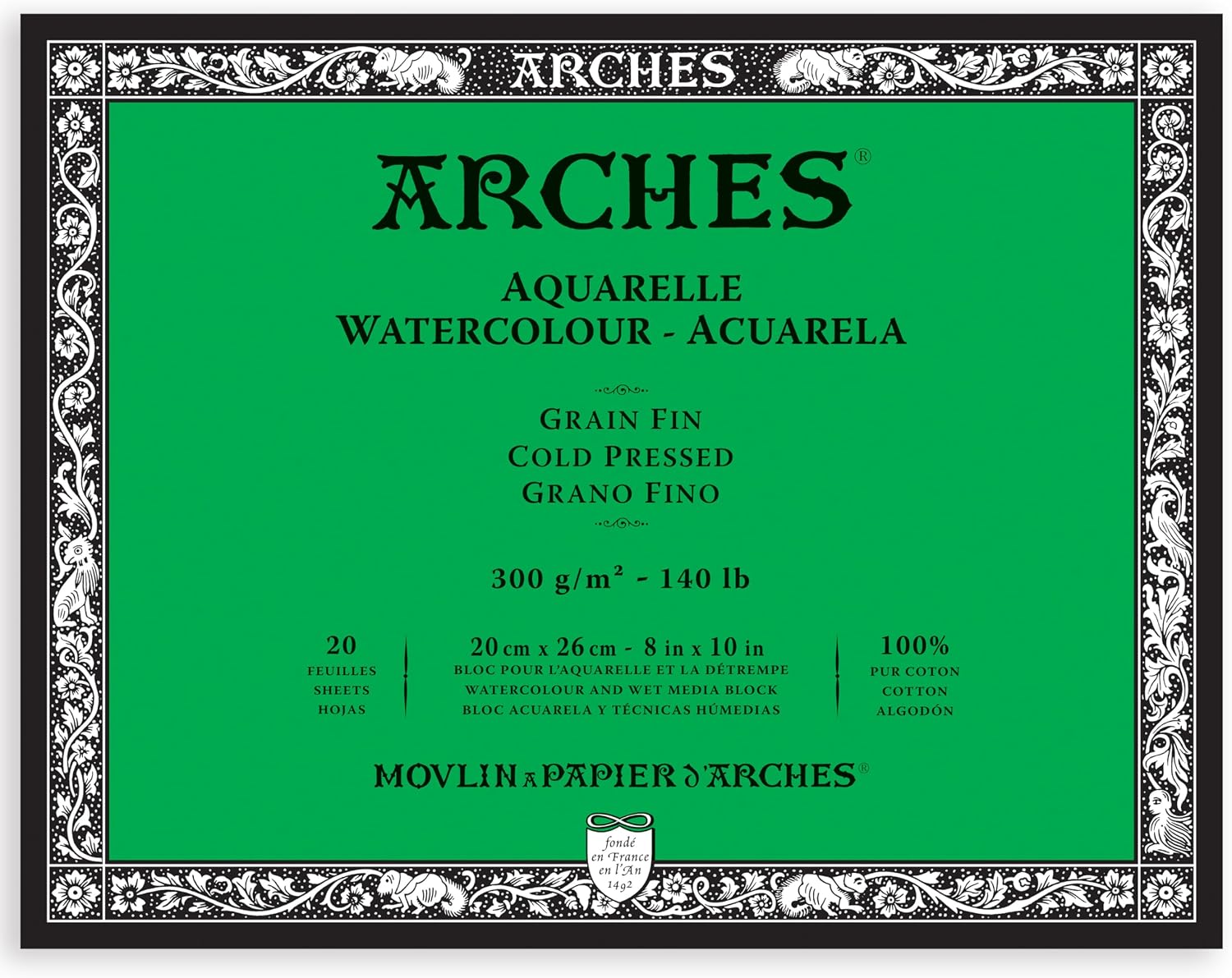
Arches
$39.79
In stock on Amazon
Check price on AmazonMoleskine Watercolor Album
Moleskine’s watercolor-specific album runs on heavier paper than the brand’s standard sketchbooks, and that distinction matters. The standard Moleskine paper is famously inadequate for wet media — the brand name carries prestige the paper doesn’t always justify. The watercolor album is a different product. One owner review that circulates widely in urban sketching communities describes actively overcoming Moleskine skepticism before buying the watercolor edition, then being won over specifically by gouache performance — the paper held opaque layers without lifting or streaking underneath.
Artists Network, in their article “Best Watercolor Paper for Every Budget,” flags the Moleskine Watercolor Album as one of the more reliable small-format options for mixed media, particularly for artists who use both transparent watercolor and opaque gouache in the same session. The acid-free, heavyweight pages also represent better archival behavior than standard journal paper, which matters if you’re keeping a record of color studies or daily practice work you might reference later.
The honest limitation: at heavier wash loads — full-bleed backgrounds applied very wet — some owners report minor cockling (waviness at the page edges). The book is not spiral-bound, so the spine creates some resistance.
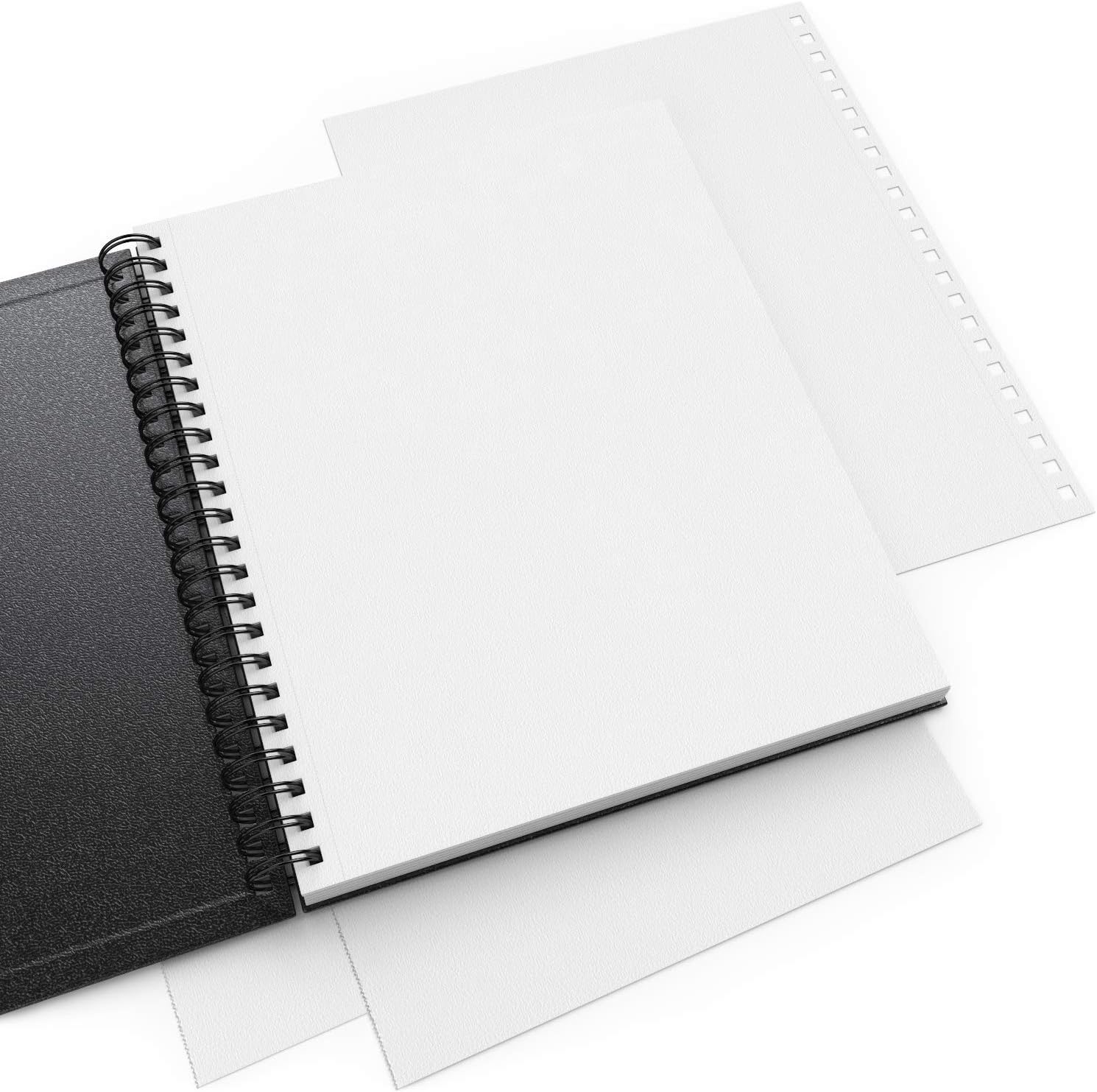
ARTEZA
$26.99
In stock on Amazon
Check price on AmazonARTEZA Watercolor Spiral Sketchbook
The ARTEZA spiral book generates some of the most passionate loyalty of any affordable watercolor sketchbook, and the reviews include an unusually useful piece of self-reported benchmarking: at least one owner explicitly compares the ARTEZA paper against Canson XL and rates the ARTEZA surface as more workable for wet layers. Given that Canson XL is the de facto reference point for intermediate-level student paper, that comparison is genuinely informative.
Fine Art Tips, in their guide “How to Choose the Right Watercolor Sketchbook,” lists spiral binding as one of the underrated practical features for consistent daily use — the pages stay flat, you can fold the cover behind the book, and there’s no spine fighting your brush hand. ARTEZA makes multiple sketchbook formats, and buyers sometimes conflate them. The square journal and the 9×12 spiral sketchbook are different products with different paper weights — the FAQ section below clarifies the distinction.
The tradeoff here is that ARTEZA’s paper is cellulose (wood pulp), not cotton. For light-to-medium washes and quick studies this is a non-issue. For sustained wet-on-wet work with heavy pigment loads, cotton paper will outlast it. The spiral format and the price-per-page math make it a strong daily-use choice for practice sessions where archival permanence is not the goal.
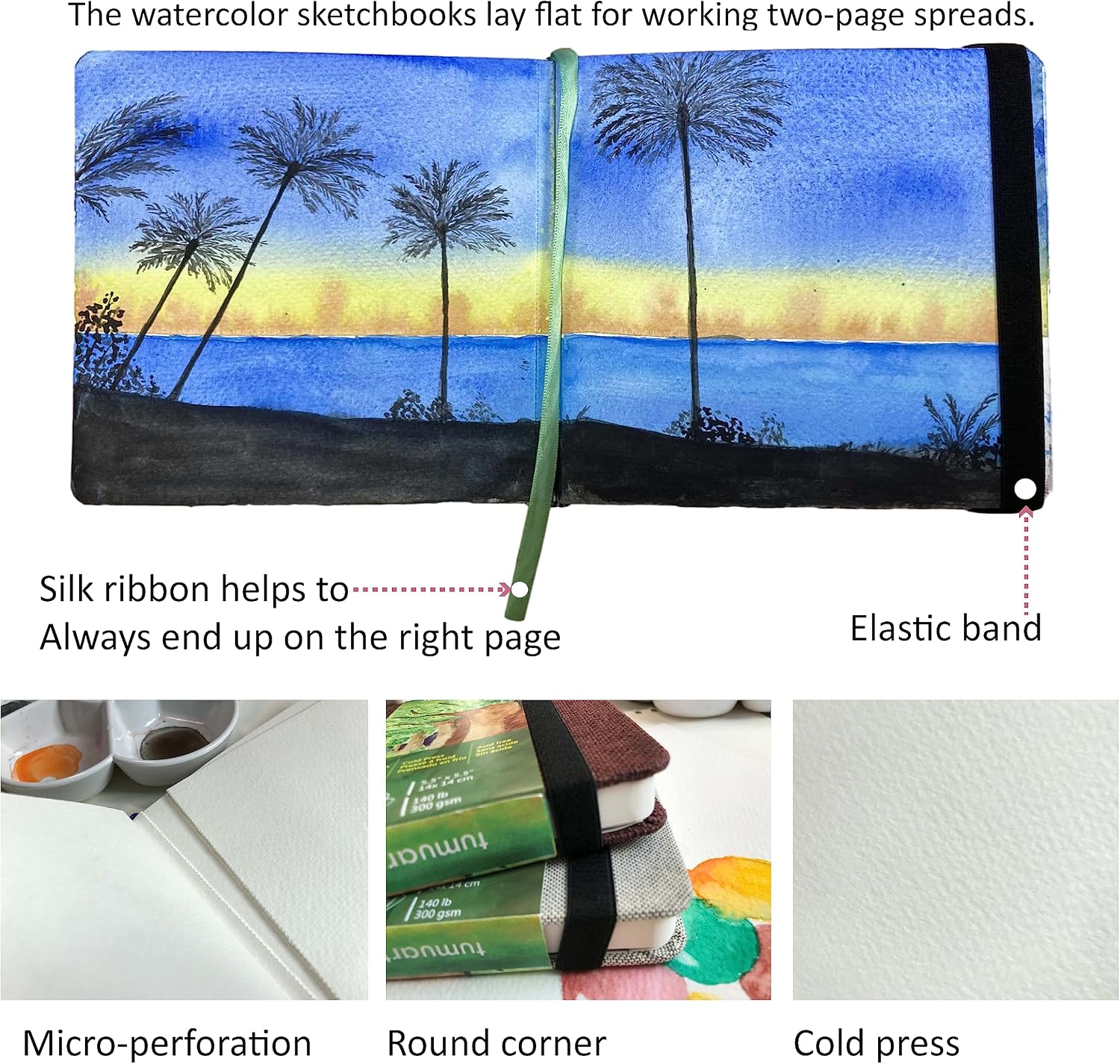
tumuarta
$13.99
In stock on Amazon
Check price on AmazonFunto Watercolor Journal
Funto reviewers are notably enthusiastic about two things: the pocket size and the paper’s thickness relative to expectations. The book sits at a price point where thick paper feels like a surprise, and owners report that it does genuinely resist warping under moderate washes. The lie-flat question comes up repeatedly in buyer comments (addressed in the FAQ below).
The Funto book reads best as a plein-air companion or daily journaling tool for artists whose practice is sketch-weight rather than sustained-wash. For light gouache, ink-and-watercolor combinations, or pencil-and-wash work, owners describe it as excellent. For heavy, multi-layer watercolor studies, the paper’s limits show up sooner than cotton alternatives. At maximum portability — the sketchbook has to coexist with a wallet, a phone, and a 12-half-pan travel palette — the Funto is sized for exactly that scenario.
tumuarta
$13.99
In stock on Amazon
Check price on AmazonThe Math: Cotton vs. Pulp at Pocket Scale
Understanding the cost-per-page relationship helps resolve the choice for most daily practitioners. The table below summarizes each book’s key variables:
| Book | Fiber | Binding | Typical GSM | Best For |
|---|---|---|---|---|
| tumuarta Watercolor Journal | Cotton (owner-reported) | Case-bound | ~200+ GSM | Granulating washes, archival studies |
| Moleskine Watercolor Album | Cellulose (enhanced) | Case-bound | 200 GSM | Gouache, mixed media, travel |
| ARTEZA Watercolor Spiral | Cellulose | Spiral | 140–200 GSM | Daily practice, light washes |
| Funto Watercolor Journal | Cellulose | Case-bound | ~160 GSM | Sketch-weight, plein air |
For a daily practice book you go through in two to four months, cost-per-page math often favors the ARTEZA spiral. For work you’re keeping — color studies, location sketches, reference palettes — the tumuarta or Moleskine Watercolor Album’s more stable paper justifies the higher page cost.
If X, Then Y: The Decision Rules
This is where the comparison resolves into a framework you can apply directly:
If your daily practice centers on wet washes, layering, or granulating single-pigment watercolors — Daniel Smith PrimaTek colors, Sennelier heavy-sediment pigments — then cotton paper is the non-negotiable variable. The tumuarta is the small-format cotton option owners point to most consistently for this use case.
If you work across media in the same session — transparent watercolor plus a few opaque gouache passages — then the Moleskine Watercolor Album’s proven gouache performance makes it the lower-risk choice, even with its case-bound spine limitations. Artists Network’s coverage of watercolor sketchbooks for travel specifically names gouache handling as a strength of the enhanced cellulose surface.
If daily practice means filling pages fast, working loosely, and treating the sketchbook as a disposable practice space rather than an archive, then the ARTEZA spiral’s price-per-page math and flat-opening binding make it the practical winner. Its paper handles what owners use it for, and the format disappears while you work.
If maximum portability is the constraint — the sketchbook coexists with a wallet, a phone, and a compact palette — then the Funto is sized for that scenario, and its paper handles the light-to-medium washes that pocket-scale sessions typically involve.
Frequently Asked Questions
Is the tumuarta watercolor journal actually 100% cotton at that price? Owner reviews and the product’s published specs both describe it as cotton paper. The behavioral reports — granulation performing correctly, no warping under moderate washes — are consistent with cotton fiber, not cellulose. No site-verified lab test exists in the public record; the consistency of owner-reported behavior is the evidence base here.
Can the Moleskine Watercolor Album handle heavy washes without warping? For moderate-to-heavy washes, owners report minor cockling at page edges but not the dramatic warping that standard Moleskine paper produces. Full-bleed very wet washes pushed hard at the edges can stress any unattached paper. Owners who tape edges or use a backing board report better results.
What is the difference between the ARTEZA square journal and the ARTEZA 9×12 spiral sketchbook? These are distinct products. The square journal is a smaller, case-bound format; the 9×12 spiral is a larger, spiral-bound sketchbook with different paper weight. They are sometimes confused in reviews. The spiral format lies flat; the square journal does not fully open flat in the same way. Confirm format and GSM before ordering.
Which small watercolor sketchbook works best for gouache? Moleskine Watercolor Album owners specifically name gouache performance as a strength — the enhanced cellulose surface holds opaque layers without lifting. Among cotton options, tumuarta’s surface handles gouache well, but the owner data on gouache performance is denser for the Moleskine watercolor edition.
Does the Funto journal lie flat when open? Owner reviews are mixed. The Funto is case-bound, and like most glue-bound journals, it resists fully opening flat — particularly in the first third and last third of the book. It lies flatter as the book breaks in. Artists who find this limiting often use a rubber band around the back cover to hold it open.
How many pages does a small watercolor sketchbook realistically last for daily practice? At one page per day, a 60-page book lasts two months; an 80-page book lasts just under three months. Most pocket sketchbooks in this category run 40–80 pages. If your practice produces multiple small studies per session, plan for monthly replacement — and factor that into the cost-per-page math when deciding how much paper quality you need for practice versus archival work.