Watercolor is one of those mediums you never fully forget — your muscle memory for wet-on-wet washes (applying wet paint to a surface that’s already damp) and the instinct to tilt your board at just the right moment tend to survive even a decade-long gap. What doesn’t survive intact is your mental map of the supply landscape, which has shifted considerably in the last ten to twenty years. New pigment formulations, a dramatically improved budget paper market, and the rise of premium single-pigment (one pure colorant per tube, no mixing of cheaper dyes) paints from brands like Daniel Smith have changed what “good enough” means at every price tier. This guide is calibrated for returning artists specifically — people who have real prior skill but need an honest recalibration of materials, not a lecture on how to hold a brush.
If you painted seriously before and are coming back now, the good news is that your instincts are mostly right. The tricky part is that your calibration is off, and the wrong materials during re-entry can make skilled hands look like a beginner’s. Here’s how to sort that out efficiently.
Why Re-Entry Feels Harder Than It Should
The most common complaint from returning watercolorists isn’t rusty technique — it’s the bewildering sense that the medium isn’t responding the way it used to. Across aggregated reviews and community discussions documented on artistsnetwork.com, two culprits account for the majority of this frustration: paper and paint concentration.
Paper is the bigger factor, and it’s often invisible as a variable. If you trained on student-grade wood-pulp paper (common before the mid-2010s) and are now returning to a different budget paper, or if you’re attempting cotton-rag paper for the first time, the surface behavior will feel foreign. Wood-pulp paper (made from processed wood fiber, which is more acidic and less durable than cotton) tends to absorb pigment quickly and gives you less time to work a wash before it locks in. Cotton-rag paper — the category that includes Arches cold-press, Fabriano Artistico, and similar professional surfaces — holds water longer, lifts more cleanly, and granulates (creates textured, grainy visual effects) differently. If you switched paper type and didn’t know it, the medium feels broken.
There’s a well-documented phenomenon in Arches cold-press pad reviews that’s worth naming directly: multiple returning artists report nearly abandoning watercolor entirely before discovering that the issue was their paper, not their skill. The switch to a cotton surface resolved years of frustration in a single session. That’s not marketing — it’s a real calibration problem that better information would have solved earlier.
Paint concentration is the second major variable. If your reference point is student-grade or older professional paint — brands that were common fifteen to twenty years ago and carried more filler and less pigment per tube — Daniel Smith extra-fine watercolors will read as shockingly intense. Returning artists who jump straight to Daniel Smith frequently report over-loading their mixes and producing colors that feel aggressive and hard to control, wasting expensive paint while doing it. The adjustment is simple once you know it exists: use less paint, more water, and give yourself three or four sessions to recalibrate your loading instinct before judging your results.
The Paper Decision: Practice Surface vs. Cotton Rag
This is the highest-leverage choice you’ll make as a returning artist, and it involves a real tradeoff that deserves honest framing.
The case for Canson XL (or similar budget cellulose paper) as a re-entry surface:
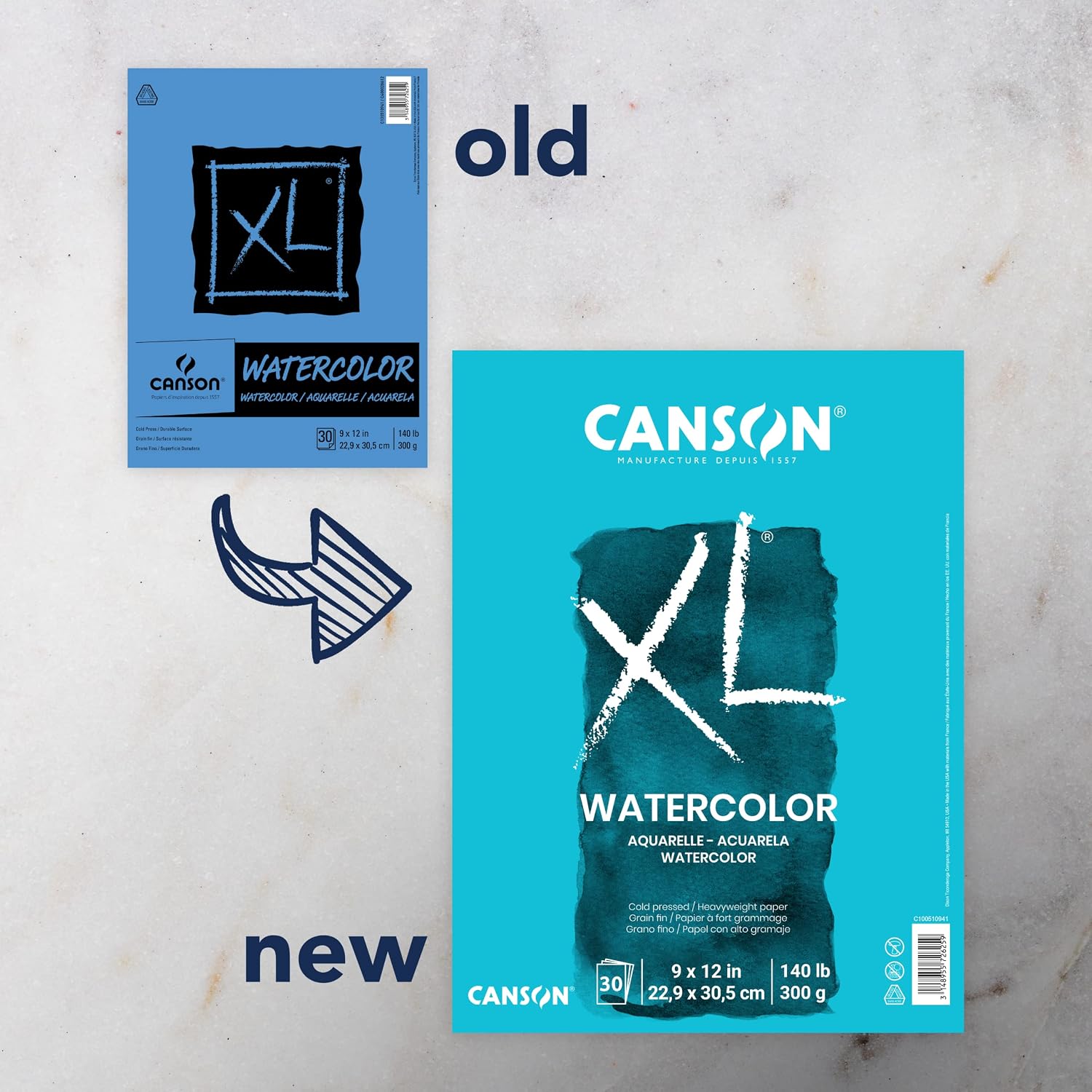
Canson XL pads — available in 9×12 and 11×15 formats — are significantly better than the student paper of ten to fifteen years ago. The manufacturing of wood-pulp watercolor paper has improved, and reviewers consistently note that Canson XL holds up to moderate wet-on-wet work without immediate buckling or feathering. The practical argument for using it during re-entry comes down to repetition math: if expensive paper creates psychological friction around “wasting” a sheet, you’ll do fewer repetitions. A returning artist who documented a 25-year gap from the medium noted in a Canson XL review that the relief of not worrying about ruining a costly sheet was the direct reason they rebuilt momentum. That’s a real and legitimate use case.
The honest limitation: Canson XL will not teach you cotton-paper behavior, and some techniques — loose wet lifting, granulation effects, soft edge control — simply don’t perform on cellulose the way they do on cotton. If your prior work was done on good cotton paper, Canson XL may actually feel like a step backward in surface responsiveness.
The case for going straight to cotton paper:
If you have prior experience on cotton-rag surfaces, returning to them immediately is defensible. The Arches cold-press pad (available in block and spiral formats) gives you the archival surface without committing to expensive individual sheets before you’ve rebuilt your confidence. Reviewers who made this jump report that the cotton surface itself accelerated skill recovery — the paper’s forgiving wet-window and clean-lifting behavior reinforced good technique rather than fighting it. Per Jackson’s Art Blog’s guide to watercolour paper, cotton-rag papers sized with traditional gelatin (a surface treatment that controls absorbency) offer significantly more working time than cellulose alternatives, which is a genuine advantage when you’re re-learning timing.
The decision rule: If you’re painting fewer than two sessions per week during re-entry, start with Canson XL for the first four to six weeks without guilt — the repetitions matter more than the surface. If you’re committing to three or more sessions per week and you have prior cotton-paper experience, go straight to an Arches cold-press pad. The cost-per-session math favors cotton at higher frequency because you’re building transferable habits from day one.
Paint: What’s Changed, and What It Means for You
The short version: the best watercolor paints of 2026 are substantially better than what was widely available twenty years ago, primarily because single-pigment transparency and lightfastness data (rated on the ASTM scale from I — excellent — to V — very poor) are now standard information on tubes and in manufacturer documentation. This matters for anyone selling work or building a portfolio meant to last.
By the numbers:
| Era | Typical Pigment Info on Tube | Lightfastness Rating Published? | Single-Pigment Options |
|---|---|---|---|
| Early 2000s student grade | Color name only | Rarely | Few |
| Early 2000s professional | Sometimes pigment code | Inconsistently | Some |
| 2026 professional grade | Pigment code(s) standard | Yes, ASTM I–II common | Extensive |
Handprint.com’s comprehensive survey of watercolor pigments — one of the most cited reference documents in the watercolor community — tracks this shift in detail, noting that the move toward transparent, single-pigment formulations across brands like Daniel Smith, Schmincke Horadam, and Sennelier represents a structural improvement over the multi-pigment, opacifier-heavy formulations that were standard in many lines before roughly 2005.
On Daniel Smith specifically: Returning artists who trained on Winsor & Newton Artist’s or older professional lines note a real adjustment period. Daniel Smith’s pigment load is high — reviewers consistently describe needing to use noticeably less paint from the tube than they’d expect — and certain colors (Lunar Black, Sleeping Beauty Turquoise, anything in the PrimaTek mineral line) behave in ways that have no direct analog in older palettes. The Daniel Smith Essentials sets are a thoughtful re-entry point: the curated color selection builds a functional limited palette (a deliberately small set of colors that can mix a wide gamut) without committing to a full collection before you’ve relearned your mixing instincts.
On pan sets for returning artists: The Kuretake Gansai Tambi sets address a specific re-entry problem that’s worth acknowledging openly — pans that have sat unused activate more easily when they’re larger, and the Gansai Tambi pans are notably bigger than the half-pans in most compact sets. Reviewers returning after gaps of forty-plus years specifically cite this as a practical feature: easier to load a brush, easier to see colors clearly, less frustration at the start of a session. If motor control or vision has changed in the intervening years, pan size is a legitimate equipment variable, not a cosmetic one.
When to Move From Practice Paper to Arches
The question “am I ready for good paper?” is almost always the wrong frame. A more useful question is: what do I want to learn next, and does my current surface support that?
Arches cold-press teaches you things that Canson XL simply cannot demonstrate: how pigment blooms differently on a slow-absorbing cotton surface, how granulating pigments (those that separate into textured particles in a wash) behave on tooth, and how reliably you can lift a dried passage with a damp brush without destroying the paper. If any of those are on your learning agenda, you need cotton paper to practice them — there’s no workaround. Per the Artwork Archive’s guidance on archival materials, work intended for exhibition or sale should be on cotton-rag paper rated acid-free, as cellulose papers will yellow and become brittle over time regardless of paint quality.
The practical trigger: when you’re completing paintings you want to keep or show, switch to Arches or a comparable cotton surface for those pieces regardless of where you are in the re-entry process. Use budget paper for studies and warm-ups. That division requires no waiting for a skill milestone — it’s just a workflow decision.
Frequently Asked Questions
Should I start with a pan set or tubes when returning to watercolor after years away? Pans have a meaningful advantage for returning artists who aren’t sure how frequently they’ll paint: they don’t dry out and waste paint between sessions the way open tubes can. If your sessions are irregular, start with a quality pan set. If you’re committing to regular practice, tubes give you more paint volume per dollar and allow larger washes. The Kuretake Gansai Tambi sets and the Daniel Smith Essentials dot card (a sample card with dried paint dots, not a pan set) are both sensible re-entry formats for different reasons.
Is Canson XL good enough to rebuild skills on, or do I need cotton paper right away? Canson XL is genuinely good enough for rebuilding core skills — washes, wet-on-wet timing, color mixing. It will not accurately simulate cotton-paper behavior, but that’s fine if you’re not ready to make the investment. The upgrade trigger is when the paper’s limitations start producing habits you’d have to unlearn on cotton.
How is Daniel Smith different from the watercolor paints I used 20 years ago? Higher pigment concentration, more single-pigment formulations, and ASTM lightfastness ratings published on every tube. The practical difference: you’ll use less paint than you expect, and some colors — particularly the PrimaTek granulating pigments — have no equivalent in older palettes. Budget an adjustment period of several sessions before judging your results.
Why does my watercolor look flat and muddy even though I used to paint well? The most common culprit is paper — specifically, painting on a surface that absorbs too quickly and doesn’t allow pigments to settle into natural variation. The second culprit is over-mixing colors on the palette before they hit the paper, which homogenizes them. On cotton paper, many mixing problems resolve themselves in the wash. Handprint.com’s pigment survey notes that muddy results often trace to mixing complements (colors opposite on the color wheel) from multi-pigment paints, where hidden third pigments create neutralization.
How much has the budget watercolor paper market improved in the last decade? Substantially. Jackson’s Art Blog’s paper guide notes that mid-range cellulose papers now incorporate better sizing and improved surface treatments compared to a decade ago. The Canson XL line specifically has received consistent positive re-evaluation from returning artists who remember the thinner, more fragile budget papers of the early 2000s.
When is the right time to move from practice paper to Arches? When you’re making work you want to keep. There’s no skill threshold — the paper move is a workflow and intention decision, not a reward for reaching a certain level. For studies and repetitions: budget paper. For work you’re invested in: cotton rag, every time.