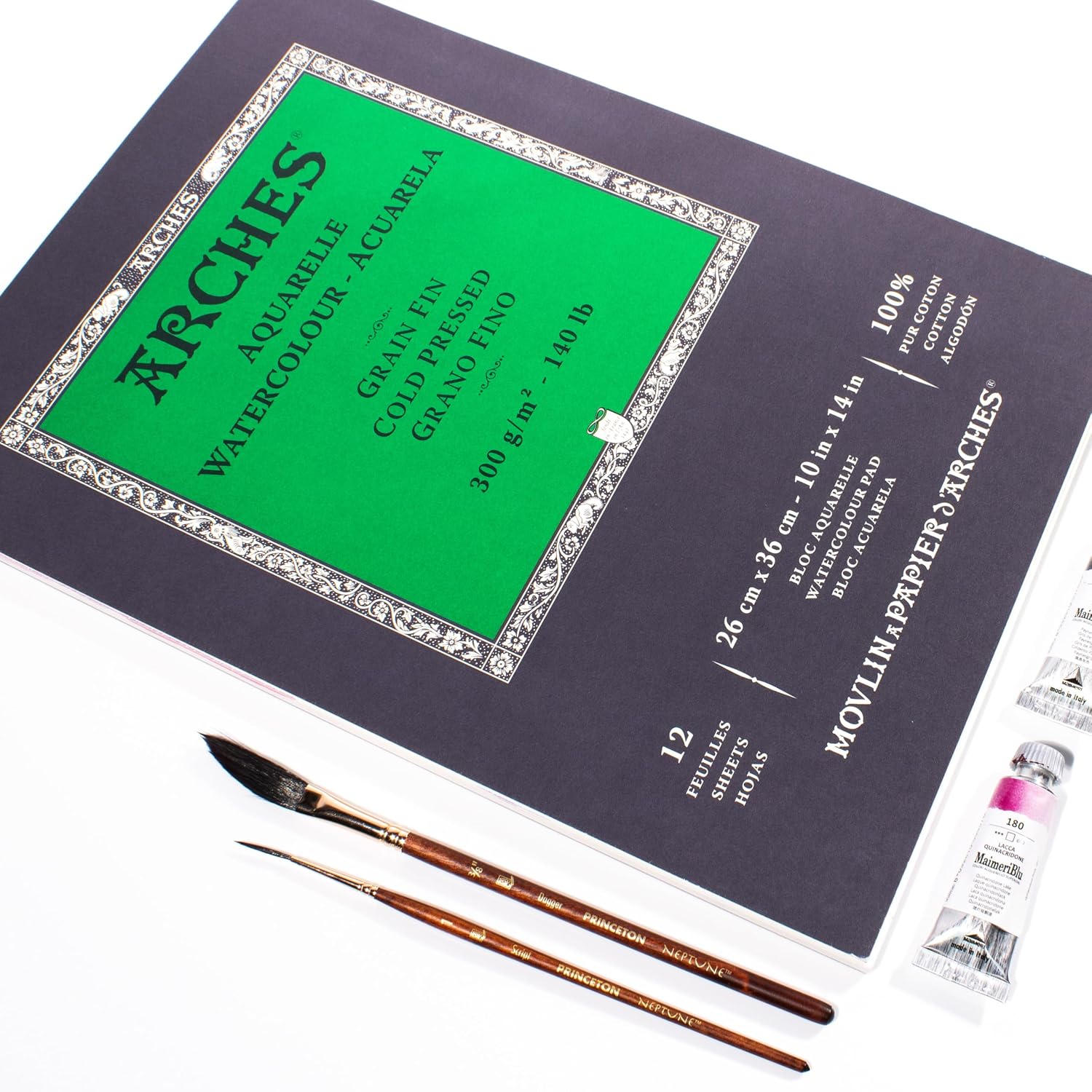
Gouache (pronounced gwash) is an opaque water-based paint — think watercolor’s bolder, more light-blocking sibling. Where watercolor depends on the white of the paper shining through translucent washes, gouache lays down flat, matte color you can paint light over dark with. That single difference changes everything about what you need from a surface. Gouache rewards scrubbing, re-wetting, and building multiple layers — workflows that eat budget paper alive. If you’ve ever watched a corner of your sketchbook pill into gray fuzz mid-painting, or seen a whole spread buckle into a relief map, this article is the post-mortem. What follows is a surface-by-surface breakdown of how popular watercolor papers actually behave under gouache, with a decision tree at the end so you can match paper to practice rather than buy on brand name alone.
| EDITOR'S PICKArches Watercolor Pad 9x12 Inch… | Mid-tierArches Aquarelle Watercolor Pap… | Budget pickMoleskine Art Watercolor Album | |
|---|---|---|---|
| Paper size | 9x12" | 10x14" | 5x8.25" |
| Weight (gsm) | 300gsm | 300gsm | — |
| Finish | Hot press | Cold press | — |
| Format | Pad | Pad | Album |
| Sheets/pages | — | 12 sheets | 72 pages |
| Price | $31.72 | $27.23 | $18.08 |
| See on Amazon → | See on Amazon → | See on Amazon → |
What Gouache Actually Demands from a Surface
Before comparing papers, it helps to name the three stresses gouache puts on a surface that watercolor largely doesn’t.
Reworkability. Gouache stays water-soluble when dry, which is both its superpower and its trap. Laying a second wet layer over a dried first layer risks lifting and muddying the underlayer. That means you’re often scrubbing gently, blotting, or working quickly — all of which require a surface with physical resilience. Papers with weak sizing (the internal or surface treatment that controls absorbency) break down under that friction.
Opacity buildup. A finished gouache piece might carry four to eight discrete layers. Each adds weight and moisture. Papers under 200 gsm (grams per square meter — a standard measure of paper weight and density) that aren’t stretched or block-mounted are prone to cockling, a wavy buckling that gets worse with each successive layer.
Edge precision. Gouache’s flat, opaque quality is often used for sharp graphic marks and clean edges — especially in illustration. Hot-press papers (smooth, calendered surface) support this. Cold-press papers (lightly textured, the most common watercolor surface) add grain that can break up hard edges. Neither is wrong; they suit different practices.
Jacksons Art Blog’s “Paper for Gouache” guide frames this well: the ideal gouache support has enough tooth to grip the pigment-heavy paint, enough weight to resist warping, and enough surface strength to survive repeated re-wetting. That’s a narrower window than most beginners expect.
Surface-by-Surface Breakdown
Arches Cold-Press Block: The Benchmark
Arches cold-press paper — made from 100% cotton rag and typically available in 140 lb / 300 gsm — is the most widely cited standard for serious watercolor and gouache work. Cotton-rag papers behave differently from wood-pulp papers at a structural level: the fibers interlock rather than stack, giving the sheet far more resilience under wet abrasion.
Across aggregated reviews, Arches block owners consistently highlight the surface’s tolerance for “lots of blotting, scraping, and erasing without damage” — exactly the language that maps onto gouache’s rework demands. The block format (sheets glued on four sides, released one at a time with a palette knife) means the paper stays flat under even aggressive layering because it can’t buckle freely.
Handprint.com’s comprehensive “Watercolor Supports: Paper” section confirms that 100% cotton papers show significantly less fiber lifting and surface breakdown under repeated wet passes compared to cellulose papers — and notes that sizing integrity holds through multiple wetting cycles.
The tradeoff: Arches cold-press is genuinely expensive per sheet, and the block format limits you to one size. If you’re doing large-format work or burning through paper in a daily sketchbook practice, the cost adds up quickly.
Best for: Finished illustration, pieces intended for sale or reproduction, any work where surface failure is unacceptable.
Moleskine Watercolor Album: The Counterintuitive Favorite
Here’s the pattern worth paying attention to: reviewers who buy the Moleskine watercolor album for watercolor are split. Reviewers who reach for it for gouache are noticeably more enthusiastic. Multiple owners describe it as a favorite gouache paper specifically, praising its “not too toothy” texture — a surface that accepts gouache’s thick consistency without the grain breaking up flat fields of color the way heavier cold-press textures can.
The Moleskine watercolor album uses a 200 gsm cotton-blend paper that sits between a standard sketchbook and a dedicated watercolor block. It’s not rated for the heavy pooling and granulation work that pure watercolor demands, but gouache’s lower water-to-pigment ratio means it doesn’t stress the surface the same way.
Artists Network’s “How to Use Gouache Paint” overview notes that gouache’s thicker application actually protects somewhat against the surface breaking down under rework, because you’re rarely floating large, saturated washes. The Moleskine’s weight and texture hit a practical sweet spot for that workflow.
The tradeoff: The bound album format means pages can still warp slightly under very heavy applications. The paper isn’t archival-rated in the way Arches is, which matters if longevity of the work is a priority.
Best for: Daily practice, location sketching, designers and illustrators doing comp work or reference studies where the bound format is an active convenience.
Canson XL Watercolor Pad: Know the Ceiling
Canson XL is the default entry-level watercolor pad for a reason — it’s accessible, widely available, and performs well for light watercolor washes. But reviewers are candid about its limits with gouache: it “won’t stand up to a lot of scrubbing and layering.” That’s not a casual complaint; it’s a direct description of the failure mode that makes it a poor match for gouache’s workflow.
Canson XL uses a cellulose (wood-pulp) base rather than cotton rag. The sizing is applied primarily to the surface rather than throughout the sheet. That means the first few wet passes are fine, but as you re-wet and rework, the surface sizing breaks down and fibers start to pill — that gray fuzz that ruins a painting mid-session.
By the numbers:
- Canson XL Watercolor: 140 lb / 300 gsm, cellulose, surface-sized
- Arches Cold-Press: 140 lb / 300 gsm, 100% cotton, internally and surface-sized
- Moleskine Watercolor Album: 200 gsm, cotton-blend, lightly textured
Same weight, very different durability under gouache’s demands. The gsm number tells you about buckling resistance; the fiber source tells you about rework resilience.
Best for: Preliminary color studies, practice work where paper failure is educational rather than costly.
Arteza Watercolor Journal: A Legitimate Middle Option
Arteza’s watercolor journal occupies a practical middle tier that often gets overlooked. Reviewers consistently compare it favorably to Canson XL, noting that multiple layers work well with adequate drying time between passes. That drying-time caveat is important: it suggests the paper can handle gouache’s layering demands if you don’t push it too fast, but it lacks the margin of cotton papers that forgive impatience.
The Arteza journal format — spiral-bound, lay-flat — solves a real workflow problem for gouache painters who work on location or at a desk without a board setup. Spiral binding lets pages lie flat without the backbone tension of a case-bound journal, which reduces stress on individual sheets under wet applications.
Reviewers who paint digitally and use physical gouache work as reference or thumbnail studies find the format particularly convenient: portable, flat-opening, and forgiving enough for the preparatory work it’s suited to.
The tradeoff: Archival quality is unverified by manufacturer specs at the level Arches publishes. For work that needs to last, this is a practice surface, not a final-piece surface.
Best for: Intermediate practitioners building layer-control intuition, daily warm-up work, location studies.
Hot Press vs. Cold Press: The Texture Decision
This is the question that trips up illustrators migrating from digital to physical gouache work most often.
Cold-press paper (lightly textured, the default “watercolor” surface) gives gouache something to grip. Flat washes stay put. The texture adds visual interest to loose, expressive brushwork. But that same texture breaks up hard geometric edges and thin linework — it fights against graphic, vector-adjacent illustration styles.
Hot-press paper (smooth, calendered) is the natural home for detailed gouache illustration. Per Jacksons Art Blog’s “Gouache: A Complete Guide to the Medium,” gouache’s opacity and body mean it handles well on smooth surfaces where watercolor would bead or flow unpredictably. Hot-press cotton papers like Arches Hot Press accept precise brushwork, clean masking, and sharp geometric shapes cleanly.
The if/then decision rule:
- If your gouache work is loose, painterly, or botanical — cold press.
- If your gouache work is graphic, editorial, or detail-heavy — hot press.
- If you’re unsure, cold press is the more forgiving starting point.
Decision Tree: Matching Surface to Practice
| Practice type | Surface recommendation | Why |
|---|---|---|
| Finished illustration, archival intent | Arches Cold or Hot Press block | Cotton resilience, block format prevents buckling |
| Daily sketchbook, location work | Moleskine Watercolor Album | Right texture for gouache, convenient format |
| Practice and studies, budget priority | Arteza Watercolor Journal | Handles layers with patience, affordable iteration |
| Entry-level color exercises only | Canson XL | Fine for single-pass work; avoid heavy reworking |
Frequently Asked Questions
Can I use regular watercolor paper for gouache, or do I need a special surface? Most watercolor papers will accept gouache, but not all will handle its rework-heavy workflow. The key variable is fiber source: cotton-rag papers survive repeated re-wetting and scrubbing; cellulose papers pill and break down. For casual practice, any 300 gsm watercolor paper works. For serious work, cotton is worth the price difference.
Why does my gouache buckle or pill on budget paper but not on cotton paper? Buckling comes from moisture stress that the fibers can’t absorb evenly — block formats and heavier weights reduce it, but cotton’s interlocking fiber structure handles it better at any weight. Pilling is surface sizing breaking down under wet abrasion. Cotton papers are typically internally sized throughout the sheet, not just on the surface, so they don’t pill the same way.
Is hot press or cold press better for detailed gouache illustration? Hot press, consistently. Smooth surfaces let gouache’s opacity do precise graphic work without texture interrupting edges. Cold press is better for looser, expressive styles where the grain adds to the aesthetic rather than fighting it.
Does the Moleskine watercolor album really hold up to heavy gouache applications? Owners report it holds up well for gouache specifically — better than for heavy watercolor washes. The “not too toothy” texture and 200 gsm weight handle gouache’s lower water content and thicker application better than its watercolor performance might suggest. Very heavy or repeated applications on a single page can still cause some warp, but it’s noticeably more stable than budget cellulose pads.
Can I use a spiral-bound journal for gouache without the pages warping? Spiral binding helps because pages can lie flat without backbone resistance. Combined with adequate weight (200 gsm minimum) and drying time between layers, spiral-bound journals like the Arteza watercolor journal handle gouache reasonably well for practice and studies. For archival or exhibition-quality work, a block-format cotton paper is still the more reliable choice.
Is the Arches block format worth the extra cost for gouache work compared to a pad? If you’re painting to sell or exhibit work, yes — the combination of cotton-rag fiber, block mounting, and Arches’ consistent sizing produces a surface that actively supports gouache’s demands rather than tolerating them. The block format alone eliminates the buckling problem that plagues loose pad sheets under heavy layering. For practice work, the premium is harder to justify; that’s where the Arteza journal or Moleskine album earn their place.
The honest summary: gouache is a forgiving medium in terms of color correction, but it’s an unforgiving medium in terms of surface quality. The rework that makes gouache useful — the ability to go back in, lift, adjust, and layer — is exactly what destroys budget paper. Getting the surface right doesn’t mean spending maximum money; the Moleskine album sits at a fraction of Arches pricing and outperforms papers that cost more. It means matching the surface’s actual tolerances to what your practice actually demands.