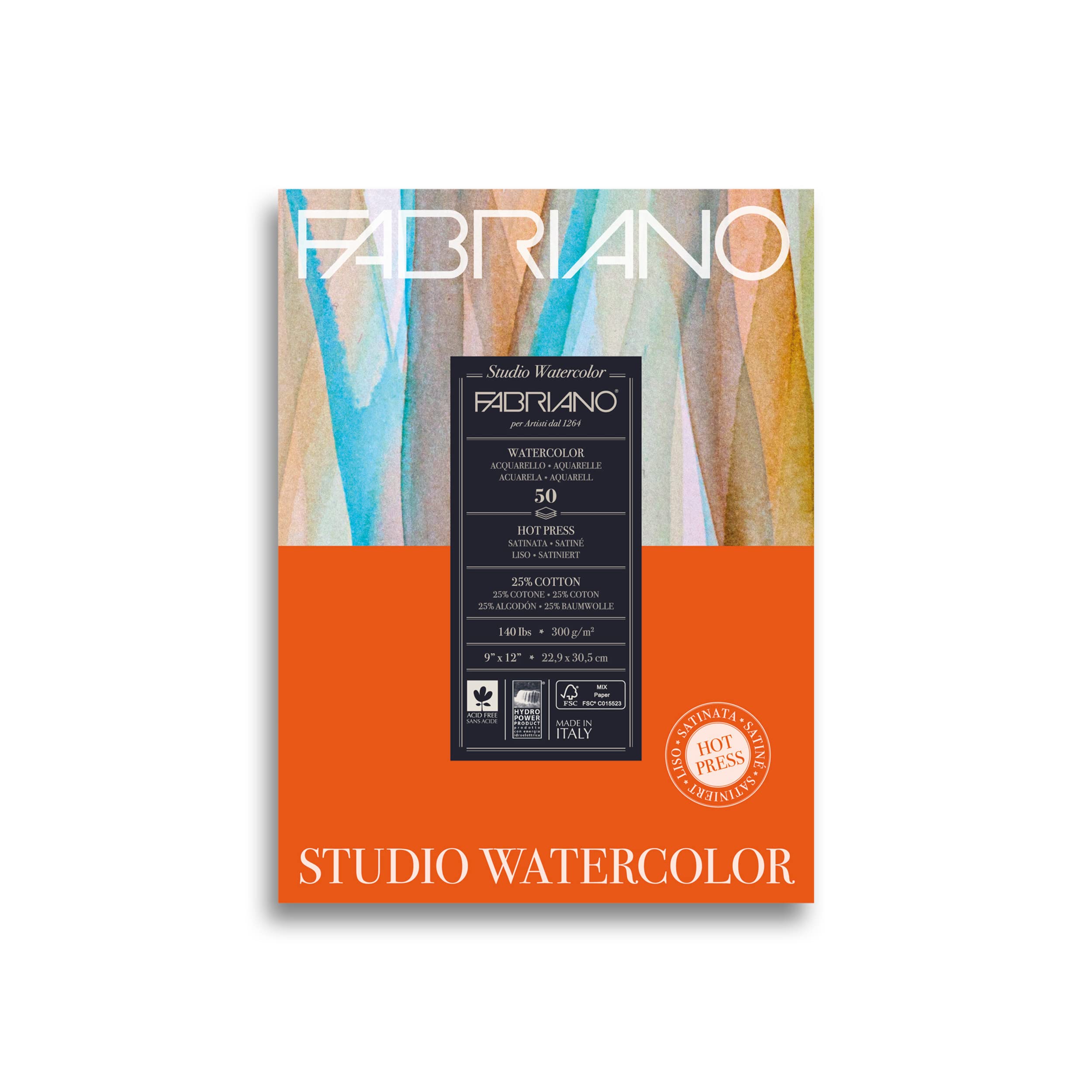
If you’ve ever stood in the paper aisle — or scrolled through a retailer’s watercolor section — wondering why one Fabriano pad costs half what another does, you’re asking exactly the right question. Fabriano is an Italian paper mill that has been operating since 1264, and it makes paper at several quality tiers under the same brand umbrella. “Watercolor paper” isn’t one thing: it ranges from wood-pulp sheets that yellow and buckle over time to archival cotton-rag paper that survives aggressive rinsing, heavy erasure, and decades of display. The practical difference matters especially if you’re selling work or building a portfolio you want to last. This article breaks down what separates Fabriano Studio from Fabriano Artistico, names the tradeoffs clearly, and tells you which one to buy depending on what you’re actually doing.
| EDITOR'S PICKFabriano Studio Watercolor Pad | Mid-tierFabriano Artistico 140 lb. Hot… | Budget pickFabriano Studio Watercolor Pad | |
|---|---|---|---|
| Finish | Hot-Press | Hot Press | Cold-Press |
| Size | 11" x 14" | 9" x 12" | 9" x 12" |
| Sheet Count | 50 | 20 | 50 |
| Format | Pad | Block | Pad |
| Surface | White | Traditional White | White |
| Price | $45.00 | $39.39 | $26.66 |
| See on Amazon → | See on Amazon → | See on Amazon → |
What the Spec Sheets Actually Say
Start with the manufacturing difference, because it drives everything else.
Fabriano Artistico is 100% cotton-rag paper, cold-pressed, hot-pressed, or rough, at 300 gsm (grams per square meter — the standard weight measure for paper; heavier means more fiber, less warping). Cotton rag is the archival baseline for fine art: it’s acid-free, pH-neutral, and sized internally with gelatin, which controls how fast water and pigment absorb into the sheet. Per Fabriano’s official product documentation, Artistico also carries an “Extra White” variant that uses a brighter base sheet without optical brightening agents — a meaningful distinction for artists who care about long-term color accuracy, since optical brighteners can fade unevenly over years.
Fabriano Studio is marketed as a “studio practice” paper and is significantly less expensive per sheet. Per Fabriano’s published specs, Studio is also described as 100% cotton in several of its listings — which is exactly where the confusion begins. The fiber claim is similar; the price isn’t.
| Fabriano Artistico | Fabriano Studio | |
|---|---|---|
| Fiber content (per spec) | 100% cotton rag | 100% cotton (some formats) |
| Weight (gsm) | 300 gsm standard | 200–300 gsm depending on format |
| Sizing type | Internal gelatin | Internal sizing |
| Archival rating | Yes, acid-free | Yes, acid-free |
| Relative price per sheet | Higher | Lower by ~30–50% |
The spec overlap is real. So why the price gap, and does it show up in practice?
What Owners Actually Report
This is where it gets honest. Because the specs are close, the most useful signal comes from practitioners who have used both.
The calligrapher comparison. One of the most-cited owner observations — referenced across multiple paper review threads and summarized in Jackson’s Art Supplies’ watercolor paper guide — is from a calligrapher who worked both surfaces extensively and stated explicitly that Fabriano Studio “feels and functions just like the Artistico.” For calligraphy and fine-line ink work, that’s a credible verdict: the surface texture and sizing behavior are close enough that the working experience feels interchangeable. If your primary use is ink or light watercolor washes without heavy rework, that comparison matters.
The cyanotype printer’s data point. An unexpected but telling report comes from a cyanotype printer (cyanotype is a photographic process where chemical-coated paper is exposed to UV light, then rinsed repeatedly under running water). This owner used Fabriano Studio hot press and specifically praised its durability under heavy rinsing — the sheet didn’t delaminate or fall apart through multiple wash cycles. That’s a structural signal: the paper holds together under sustained water stress, which is exactly what a loose watercolor wash also demands. Owners reporting their experience, as aggregated in watercolor community discussions, tend to confirm that Studio behaves better than its price suggests.
The botanical artist’s Artistico account. The strongest performance case for Artistico comes from botanical illustration practitioners, where material demands are unusually high. One detailed owner account — referenced in Artists Network’s editorial coverage of precision watercolor techniques — describes fully erasing pencil lines after layered washes without the surface pilling or ghosting, applying multiple glaze layers without lifting previous ones, and using solvent-based masking fluid without the paper shredding on removal. That’s a specific mechanical stress test that student-grade paper consistently fails, and it’s the clearest articulation of what Artistico’s cotton and sizing combination actually buys you.
The warping caveat on Studio cold press. One cold-press Studio reviewer flagged something worth including without minimizing: the paper warped noticeably when wet, then flattened itself as it dried. That’s not unusual behavior for any paper under 300 gsm without prior stretching or block format, but it does mean you’ll want to either tape the sheet down, use a block, or accept some handling. The Artistico at 300 gsm warps less aggressively under equivalent washes, per consistent owner reporting — the heavier, denser cotton sheet resists buckling better.
The Arches Frame: Is Premium Paper “Snob Appeal”?
Fabriano Artistico sits in roughly the same tier as Arches cold-press cotton-rag paper — both are the go-to professional watercolor papers, both are 100% cotton, and the debate between them is genuinely useful for calibrating what Artistico is worth.
The most candid framing comes from an Arches reviewer quoted in several aggregated paper discussions: they described years of assuming Arches was “snob appeal” before finally working on it and revising their opinion. The consensus from practitioners who have made that same journey — documented in Handprint.com’s watercolor supports reference pages, one of the most detailed technical resources available for watercolor paper behavior — is that the performance difference between Arches and Fabriano Artistico is real but narrow. Granulation reads slightly differently. Surface tooth varies. But both papers earn the premium over student stock for the same reason: cotton rag at proper weight and sizing genuinely changes what is possible with layering, lifting, and edge control.
The honest version of that frame applied to the Studio question: if you’re comparing Studio to Artistico, you’re not comparing student to professional. You’re comparing a capable workhorse to a refined professional surface. That’s a different calculation than the student-to-pro leap, and the right answer depends on what you’re making.
If X, then Y — the decision rule:
-
If you’re doing daily studies, practice paintings, or color exercises where the work is process rather than product: Fabriano Studio is the call. The working experience is close enough that you won’t feel compromised, and the cost savings compound meaningfully across a year of regular use.
-
If you’re working on pieces you’ll sell, exhibit, or archive — or if your technique requires aggressive lifting, layering, or erasing: Fabriano Artistico is worth the premium. The botanical artist’s account of damage-free erasure and multi-layer stability isn’t a luxury detail; it’s the paper doing structural work your technique depends on.
-
If you’re doing mixed media, botanical illustration, or any process that involves masking fluid, solvents, or repeated wet-dry cycles: Artistico is not optional. The cotton-rag sizing absorbs that abuse without surface degradation in a way Studio cannot reliably promise across all formats and weights.
Format Decision: Pad, Block, or Sheet?
If you’re buying Fabriano for the first time and the pad vs. block vs. pre-cut sheet question is making the decision harder, here’s the short version.
Pads (spiral or glue-bound on one edge) are the easiest entry point and the most flexible format — you tear sheets off as needed, can work on multiple pieces simultaneously, and the smaller footprint makes storage simple. The tradeoff is warping: a single sheet on a pad has no tension holding it flat while wet.
Blocks (sheets glued on all four edges, released after drying with a palette knife) address the warping problem directly. The glued border keeps the sheet under tension while you work, and it dries flat without taping. For anyone who finds stretching paper tedious, a block is worth the modest price premium over a pad.
Pre-cut sheets (individual 22×30 inch full sheets) offer the best value per square inch and maximum flexibility for sizing, but they require either stretching, taping down, or accepting warp. They’re the choice for experienced practitioners who already have a stretching workflow.
For a first buy: a Fabriano Artistico block in cold press is the most forgiving format for building intuition, because it removes the warping variable from the equation while you’re still calibrating pressure and water load.
Frequently Asked Questions
Is Fabriano Studio the same paper as Fabriano Artistico? Not exactly, but they are closer than the price gap implies. Both are marketed as cotton-based and acid-free, but Artistico is manufactured to tighter archival specifications with internal gelatin sizing and a more consistent surface finish. Owners who have used both report that Studio performs comparably for ink and light watercolor work, but Artistico shows a meaningful advantage under the stress conditions professionals encounter: heavy lifting, masking fluid, solvent application, and multi-layer glazing.
Is Fabriano Artistico as good as Arches watercolor paper? The practitioner consensus — documented thoroughly in Handprint.com’s watercolor paper comparisons and reinforced in Jackson’s Art blog coverage — is that they’re peers, not ranked alternatives. The surfaces behave slightly differently: Arches cold press has a more pronounced tooth; Artistico’s surface is somewhat smoother at equivalent texture grades. Which you prefer often comes down to your specific technique and pigment palette. Neither is objectively superior; both are legitimate professional choices.
What is Fabriano hot press best used for compared to cold press? Hot press (smooth surface, pressed under heat rollers) is best suited for fine-line detail work, botanical illustration, pen-and-ink wash, and any technique where you want precise edge control without the surface texture interfering. Cold press (light texture, the most common watercolor surface) suits looser, more expressive painting, granulating pigments, and techniques that benefit from the paper’s texture creating visual interest. If you’re working with Daniel Smith’s granulating colors — Piemontite Genuine or Lunar Black, for instance — cold press amplifies that granulation; hot press suppresses it.
Can Fabriano Artistico handle colored pencil as well as watercolor? Owners using Artistico for mixed media report good results with colored pencil over dry watercolor washes — the cotton surface has enough tooth to hold pigment from the pencil without the sheet feeling slick. It’s not optimized for dry colored pencil the way a dedicated colored pencil paper is (Stonehenge or UART pastel paper, for reference), but for watercolor-plus-colored-pencil finishing work, Artistico performs well. The botanical illustration community, which often combines both, uses it regularly for exactly this workflow.
Does Fabriano Studio cold press warp and stay warped? Based on owner reporting, Studio cold press does warp under wet washes — particularly in lighter weight formats — but typically flattens itself on drying if left under a flat weight or book stack. It doesn’t permanently deform in most reported cases. That said, if warping mid-painting disrupts your workflow, the block format or prior stretching is the practical fix, regardless of which Fabriano line you’re using.
Which Fabriano format — pad, block, or pre-cut sheets — is best for a beginner buying for the first time? A cold-press block is the best entry point, full stop. It solves the warping problem without requiring any additional technique, keeps each painting confined to its own flat surface, and releases cleanly when the work is dry. Pads are cheaper and more flexible but introduce warping as a variable while you’re still learning water load. Pre-cut sheets are the most economical per area but require a stretching or taping workflow that adds setup friction beginners don’t need yet.