If you’ve been painting with watercolors for a while, you’ve almost certainly stared at the same brand listed twice in a catalog — once as tubes, once as pans — and wondered whether you’re missing something. For Daniel Smith, one of the most respected professional watercolor lines on the market, the answer matters: the two formats carry identical pigment codes and lightfastness ratings, but they behave differently in the studio, cost differently per milliliter, and suit different working styles. This article runs the actual math, names the real tradeoffs, and ends with a clear decision rule so you can stop second-guessing and get back to painting.
| EDITOR'S PICKDaniel Smith Color Hand Poured… | Mid-tierDANIEL SMITH 285610005 Extra Fi… | Budget pickDaniel Smith Extra Fine Waterco… | |
|---|---|---|---|
| Format | Pan | Tube | Tube |
| Color count | 24 | 6 | 1 |
| Paint amount | — | 5ml | 15ml |
| Metal case | ✓ | — | — |
| Empty pans | 24 | — | — |
| Pigment line | — | Extra Fine | Extra Fine |
| Price | $132.65 | $34.35 | $14.49 |
| See on Amazon → | See on Amazon → | See on Amazon → |
What You’re Actually Comparing (and Why It’s Not Obvious)
The pan-versus-tube question sounds simple until you dig into it. At the surface, both formats contain Daniel Smith Extra Fine Watercolor — same pigment codes, same ASTM transparency grades, same lightfastness ratings. But the format changes three things that matter in practice: pigment concentration after drying, cost-per-use efficiency, and workflow friction.
Pigment concentration is the first variable. Daniel Smith’s tubes are formulated with a higher water content than the dried pan equivalent, which is why tube paint is looser and more immediately workable straight from the cap. When tube paint is dried down into a pan — either factory-pressed or home-filled — the water evaporates, concentrating the pigment solids. The practical implication is that dried-down tube paint in a pan can yield slightly stronger tints for the same volume of material picked up on the brush, though the effect varies by pigment. As detailed in the watercolor pigments and paints reference pages on Handprint.com (pan vs. tube binder formulation notes), factory-pressed pans are not simply “dried tubes” — they are a distinct formulation optimized for activation with a wet brush, with the binder-to-pigment ratio adjusted accordingly.
Cost-per-use math is where the format decision gets financially meaningful, and we’ll cover that in depth in the next section.
Workflow friction is the factor most beginners underestimate. Tubes require a palette, a squeeze step, and a willingness to manage half-dried puddles between sessions. Pans eliminate that friction entirely — open the box, wet the surface, paint. That convenience has real value for intermittent painters, field painters, and anyone who wants to be painting within sixty seconds of sitting down.
The Cost-Per-Use Math: Pans vs. Tubes
Let’s run the numbers using current (May 2026) street pricing for Daniel Smith Extra Fine Watercolor, which holds fairly consistent across major art supply retailers.
| Format | Typical volume | Street price (single color) | Approx. price per ml |
|---|---|---|---|
| Tube (5 ml) | 5 ml | ~$11–$14 | ~$2.20–$2.80/ml |
| Tube (15 ml) | 15 ml | ~$22–$30 | ~$1.47–$2.00/ml |
| Half-pan (factory) | ~1.3 ml | ~$6–$9 | ~$4.60–$6.90/ml |
| Full-pan (factory) | ~2.6 ml | ~$10–$15 | ~$3.85–$5.77/ml |
The math is unambiguous: tubes win on price-per-ml, and the gap widens significantly with the 15 ml size. A 15 ml tube of Daniel Smith French Ultramarine (PB29) consistently runs around $1.50–$2.00 per ml at retail. A factory half-pan of the same color runs $4.60–$6.90 per ml — roughly two to three times the cost for the same pigment.
That said, price-per-ml only tells part of the story. If you paint infrequently, in small-scale sketchbook formats, or primarily on location, you will never work through a 15 ml tube efficiently before it begins to skin over or dry at the nozzle. Any wasted paint immediately erodes the tube’s cost advantage. The editorial overview “Watercolor Paints: Tubes vs. Pans,” published by Artists Network, makes precisely this point: actual cost-per-use depends on your consumption rate and studio habits — a painter working twice a month on quarter-sheet paper is not getting the value a tube format promises.
The rough break-even threshold for the tube format is: painting at least once per week, mixing generous washes, or working at half-sheet scale or larger. Below that usage level, the pan format’s lower waste rate begins to offset its higher per-ml sticker price.
Pigment Behavior: Does the Format Change How the Paint Performs?
This question generates consistent debate in watercolor communities, and it deserves a direct answer organized by what actually differs.
Workhorse Pigments — Comparable Performance When Properly Wetted
For the majority of pigments in the Daniel Smith line — the single-pigment transparents like Quinacridone Magenta (PR122), Phthalo Blue (PB15:3), and Hansa Yellow Medium (PY97) — tube and pan versions perform comparably on color strength, transparency, and bloom behavior, assuming the pan is properly wetted before use. The guide “Watercolour Pans vs. Tubes: Which Is Best For You?,” published by Jacksons Art Blog, makes this point directly: a factory-pressed pan wetted for 30 to 60 seconds before painting will release color with similar intensity to a freshly squeezed tube puddle of equivalent volume.
The operative phrase is “properly wetted.” Dry-brushing a pan that hasn’t been pre-moistened scrubs the pigment surface rather than dissolving it, producing chalky, inconsistent marks. That is a user error, not a material flaw — and it accounts for most of the negative pan reviews that appear in painting communities.
DANIEL
$34.35
In stock on Amazon
Check price on AmazonGranulating Primatek Colors — Pans Can Intensify Texture
Where format does create a meaningful performance difference is with Daniel Smith’s Primatek mineral line: Sleeping Beauty Turquoise, Hematite Genuine, Jadeite Genuine, and related colors. These pigments are ground from actual mineral sources, producing coarser particles than conventional synthetic pigments. In pan form, after the water content has evaporated, some painters report that Primatek colors show stronger granulation texture — the mineral particles appear to settle more dramatically in washes because the pigment concentration per unit volume is slightly elevated after drying.
This is a nuanced effect and not guaranteed across every paper-and-water combination, but it is worth knowing if granulation is central to your practice. Artists who work extensively with Primatek colors sometimes prefer pans specifically for this reason, even though the per-ml cost is higher. As the watercolor pigments and paints reference pages on Handprint.com note in their binder formulation discussion, mineral-ground pigments behave distinctly from synthetic organic pigments during both initial pressing and subsequent rewetting, which helps explain the texture differential painters observe in practice.
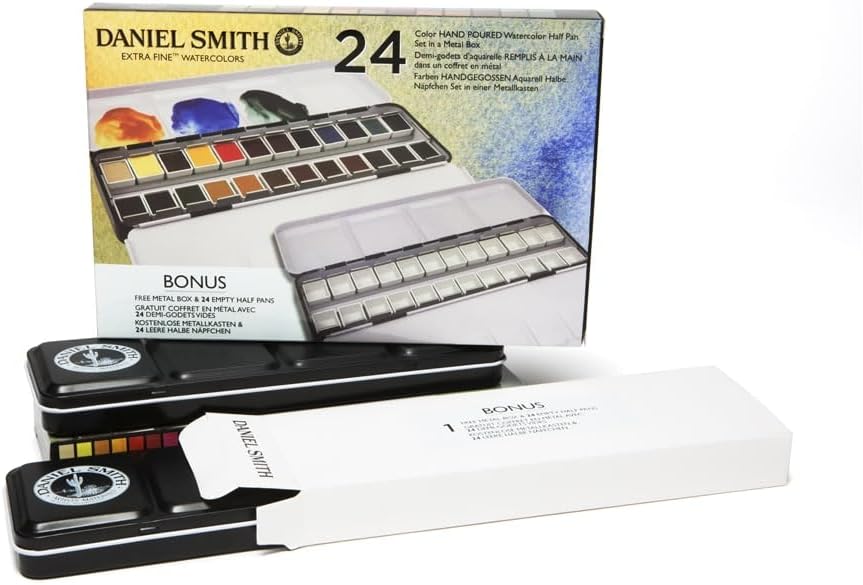
Daniel
$132.65
In stock on Amazon
Check price on AmazonReactivation and Freshness — Where Home-Filled Pans Excel
A third performance distinction involves reactivation behavior for artists who fill their own pans from tubes. Daniel Smith tube paint squeezed into empty half-pan wells and allowed to dry fully — typically 48 to 72 hours — rewets with exceptional ease. The watercolor pigments and paints reference pages on Handprint.com specifically call out Daniel Smith’s binder formulation as a strong performer for rewetting after extended drying, noting that the paint picks up cleanly with a wet brush without crazing, crumbling, or going tacky.
This matters because home-filled pans give you tube pricing, compactness, and full control over your palette layout — the hybrid approach discussed in the next section. Factory pans, by contrast, are pre-dried at the manufacturing stage. Their reactivation is reliable, but artists report that home-filled pans from Daniel Smith tubes can feel marginally more responsive, likely because the binder hasn’t undergone the additional processing of factory pressing. The studio practice and material investment resource library published by Artwork Archive identifies this hybrid method as a preferred approach for painters who want to balance cost efficiency with portability across studio and field contexts.

Daniel
$14.49
In stock on Amazon
Check price on AmazonWhich Format Fits Your Practice: The Decision Frame
Here is where we name the tradeoffs explicitly and provide the decision rule.
Choose tubes (15 ml) if:
- You paint at least weekly, at half-sheet scale or larger
- You mix large, generous washes and need volume on the palette
- You own a covered wet palette or use a covered mixing palette consistently between sessions
- You’re building a studio inventory and want the best cost-per-ml
- You plan to fill your own travel palette with dried-down tube paint
At this usage level, a 15 ml tube of a workhorse color represents genuine long-term value. Across a year of regular painting, the per-use cost of tube paint is a fraction of equivalent pans. The studio practice and material investment resource library at Artwork Archive consistently describes tube paint as the standard format for painters working at volume in studio conditions, with the 15 ml size identified as the practical sweet spot between cost efficiency and palette commitment.
Choose a pan set if:
- You primarily paint on location, in sketchbooks, or in travel contexts where compactness matters more than volume
- You paint infrequently — a few times a month — and want paint that is ready to use without any setup step
- You want a curated, fixed palette where every color is contained, labeled, and stable
- You’re purchasing as a gift or structured introduction to the Daniel Smith range — the Essentials and Primatek introductory pan sets offer broad pigment exposure at lower per-set entry cost
The hybrid approach (underrated): Buy 5 ml or 15 ml tubes of your six to twelve core colors, squeeze them into empty half-pan inserts, let them dry fully, and drop them into a travel palette with removable wells. You get tube pricing, pan compactness, and complete control over your palette layout. The guide “Watercolour Pans vs. Tubes: Which Is Best For You?,” published by Jacksons Art Blog, identifies this method as the preferred format for serious painters who move between studio and field contexts — and it is worth the one-time investment in an empty travel palette with removable pan wells.
Specific Recommendations by Use Case
For the studio painter building inventory: Start with Daniel Smith 15 ml tubes of your anchor pigments — French Ultramarine (PB29), Quinacridone Magenta (PR122), and a warm and cool yellow. The 15 ml size is the sweet spot for cost-per-ml without locking you into a color you may abandon. The editorial overview “Watercolor Paints: Tubes vs. Pans,” from Artists Network, recommends establishing your core palette in tube format before expanding into specialty or travel configurations.
DANIEL
$34.35
In stock on Amazon
Check price on Amazon[PRODUCT: Daniel Smith Extra Fine Watercolor 15ml Tube — mid-tier-pick]
For the field or travel painter: The Daniel Smith Essentials Sample Set in half-pan format is a legitimate way to audition the Daniel Smith range before committing to full pans or tubes. The Primatek Introductory Set is a particular standout for painters interested in mineral pigment behavior and granulation texture.
Daniel
$14.49
In stock on Amazon
Check price on Amazon[PRODUCT: Daniel Smith Essentials Watercolor Half-Pan Set — budget-pick]
For the hybrid palette builder: An empty metal travel palette with removable half-pan wells is the infrastructure that makes the hybrid approach work. Fill with dried-down tube paint from your core palette, and you have the cost efficiency of tubes with the portability of pans. As the studio practice resources at Artwork Archive describe, this format is the practical standard for painters working across multiple environments and represents the most economical long-term configuration for any painter who paints both at home and in the field.
Daniel
$132.65
In stock on Amazon
Check price on Amazon[PRODUCT: Empty Watercolor Travel Palette with Half-Pan Wells — premium-pick]
The Bottom Line
The pan-versus-tube decision is less about quality and more about matching format to habit. Daniel Smith’s pigment quality — the single-pigment transparency, the lightfast ratings, the unusual Primatek mineral earths — is consistent across both formats. What changes is how efficiently you extract that quality onto paper given your actual painting frequency, scale, and context.
The decision rule, simplified:
- Paint regularly at studio scale → 15 ml tubes, home-fill your travel palette from them
- Paint occasionally or primarily on location → factory pans or a pan set, prioritize compactness and zero-setup convenience
- Unsure of your habits → buy one 5 ml tube of your most-used color, squeeze it into a half-pan well, let it dry 48 hours, and evaluate before committing to a full set in either direction
The math favors tubes for heavy users. Convenience favors pans for intermittent or field painters. The hybrid approach captures both — and it is the format worth building toward as your practice matures and your palette stabilizes.