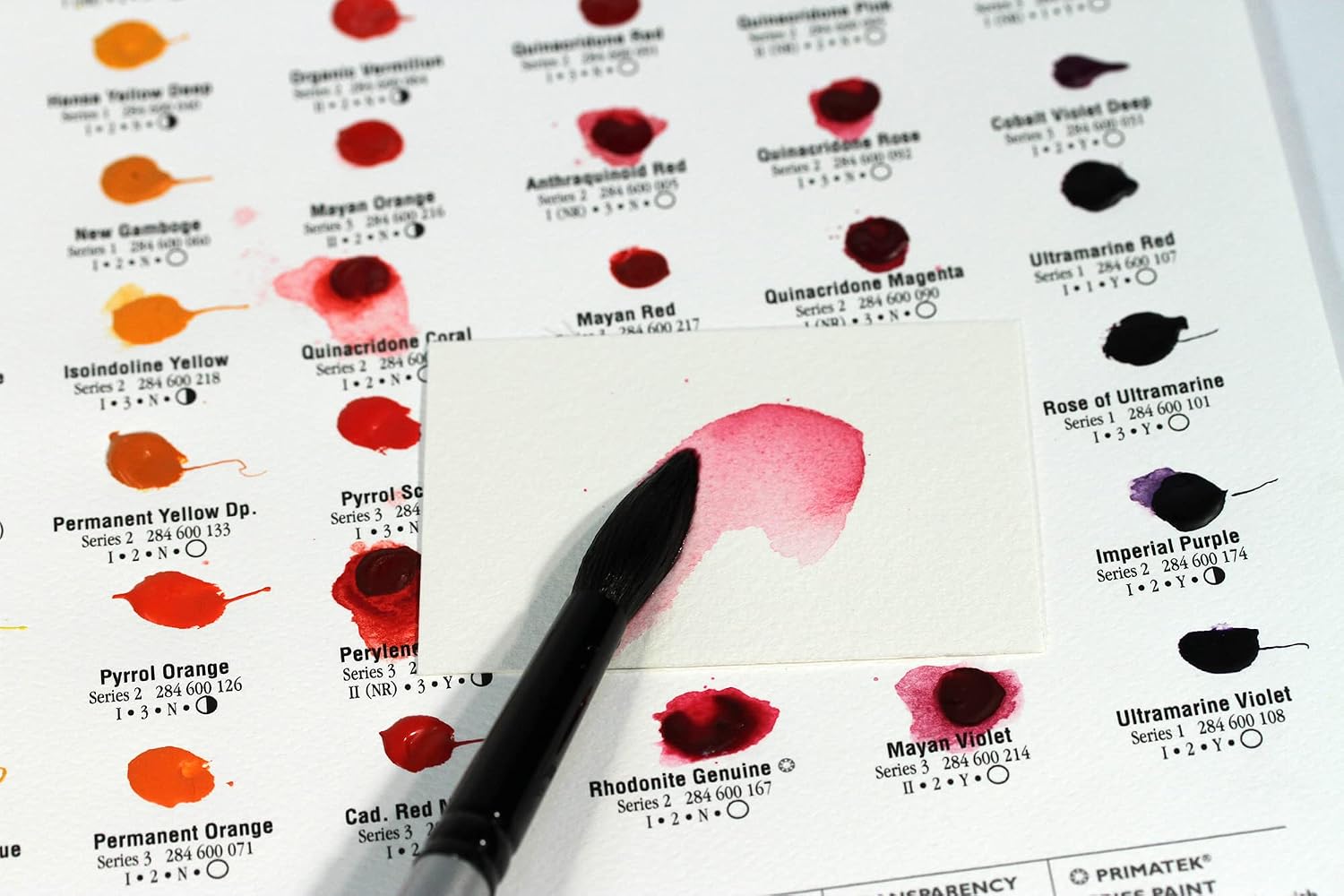
If you’ve ever stood in front of a wall of professional watercolor tubes — each one costing $15 to $40 — and wondered whether the quality jump over your student-grade paints is actually worth it, you’re not alone. Daniel Smith is one of the most respected names in professional watercolor (meaning artist-grade paint made with finely milled, highly concentrated pigment rather than the cheaper fillers used in student sets). Their tubes are priced accordingly. The smart move before committing to a full palette? The Daniel Smith Dot Card — a printed card with 66 small dried paint samples that you wet and paint with, available for a few dollars, letting you audition nearly the entire color line before spending a cent on full tubes. This guide explains exactly what the dot card can and can’t do, how it compares to the brand’s introductory sets, and which path makes sense depending on where you are in your practice.
What the Dot Card Actually Is — and Why It Works as a Decision Tool
A dot card is not a swatch chart. That distinction matters. A printed swatch is just ink on paper showing you what a color might look like. A dot card gives you actual paint — real pigment in its dried, concentrated form — that you activate with a wet brush and move across watercolor paper exactly as you would from a tube or pan.
The Daniel Smith 66-Color Dot Card covers essentially the full core line: earth tones, single-pigment primaries, granulating minerals, and the brand’s proprietary specialty colors. Reviewers at Artists Network consistently note that the dots are generous enough to produce usable washes and layered glazes, not just one-pass smears. One common pattern in owner feedback: artists who bought the card specifically to evaluate whether Daniel Smith was worth the price premium for detailed naturalist or botanical work came away with a clear answer, because they could actually test lightfastness behavior, granulation texture, and transparency on their preferred paper — not guess at it from a jpeg.
Per Jackson’s Art Blog’s guide to Daniel Smith watercolors, the brand uses single-pigment formulations wherever possible, which matters enormously for mixing predictability. A color built from a single pigment (identified by codes like PB29 for ultramarine blue or PR254 for a clean red) mixes cleanly with other single-pigment colors. Multi-pigment mixes, by contrast, can go muddy unpredictably. The dot card lets you verify which colors in the line behave the way you need them to — on your paper, in your water, under your light.
By the numbers:
- 66 colors on the standard dot card
- Approximate cost: $5–$7 (varies by retailer)
- Average Daniel Smith tube (5ml): $18–$38 depending on pigment grade
- Potential outlay if you bought all 66 tubes: $1,200–$2,500+
The math makes the case before you even open the card.
The Split Primary Question: 3-Tube Set vs. 6-Tube Essentials Set
Daniel Smith sells several introductory tube sets aimed at newcomers to the brand. The two that come up most in buyer discussions are the 3-Tube Primary Set and the 6-Tube Essentials Set, and reviewers have a clear preference worth understanding.
The 3-Tube Primary Set gives you one red, one yellow, one blue — a “primary triad” approach to color theory (the idea that all other colors can be mixed from three primaries). In practice, this is an oversimplification. No single red, yellow, and blue can produce a full-range gamut. You’ll hit limits fast: certain oranges go dull, certain violets go gray.
The 6-Tube Essentials Set is built around what colorists call a “split primary palette” — two versions of each primary, one warm and one cool. You get a warm red and a cool red, a warm yellow and a cool yellow, a warm blue and a cool blue. The logic: mixing a warm red with a warm yellow produces a vivid orange; mixing a cool red with a cool blue produces a vivid violet. Reviewers who have written up both sets consistently recommend the 6-tube split primary configuration for anyone serious about mixing range. Fine Art Tips’ palette-building guide makes the same structural point: a split primary of six colors will outperform a three-color triad on nearly every mixing task a working artist encounters.
If you are deciding between the two right now: the 6-tube set is the correct choice unless you have a specific pedagogical reason to constrain yourself to three. The cost difference is real but modest relative to the mixing versatility you gain.
The Specialty Colors: Moonglow, Lunar Blue, and What “Granulating” Actually Means
Part of the excitement that surrounds Daniel Smith — the thing that makes dot card owners want to immediately order full tubes — centers on a category the brand calls PrimaTek and specialty colors. These aren’t conventional pigments. They behave differently on paper, and the dot card is the honest way to find out whether that different behavior is useful for your work or just interesting to look at.
Moonglow (a pre-mixed color, not single-pigment) is a dark, shifting violet-blue-gray that separates on wet paper into its component hues: warm brown, violet, and blue-black drift apart as the wash dries, creating a layered, atmospheric effect. Reviewers working in landscape and night-sky subjects name it frequently as a color that earns its non-single-pigment status because the granulation and bloom effect is the whole point.
Lunar Blue is the one that tends to genuinely surprise new owners. It contains actual iron-based magnetic particles — a real, documentable ingredient difference, not marketing language. The particles settle into the tooth of watercolor paper in ways that create a mottled, almost crater-like granulation that no conventional pigment replicates. Per handprint.com’s extensive pigment reference pages, granulating colors (those that separate into visible particle textures as they dry) are among the hardest to evaluate from swatches or color charts, because the effect is highly dependent on paper texture, water quantity, and drying time. The dot card, used on your actual paper, answers the question the chart cannot.
The honest tradeoff: specialty colors like these are not mixing workhorses. They’re effects colors — valuable for specific moments in a painting, not the backbone of a palette. Knowing that before you order is why the dot card exists.
Building Incrementally: The Single-Tube Pattern
A specific pattern emerges in reviews of individual Daniel Smith colors — colors like Rich Green Gold and Permanent Yellow Deep — that is worth naming directly because it maps a realistic upgrade path.
Artists who buy one tube after a positive dot card experience tend to become committed incrementalists. They don’t buy a 24-tube master set. They add one or two specific colors that solved a problem their current palette couldn’t: a cleaner mixing yellow, a granulating neutral that replaced a pre-mixed convenience color, a genuine earth red with better lightfastness than their previous option.
This is actually the correct purchasing logic for a maturing practice, not just a budget constraint. Jackson’s Art Blog notes that a small palette of well-understood, high-quality single-pigment colors outperforms a large palette of unfamiliar or poorly characterized colors in almost every real working situation. The dot card accelerates that audit — you learn what you need before you spend.
One longevity data point worth including: a reviewer who purchased a Daniel Smith Master Artist set reported that tubes bought in 1998 were still fresh decades later. That tracks with the general understanding of professional-grade watercolor tubes: proper sealing and storage (away from heat and light) can preserve even opened tubes for years. The implication for cost-per-use math is significant. A $30 tube used thoughtfully over three or four years costs less per session than almost any alternative.
Frequently Asked Questions
Is the Daniel Smith dot card worth buying if I already have a starter watercolor set?
Yes, and particularly so. If you own a student-grade set (Cotman, Van Gogh, or similar), the dot card functions as a direct comparison test. You can mix the same color on the same paper side by side and see whether the pigment load, transparency, and granulation behavior justify the price difference for your subject matter. Many buyers report the dot card is what finally makes the student-to-professional transition feel concrete rather than theoretical.
What is the split primary palette and why do reviewers recommend it for beginners?
A split primary palette means six colors rather than three: two reds (one warm, one cool), two yellows (one warm, one cool), two blues (one warm, one cool). The logic is that warm-to-warm mixes produce vivid secondary colors, while warm-to-cool mixes produce muted, natural-looking ones. With six colors you have both options available. With three, you’re locked into one color temperature per primary and your mixing range is substantially limited. Reviewers consistently recommend the Daniel Smith 6-Tube Essentials Set over the 3-Tube Primary Set for exactly this reason.
How much paint is actually in each dot on the 66-color card — can you really paint with it?
Owners consistently report that the dots are larger than they look in product photos and that they yield multiple usable washes, not just a single smear. You can glaze, you can pull diluted washes, and you can layer. The dots won’t produce a finished 9×12 painting each, but they’re genuine swatching-and-testing samples rather than token chips. For evaluation purposes — which is the card’s job — they’re more than sufficient.
What makes Daniel Smith’s specialty colors like Moonglow and Lunar Blue different from standard pigments?
Standard pigments are synthetic or mineral colorants that disperse evenly. Daniel Smith’s PrimaTek line uses genuine mineral pigments (ground gemstone and earth materials), and colors like Lunar Blue incorporate iron-based magnetic particles that physically settle into paper texture as the wash dries, creating granulation that no synthetic pigment reproduces. Moonglow is a formulated color that separates into its component pigments on wet paper, creating built-in atmospheric effects. Both behave differently depending on your paper and water quantity — which is precisely why testing them on the dot card before ordering full tubes is worth the few dollars.
Should I start with the 3-tube or 6-tube introductory set?
The 6-tube Essentials Set. Reviewers and colorists who address this directly recommend it over the 3-tube Primary Set because the split primary structure gives you a full-range mixing palette rather than a pedagogically simplified one. The additional cost is modest; the additional capability is significant.
How long do Daniel Smith tubes stay fresh once opened?
Based on owner reports, including one collector who found tubes from 1998 still workable, properly sealed Daniel Smith tubes have an exceptional shelf life. Professional-grade watercolor doesn’t “go bad” the way oil paint can if you keep the cap clean and sealed. Partial tube storage in a cool, dark location is the standard practice. The cost-per-use math for a $30 tube used over several years is considerably better than it looks on the shelf tag.
The Decision Rule
Here’s the clean framework:
- If you’re undecided on Daniel Smith entirely: start with the 66-color Dot Card. It costs less than one tube and answers the fundamental question.
- If the dot card confirmed the quality but you don’t know which colors to buy: the 6-Tube Essentials Set gives you a working split primary palette that will mix 90% of what you need.
- If you already have a functional palette and want to expand: use the dot card to identify two or three specialty or single-pigment additions — Rich Green Gold, Lunar Blue, a PrimaTek earth — and add incrementally.
- If you found a specific color on the dot card that solved a problem: buy that tube first. One excellent color you understand beats six colors you don’t.
The dot card isn’t a novelty item. It’s the most efficient $6 research tool in the watercolor supply market. Use it like the decision instrument it is.