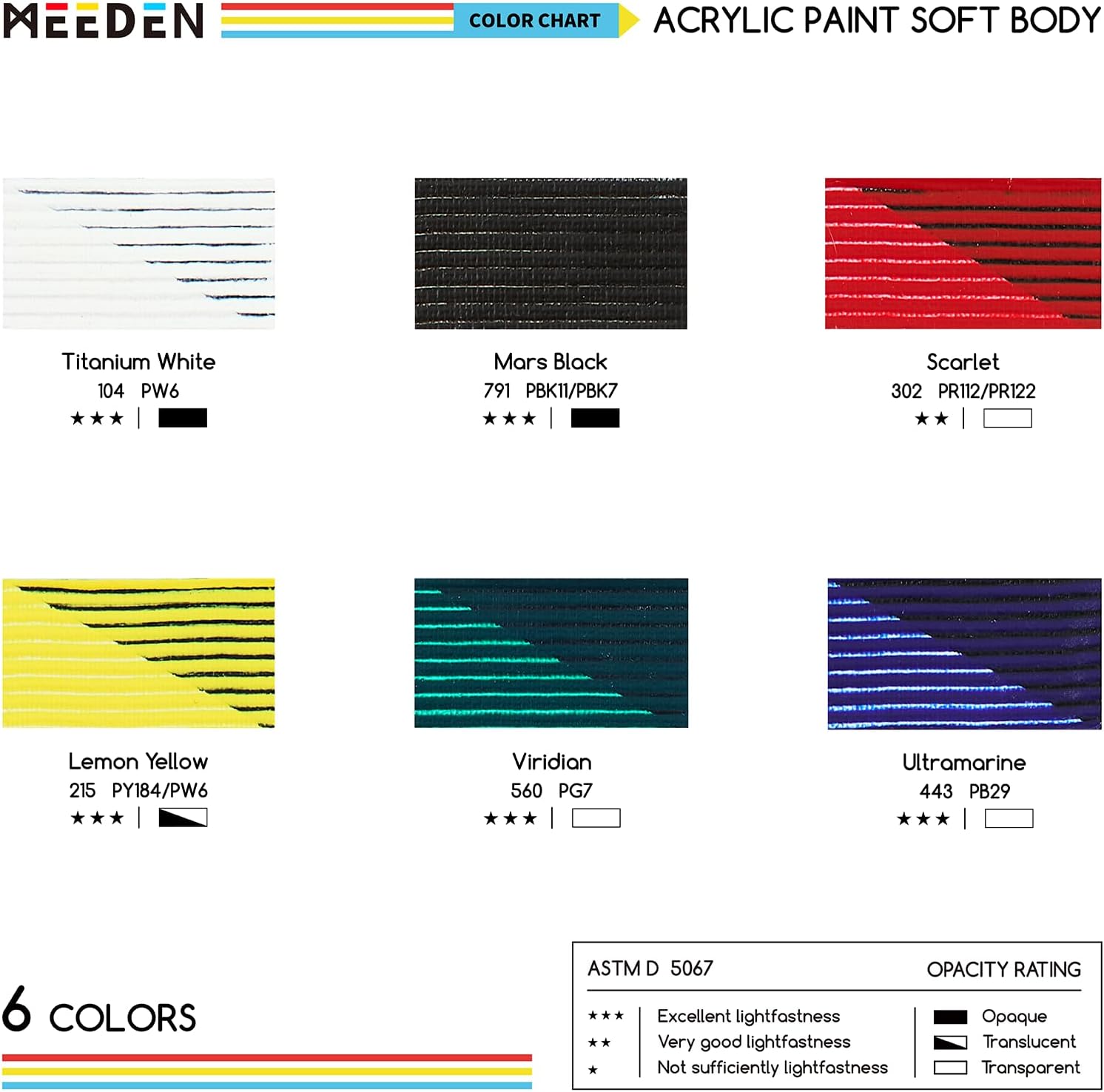
Acrylic paint comes in two basic physical forms that matter for studio buying decisions. Heavy body acrylic has a thick, buttery consistency — it holds brushstrokes and palette-knife peaks. Soft body acrylic flows more freely, closer to the texture of yogurt, and is designed for smooth blending, glazing, and coverage without adding water. Both carry pigment suspended in acrylic polymer; the difference is how much thickener and polymer binder the manufacturer uses. When you’re painting occasionally, you buy tubes in whatever body you need. But once your studio practice accelerates — teaching classes, doing commission work, running events, or simply finishing a canvas a week — the per-tube buying logic starts to break down. This guide is for painters who’ve already picked a palette they trust and are now asking a more operational question: should I be buying paint by the liter instead of by the tube?
The Real Question Isn’t Budget vs. Premium — It’s Format vs. Practice Type
The framing of “cheap bulk paint” versus “quality tubes” is a false binary that trips up a lot of intermediate painters. The more useful question is whether your practice type is matched to your buying format. A painter finishing one detailed oil-study-style canvas per month has genuinely different supply needs than someone running a community mural project, teaching 20 students, or moving through a full tube of Titanium White every two sessions.
Jacksons Art’s acrylic consistency guide makes a point that’s easy to overlook: soft body acrylic isn’t a lesser version of heavy body — it’s engineered for different applications. Soft body layers quickly, covers evenly on large fields, and requires less water dilution to achieve smooth transitions. For painters who work large, paint loose, or need to mix big batches of a consistent tone, soft body in bulk containers is often the correct tool choice, not a budget compromise.
The reviewer behavior around bulk acrylic sets reflects this exactly. Owners of large-format MEEDEN soft body sets describe the purchase in logistical terms — “a strategic investment” rather than a deal — and experienced painters explicitly note that buying small 60ml tubes of Titanium White and Mars Black when you use them at volume is simply an inefficient habit to break. That’s not a budget conversation. That’s a studio management conversation.
By the Numbers: Format Math for High-Use Colors
| Format | Typical Volume | Cost Range (2026) | Cost per ml |
|---|---|---|---|
| Student-grade tube (e.g., Liquitex Basics) | 118ml | $5–$8 | $0.04–$0.07 |
| Professional tube (e.g., Liquitex Professional) | 59ml | $10–$18 | $0.17–$0.31 |
| Bulk soft body set (e.g., MEEDEN 24-color) | 120ml × 24 | $40–$65 | $0.014–$0.023 |
| Single 2-liter container (Titanium White) | 2,000ml | $30–$50 | $0.015–$0.025 |
Artwork Archive’s material costing guidance points out that artists frequently underestimate consumable costs when pricing work — and Titanium White is the most underestimated line item in almost every acrylic painter’s budget. The math above isn’t a reason to abandon professional-grade paint across your entire palette. It is a strong reason to stop buying professional-tube white in 59ml quantities if you paint regularly.
MEEDEN Soft Body and Heavy Body: Who They’re Actually For
MEEDEN soft body bulk sets occupy an interesting category. Reviewers don’t describe them the way beginners describe student-grade paints — with enthusiasm about color variety and surprise at coverage. They describe them the way working painters describe inventory. The language is about restocking cycles, classroom management, and not running dry mid-session. That’s a meaningful signal about the actual buyer.
The honest read on MEEDEN soft body quality: pigment load is consistent with student-to-mid-grade acrylics, not with Daniel Smith or Schmincke professional lines. You’re not getting single-pigment formulations (Handprint.com’s pigment reference is useful for cross-checking actual pigment codes on any paint you’re evaluating). But for high-coverage base layers, underpainting, color-blocking large canvases, and any application where you’re going over the top with more deliberate paint later, the quality is fully appropriate — and the format is genuinely better suited than stacking tubes.
The MEEDEN heavy body 24-set draws a different audience: art educators. One teacher-reviewer’s description of it as a classroom workhorse, including an honest note that some yellows run slightly transparent, is exactly the kind of field-level feedback that’s useful. Transparent yellows are normal even in professional grades (cadmium yellows are an exception; student-grade yellows often use organic pigments that lean transparent), so the flag raises trust rather than alarm. For classroom use, this set delivers consistent coverage and a range wide enough to teach color theory without rationing paint.
Shuttle Art: Volume Paint for Group and Event Contexts
Shuttle Art acrylic earns its reviews from a different use case: group activity painting — the kind of event where a soccer team is doing art night and you need a dozen palettes of workable color, fast coverage, and no anxiety about someone wasting an expensive pigment. Reviewers consistently mention shimmer and metallic variants as crowd-pleasers in these contexts.
For solo studio work on fine-art canvas that you’re selling or showing, Shuttle Art is best understood as an event and activity paint — excellent for its intended format, but not a substitute for pigment-dense professional lines when the work needs to hold up over decades. Lightfastness ratings (how resistant a pigment is to fading under light exposure) are rarely published for this tier of paint, which is the meaningful quality flag for anyone producing work for sale. Artwork Archive’s guidance on material documentation for selling artists reinforces why lightfastness data matters: if you’re pricing your work, you’re implicitly making archival claims.
Winsor & Newton Galeria as a Quality Anchor
Among the mid-tier acrylics, Winsor & Newton Galeria functions as the benchmark that helps you calibrate everything else. Reviewers consistently flag opacity and clean blending — “no visible brushstrokes when layered correctly” appears in multiple long-form reviews — and Galeria publishes lightfastness ratings for its line, which matters for artists selling work. Artists Network’s acrylic painting guides treat Galeria as a reliable student-to-intermediate crossover: it paints like a professional-grade product, costs like a mid-tier product, and the consistency across their color range is tighter than most bulk-format alternatives.
When you’re using Galeria as your primary palette and adding bulk soft body for large-coverage needs, you’re not downgrading your practice — you’re right-sizing your format to your task. Base layers in MEEDEN soft body, detailed passages in Galeria, final glazes in Liquitex Professional or Daniel Smith: that’s a legitimate tiered approach that working painters use without apology.
Can You Mix Bulk Acrylics with Professional Brands on the Same Palette?
Yes, with caveats. All acrylic paints share the same basic chemistry — acrylic polymer binder — so they’re intermixable. The practical concern is viscosity matching. Mixing soft body bulk paint with a heavy body professional paint directly will thin the heavy body paint’s texture. If you’re relying on impasto effects or palette-knife peaks, adding soft body paint to the mix will flatten them. Stir both colors to the same working consistency before blending, or use an acrylic gel medium (a thickener that doesn’t affect color) to bring soft body up toward heavy body consistency when needed.
Pigment load differences between budget and professional acrylics mean you may need more volume of the bulk paint to hold its own in a mix — especially with saturated hues. This isn’t a dealbreaker; it’s just calibration. Most painters who use MEEDEN heavy body alongside Liquitex or Galeria on the same palette adapt quickly after a few sessions.
Frequently Asked Questions
Is MEEDEN soft body acrylic paint professional quality or only suitable for students and workshops? MEEDEN soft body sits in the student-to-mid-grade tier — above basic craft paint, below professional single-pigment lines like Daniel Smith or Schmincke. It’s appropriate for high-volume studio tasks (underpainting, blocking, large-surface coverage), teaching, and event work. It’s not the right choice for final-surface work on pieces you’re selling or exhibiting, where pigment load, lightfastness documentation, and pigment purity matter.
How does bulk soft body acrylic compare to heavy body tubes for color mixing accuracy? Soft body’s lower viscosity can make saturation harder to read in the wet state — colors look slightly different before and after drying. Heavy body’s stiffer consistency gives you more tactile feedback during mixing. For precise color matching, heavy body is easier to work with. For large-batch mixing of a consistent tone (background fields, even washes), soft body is actually more forgiving and easier to remix if you run out.
When does it make financial sense to buy a 2-liter bulk acrylic container instead of tubes? If you use more than one 118ml tube of a single color per month, a bulk container of that color pays for itself within two to three restocking cycles. Titanium White and Mars Black are the near-universal candidates. High-chroma colors you use selectively (cadmium red equivalents, phthalo blue) rarely justify bulk format unless you’re teaching or running a high-output commercial studio.
Can I mix MEEDEN heavy body with Liquitex or Winsor & Newton Galeria on the same palette? Yes. The acrylic binder is compatible across brands. Match viscosity before mixing colors — use an acrylic medium to thicken soft body if you’re blending with a heavy body paint and need the texture to hold. Expect to use more MEEDEN paint by volume in saturated mixes to compensate for lower pigment density.
Is Shuttle Art acrylic suitable for canvas work or mainly for crafts and events? Shuttle Art covers canvas fine — coverage is workable and the range is broad. For fine-art canvas work you’re selling or showing long-term, the lack of published lightfastness data is a real limitation. For display painting, event work, practice canvases, or any application where longevity isn’t the priority, it performs well at its price point.
What is the difference between soft body and heavy body acrylic, and does it affect pigment load? Consistency (thickness) and pigment load are related but not the same thing. Soft body is thinner because it contains more water and less thickener — not necessarily less pigment. However, budget soft body paints do typically carry lower pigment load than professional heavy body paints. Jacksons Art’s consistency guide notes that professional soft body lines (like Liquitex Professional Soft Body) can carry pigment loads equivalent to their heavy body counterparts — the difference in feel is formulation, not quality shortcut. In budget bulk lines, lower pigment load is more common and worth expecting.
The Decision Rule
If you paint more than twice a week, run any kind of group or classroom setting, or consistently run out of Titanium White and black before any other color: buy those two colors in bulk containers now, and evaluate whether your three or four most-used mixing colors warrant the same treatment. Keep your professional-grade tubes for the colors where pigment quality is visually non-negotiable.
If your practice is detail-focused, you produce work for sale, and volume isn’t the pressure: stay in professional tubes. The format math doesn’t favor bulk until you’re consuming paint at speed.
The MEEDEN soft body sets make the most sense as a studio infrastructure purchase — the paint that’s always there in quantity — while your Liquitex Professional, Galeria, or Daniel Smith tubes serve as the precision layer on top. That’s not a compromise. That’s how studios that paint seriously actually stock themselves.