If you’ve ever typed “acrylic paint set under $30” into a search bar, you already know the rabbit hole: dozens of brands with similar names, similar tube counts, and almost identical product photography. Three names keep surfacing at the top of that pile — Shuttle Art, Artecho, and Meeden Heavy Body. All three sell large-count sets at budget prices, all three market themselves as “heavy body” (meaning the paint is thick and holds brushstroke texture rather than flowing like a liquid), and all three have amassed enough reviews to generate a real signal through the noise. This article is a research-backed comparison of those three sets, drawn from aggregated owner reviews, published manufacturer specs, and editorial analysis from sources including Jackson’s Art Supplies and Artists Network — designed to help you decide which one belongs on your palette without wasting a tube finding out the hard way.
What “Heavy Body” Actually Means at This Price Point
Before the comparison, a quick calibration. “Heavy body” is a consistency descriptor — it means the paint is thick enough to hold peaks and ridges when applied with a palette knife or a stiff brush, the way butter holds a knife track. At the professional tier (think Golden Heavy Body or Liquitex Professional), heavy-body acrylic also implies a high pigment load: lots of actual color pigment suspended in the acrylic binder, which translates to saturation, opacity, and lightfastness — resistance to fading over time.
At the budget tier, “heavy body” primarily describes consistency, not necessarily pigment load. Jackson’s Art Supplies, in their editorial overview titled Understanding Acrylic Paint Grades and Pigment Load, makes this distinction clearly: student and value-grade paints often achieve thickness through fillers and thickeners rather than pigment concentration alone. That’s not a dealbreaker — it’s the trade-off you accept when you spend $25 on a 52-tube set. The useful question isn’t “Is this as good as Golden?” It isn’t. The useful question is: which of these three delivers the most workable, honest performance for the price?
The Three Contenders at a Glance
| Brand | Marketed consistency | Standout claim | Common ceiling comparison in reviews |
|---|---|---|---|
| Shuttle Art | Heavy body, thick out of tube | Metallic color options; bright, crowd-pleasing palette | Galeria / Liquitex BASICS |
| Artecho | Creamy, smooth, buttery | No cracking on canvas; blends easily | Liquitex BASICS |
| Meeden Heavy Body | Heavy body, high viscosity | Thick impasto-style texture | Galeria / craft acrylics |
A few things to flag immediately: none of these sets publish individual pigment codes — notations like PB29 for ultramarine blue or PR254 for a warm red — in their primary marketing materials. As Artists Network explains in their guide How to Read Acrylic Paint Labels: Pigment Codes and Lightfastness Ratings, professional-grade manufacturers list pigments by color index name precisely because serious buyers demand that transparency. The absence of those codes across all three brands signals that these sets are formulated for accessibility and value, not pigment purity. That’s fine — it just means you should weight owner experience more heavily than spec sheets when making your call.
Head-to-Head: Paint by Paint
Shuttle Art: The Event-Friendly All-Rounder
Across aggregated owner reviews, Shuttle Art earns the most consistent praise for two things: out-of-the-tube workability and color vibrancy. Owners repeatedly report that the paint is genuinely thick without needing to squeeze hard, and that a single drop of water adjusts the consistency cleanly — useful when you’re working fast or sharing tubes across a group.
The metallic colorways are a recurring highlight. Reviewers describe using Shuttle Art for teen painting nights and group creative events, calling the metallic shift effect a crowd-pleaser — which tells you something useful about where this paint performs best: social, event-based, and introductory contexts where visual impact matters more than archival permanence. The metallics are semi-opaque to sheer rather than fully opaque like a professional metallic medium, but they read as fun and special to a general audience in a way that flat student colors don’t.
Where Shuttle Art starts to show its limits is in layering for serious studio work. Owners who push it further note that lighter colors over dark require more coats than expected — a classic symptom of moderate pigment load rather than professional-grade concentration. Fine Art Tips, in their piece Student vs. Artist Grade Acrylic Paints: What’s the Difference?, frames this trade-off precisely: student-grade paints achieve coverage, but may require additional passes to match the opacity of artist-grade formulations.
Best for: Educators running group sessions, hobbyists who want a wide color range with metallic options, and anyone building familiarity with acrylic behavior before investing in single-tube professional colors.
Artecho
$28.99
In stock on Amazon
Check price on AmazonArtecho: The Canvas-Friendly Blender
Artecho’s review pattern centers on a specific texture descriptor that keeps reappearing: creamy. Owners use words like “buttery,” “smooth,” and “rich” — language that suggests the paint flows into blends without the choppiness that cheaper student acrylics can produce. Several reviewers specifically call out canvas performance, noting that Artecho sits into the tooth of a canvas surface naturally and dries without cracking or visible shrinkage.
The no-cracking claim is worth taking seriously. Cracking in acrylic paint typically happens when the paint film is applied too thickly without adequate flexible binder, or when incompatible layers dry at different rates. Jackson’s Art Supplies, in Understanding Acrylic Paint Grades and Pigment Load, notes that binder quality and ratio are the primary variables affecting film integrity — and Artecho’s owner consensus suggests the binder is doing its job at standard canvas application thicknesses.
On pigment richness relative to Liquitex BASICS — the implicit ceiling that several Artecho reviewers reference — the honest assessment is that Artecho runs slightly behind BASICS in saturation and single-layer coverage. Liquitex BASICS, while also a student-grade paint, publishes lightfastness ratings and uses a more controlled pigment load than most Amazon-native sets. That said, Artecho holds up well in layered applications and blended work. Because its consistency is so smooth, the paint builds gracefully in multiple passes, and the gap between Artecho and BASICS narrows considerably in finished, layered pieces compared to direct single-smear comparisons.
Can Artecho be used on wood or fabric? Owners report good adhesion on primed wood and mixed-material surfaces. For fabric, acrylic paint generally requires a fabric medium additive (sold separately) to remain flexible through washing — this applies to all three brands equally.
Best for: Painters focused on canvas work who want smooth, blendable color without managing a stiff or inflexible body. Also a strong choice for anyone who has encountered cracking problems with cheaper acrylics and wants a more forgiving formulation.

Shuttle
$34.99
In stock on Amazon
Check price on AmazonMeeden Heavy Body: Thick, Textured, and Yellow-Heavy
Meeden leans hardest into the “heavy body” identity of the three. Owners consistently praise the thickness — palette knife work, impasto texture, and building physical dimension into a surface are where reviewers say Meeden excels. A teacher reviewer specifically called out the value proposition for classroom instruction, noting that the thick consistency means students use less paint per stroke and tubes last longer in a shared setting. That’s a real benefit in an instructional context where per-student material costs matter.
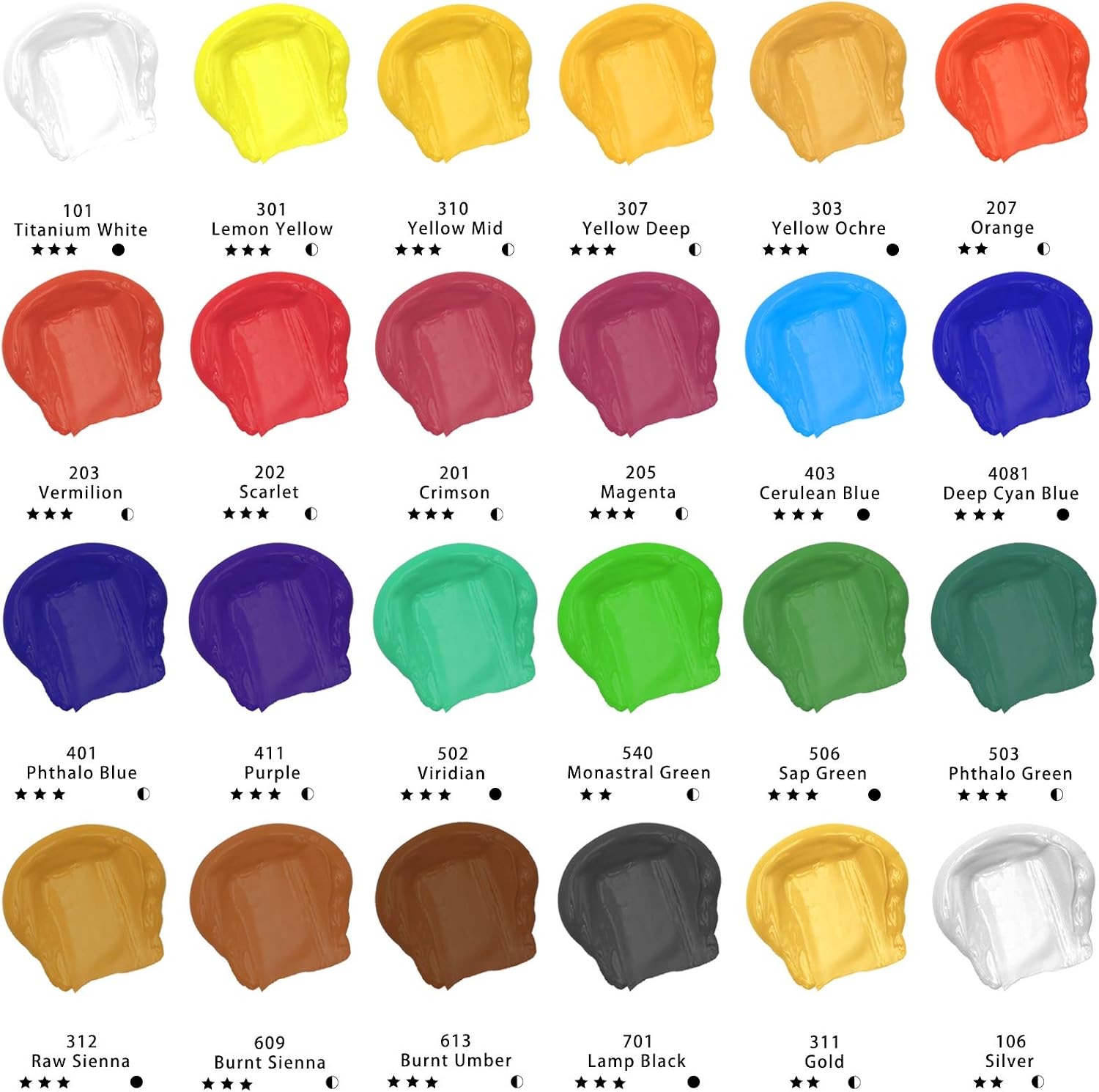
The recurring criticism, however, is specific and appears consistently enough to be a real formulation quirk: too many yellows. Owners have noted that the color assortment across Meeden’s sets skews heavily toward yellow variations. For painters who work across a full warm-cool spectrum, this means you may find yourself with four yellows and no usable violet — a frustrating ratio when you’re trying to mix a complete palette. It’s worth supplementing with individual tubes in the hue families Meeden underweights.
On cracking: owners do not raise cracking as a significant issue at standard application thicknesses. Handprint, in their reference document Acrylics: Manufacturers, Grades, and Pigment Information, notes that extremely thick single-application impasto carries inherent curing risk with any acrylic — surface film can set faster than the body below, creating stress. At moderate build-up (roughly 3–4mm per pass), Meeden reviewers don’t surface this as a problem. The safe practice for thick impasto in any brand is to let each layer cure fully before adding the next.
Best for: Educators and group instruction settings where consistency and durability matter more than palette completeness; painters exploring impasto and texture work who can supplement with individual tubes for missing hues.
Artecho
$28.99
In stock on Amazon
Check price on AmazonBy the Numbers
| Feature | Shuttle Art | Artecho | Meeden Heavy Body |
|---|---|---|---|
| Typical set size | 52–60 colors | 48–60 colors | 48–52 colors |
| Pigment codes published? | No | No | No |
| Lightfastness rating published? | No | No | No |
| Owner-reported cracking? | Rare | Rare / none | Rare at moderate thickness |
| Metallic options? | Yes | Limited | No |
| Strongest use case | Events, groups, beginners | Canvas painting, blending | Texture / impasto, classroom |
Frequently Asked Questions
Is Shuttle Art acrylic paint waterproof when dry? Yes — like all acrylic paints, Shuttle Art forms a water-resistant film once fully cured. “Dry to the touch” and “fully cured” are different states: surface dry can happen in 20–30 minutes, but full cure — where the paint is genuinely water-resistant — takes 24–72 hours depending on application thickness and ambient humidity. Until fully cured, dried acrylic can be reactivated with water.
Do Meeden heavy body paints crack or shrink on canvas? Based on owner reports, cracking is not a common issue at standard application thicknesses. Very thick single-layer impasto applications carry more risk with any budget acrylic. If you’re building texture beyond about 3–4mm in a single pass, let each layer cure fully before adding the next — a practice that Handprint’s Acrylics: Manufacturers, Grades, and Pigment Information endorses for all acrylic impasto work regardless of brand.
Can Artecho acrylics be used on fabric or wood, not just canvas? Owners report good results on primed wood. For fabric, any acrylic paint — including Artecho — needs a fabric medium mixed in to stay flexible through washing and wear. Without it, dried acrylic on fabric can crack or flake when the material bends.
Are the metallic colors in Shuttle Art sets opaque or sheer? The metallics are semi-opaque to sheer — they produce a visible metallic effect but don’t fully block underlying colors in a single pass the way a professional metallic medium would. They read as vivid and eye-catching in direct light, especially applied over a white or light-toned ground.
Is Meeden paint suitable for a classroom or group instruction setting? Based on teacher reviewer feedback, yes — the thick consistency means less paint is consumed per stroke, which helps with shared-use budgeting. The color assortment skew toward yellows is worth knowing ahead of time so you can pre-supplement with individual tubes in missing hue families before distributing sets to students.
How does Artecho compare to Liquitex BASICS in pigment richness? Artecho runs slightly behind Liquitex BASICS in single-layer coverage and saturation. BASICS publishes lightfastness ratings and operates with a more controlled pigment-to-binder ratio than most sets in this category, as described in the Artists Network guide How to Read Acrylic Paint Labels: Pigment Codes and Lightfastness Ratings. In layered or blended work, the gap narrows considerably — Artecho’s smooth consistency helps it build up gracefully — but for straight opacity in a single pass, BASICS has a measurable edge.
The Decision Rule
Here’s an honest “if X, then Y” frame for making the call:
-
If you’re running a group session, event, or classroom and want visual impact fast → Shuttle Art. The metallics earn their keep in that context, and the thick out-of-the-tube consistency works well for hands-on, fast-paced use.
-
If you’re painting on canvas and want smooth, cracking-resistant results that blend without fighting you → Artecho. It’s the most studio-natural of the three for traditional canvas work, and the forgiving binder rewards a layered approach.
-
If texture, impasto, and classroom value-per-tube are your priorities — and you can live with supplementing the yellow-heavy palette → Meeden Heavy Body. The thickness is real, the durability at standard depth is solid, and the per-stroke economy makes sense in shared settings.
None of these sets replace a restocked shelf of Daniel Smith or Liquitex Professional tubes for serious studio practice — and they’re not trying to. But as a starting point for building color confidence, teaching foundations, or stocking a shared workspace, all three earn their place. The upgrade path is clear: once you know which colors you reach for constantly, replace those positions first with single-tube professional paint. That’s how a deliberate practice grows — one informed trade-up at a time.