Acrylic paint — a water-based paint that dries to a flexible, plastic-like film — is one of the most versatile mediums in any studio. But “versatile” becomes a trap when you’re standing at a product listing trying to decide whether a given set will actually hold up on a game card, a river stone, a piece of denim, or a two-inch illustration. The properties that make one acrylic set ideal for blending on canvas can work against you when you need fast coverage on a slick card surface, or when you need paint that stays pliable through dozens of fabric washes. This article is organized around that practical question: which acrylic set is actually right for what you’re making? We’ll walk through five real use-case scenarios, name the tradeoffs explicitly, and close with clear decision rules so you can stop second-guessing and start painting.
How to Read This Guide
Each section below covers a specific application — card altering, craft and shimmer work, fabric painting, classroom use, and blended illustration. Every section includes what makes the right paint right, what the honest tradeoffs are, and a tier marker so you know where the recommendation sits on the budget-to-professional spectrum. The comparison table at the end puts all five scenarios side by side.
Matching Paint to Application: Five Scenarios
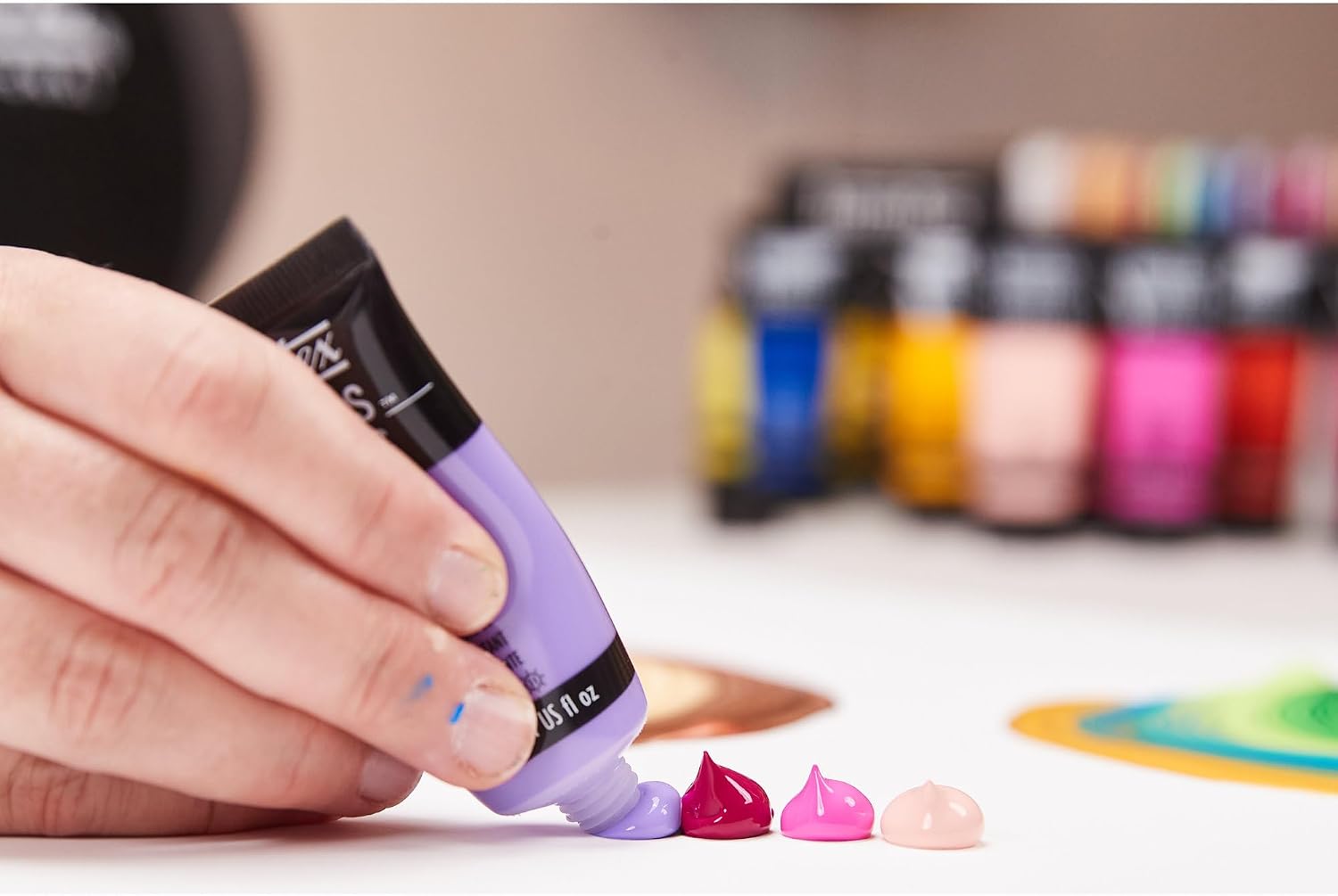
Card Altering and Small-Scale Detail Work: Liquitex BASICS
Card altering — the practice of extending or repainting collectible game cards — is one of the more demanding small-scale acrylic applications. You’re painting on a glossy, non-absorbent surface roughly the size of a playing card, often with fine detail that demands a paint that flows smoothly off a size 0 or 00 brush, covers in thin buildable layers, and doesn’t clump or drag.
Liquitex BASICS is the set that comes up repeatedly in this context. As noted in the Artists Network editorial “Choosing Acrylics for Mixed Media and Non-Traditional Surfaces” (artistsnetwork.com), soft-body acrylics — which have a lower viscosity than heavy body formulations — flow more predictably on slick, non-absorbent surfaces where over-thinning with water causes beading and uneven coverage. BASICS is a soft-body line, and that consistency is the core reason it performs well on card stock.
The cost-per-card math is also genuinely favorable. A 48-color set used in thin, economical layers can realistically cover several hundred card faces before any single color is exhausted — the low absorbency of card surfaces means paint goes further than it would on raw canvas or paper.
What makes BASICS work for card altering:
- Soft-body consistency flows without heavy water addition on slick surfaces
- Wide color range gives enough mixing flexibility for card-accurate hues
- Opacity in most colors builds adequately in two to three thin passes
The honest tradeoff: BASICS is a student-grade paint with multi-pigment formulations and lower pigment load than professional lines. For card altering where archival permanence isn’t the goal, this is irrelevant. For gallery illustration where lightfastness ratings matter, a professional line is the appropriate step up.
Artecho
$28.99
In stock on Amazon
Check price on AmazonShimmer and Novelty Effects: Shuttle Art Metallics
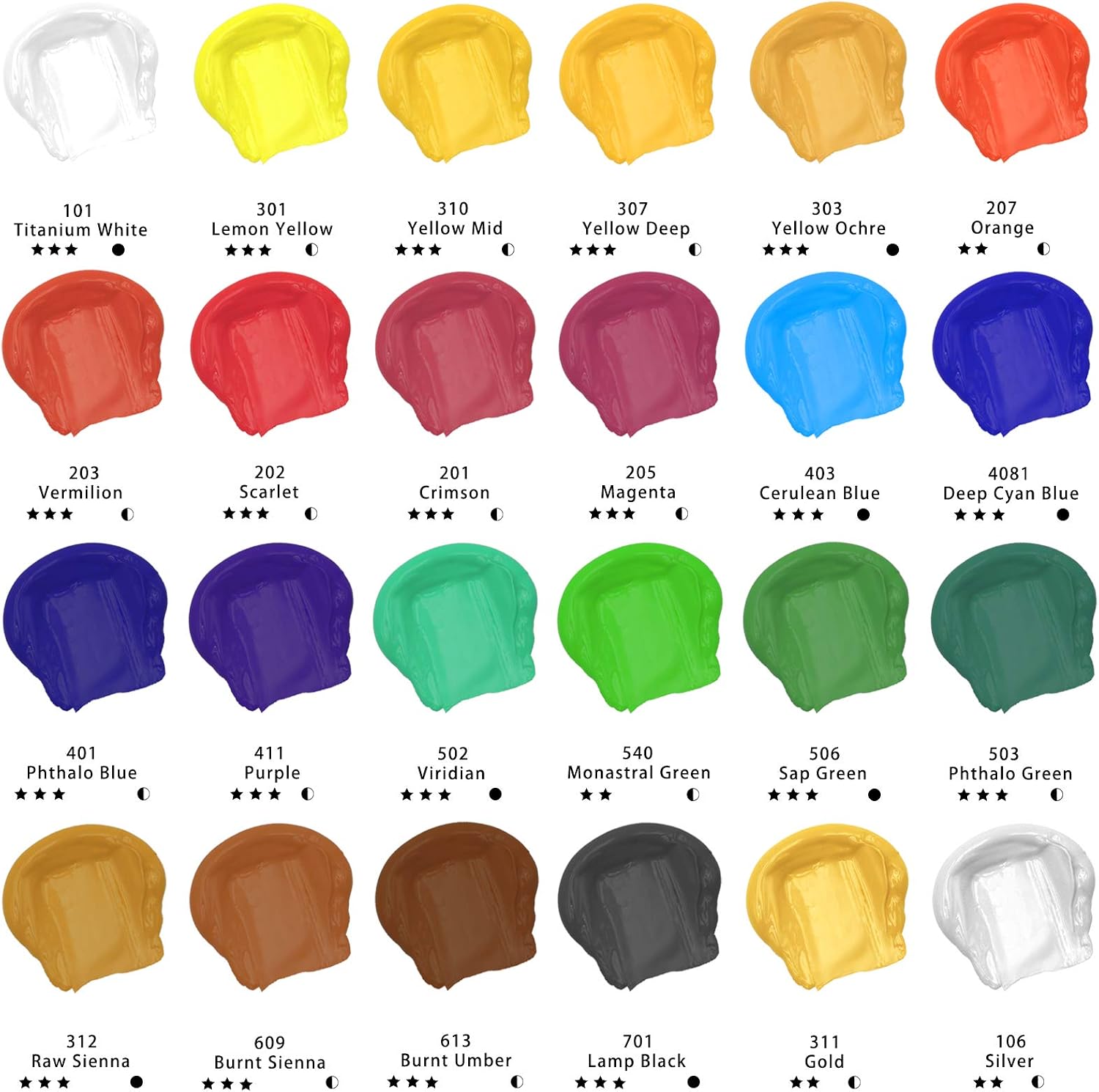
Shuttle Art sets have developed a following for craft and novelty applications — rock painting, holiday ornaments, mixed-media collage backgrounds — and the metallic colors in particular generate strong opinions from owners. The shimmer and color-shift in those metallics reads as a feature in decorative contexts.
The critical caveat: the metallic shades in Shuttle Art sets are noticeably more sheer than the standard colors in the same set. Standard Shuttle Art colors deliver reasonable opacity in two coats; the metallics often require three to four coats for solid coverage on a dark or absorbent surface. This is consistent with how metallic pigments behave across paint tiers — mica-based metallic particles reflect light rather than absorbing it, which inherently limits their hiding power. The Artists Network editorial “Choosing Acrylics for Mixed Media and Non-Traditional Surfaces” (artistsnetwork.com) notes that metallic and iridescent colors in any acrylic line tend to be more transparent than their standard counterparts.
Practical translation: If you’re using Shuttle Art metallics to accent rock painting or add shimmer to a collage surface, the sheerness can work in your favor — a translucent gold over a dried base color creates a more nuanced metallic effect than a fully opaque gold would. If you need a metallic that covers a dark surface in two passes, lay down a solid base in white or light gray first, then apply the metallic on top.
For craft and activity-based use, this is a workable limitation. For professional illustration or client-facing work, metallic mediums mixed into professional-grade heavy body paint give more consistent coverage and better archival performance.
Artecho
$28.99
In stock on Amazon
Check price on AmazonFabric Painting: Artecho and the No-Crack Question
Painting on fabric with acrylics requires one non-negotiable property: the dried paint film has to flex without cracking. A standard acrylic film is relatively brittle at scale — it performs well on a rigid support, but bend it repeatedly and it cracks. Fabric gets folded, washed, and stretched constantly.
The technical basis for this is straightforward. As detailed in the Handprint.com overview “Acrylic Paints: A Technical Overview” (handprint.com), flexibility in dried acrylic films is partly a function of the binder polymer and partly a function of application thickness — thinner layers flex more successfully than thick impasto applications. Artecho acrylic is called out by owners for no-crack performance on flexible surfaces, and that performance depends directly on how it’s applied.
What this means practically for fabric work:
- Apply in thin, even layers rather than loading the brush heavily
- Heat-set with an iron (covered with a pressing cloth) after the paint fully dries — as noted in the Fine Art Tips guide “How to Paint on Fabric with Acrylics” (finearttips.com), heat-setting converts the paint film to a more permanent, wash-resistant state
- Wash the finished piece inside-out in cold water for the first several washes to reduce mechanical stress on the painted surface
The honest tradeoff: Artecho is a budget-tier paint without published lightfastness ratings at the level of professional lines. For a custom tote bag or painted denim jacket for personal use, it’s a reasonable choice. For fabric work being sold — wearable art, custom textile pieces for clients — a fabric-specific acrylic medium such as Golden GAC 900 mixed into professional-grade paint provides documented flexibility and better color permanence.
Artecho
$28.99
In stock on Amazon
Check price on AmazonClassroom and Group Settings: Meeden Heavy Body
The use case that Meeden heavy body owners return to most often is art education — specifically, the cost-per-student-session math that any instructor running a class on a materials budget has to do. Two things stand out consistently in teacher reviews:
-
The included large white tube is cited repeatedly as a practical bonus. White is the color that disappears fastest in any group setting — students mix it into everything. Getting an oversized white without paying separately for it is a genuine value-add for classroom purchasing.
-
Yellow transparency is flagged in reviews, but consistently framed as “expected” rather than a defect. This reflects how yellows behave across all acrylic lines — yellow pigments (typically PY74 or PY83 in budget paints) have inherently lower opacity than titanium white, cadmium red, or phthalo blue. The Artists Network editorial “Choosing Acrylics for Mixed Media and Non-Traditional Surfaces” (artistsnetwork.com) confirms that pigment opacity is a pigment-physics reality rather than a manufacturing shortcut specific to any one brand.
For classroom use, heavy body consistency has a practical advantage: it doesn’t run, it holds brushstroke texture clearly, and students can see their marks. The tradeoff is that heavy body paint requires more water or medium to thin for detail work and uses up faster in group settings than soft body.
Artecho
$28.99
In stock on Amazon
Check price on AmazonBlending Time and the Galeria Question: Why Open Time Matters
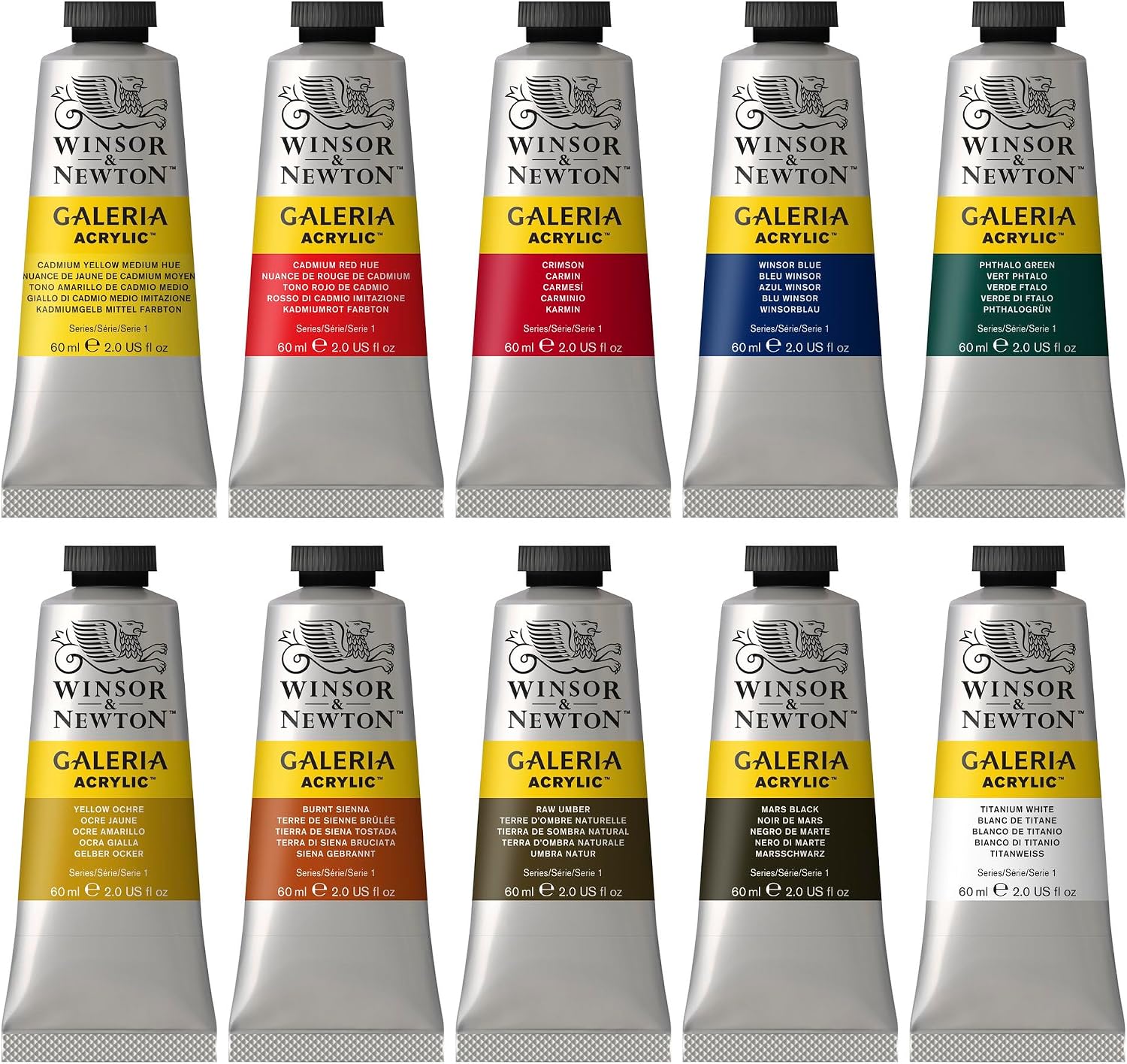
One of the most consistent patterns in intermediate-painter reviews of Winsor & Newton Galeria is the emphasis on open time — the window after paint is applied during which it remains workable before drying. Budget acrylics dry faster, partly because of lower polymer content and partly because of thinner film formulations.
The Jackson’s Art Supplies blog post “Understanding Acrylic Paint Consistency and Open Time” (jacksonsart.com) notes that Galeria’s slower dry is a function of Winsor & Newton’s binder formulation, which trades fast tack-up for a longer blending window. For painters doing wet-into-wet blending, soft-edge portraiture, or gradient work, that extra working time is the difference between a smooth transition and a hard edge you didn’t intend.
Does it matter for small-scale work? It depends on technique:
- Card altering: Faster dry is often an advantage — you want each layer set before adding detail on top. Galeria’s slower dry can cause lower layers to lift during detail work.
- Rock painting: Fast dry works well for most rock painting approaches, which are additive and layer-based.
- Fabric: Open time matters less than flexibility; budget paints perform adequately.
- Blended illustration or portraiture: This is where Galeria earns its intermediate-tier position. The open time advantage is real and consistent across owner reports from practitioners who have tested both student-grade and Galeria formulations.
Winsor
$34.07
In stock on Amazon
Check price on AmazonComparison at a Glance
| Application | Best Fit | Key Property | Tier |
|---|---|---|---|
| Card altering / fine detail | Liquitex BASICS | Soft body; flows on slick surfaces | Artecho — $28.99 |
| Rock painting / shimmer craft | Shuttle Art Metallics | Shimmer; pre-base for opacity | Artecho — $28.99 |
| Fabric painting (personal use) | Artecho | Flexible dry; heat-set required | Artecho — $28.99 |
| Classroom / group instruction | Meeden Heavy Body | Holds texture; oversized white | Artecho — $28.99 |
| Blended illustration / portraiture | Winsor & Newton Galeria | Extended open time for blending | Winsor — $34.07 |
How Far Does a 22ml Tube Actually Go?
A 22ml tube — the standard individual tube size in most student and mid-range sets — is roughly 0.75 fluid ounces. On small-scale work, the math shifts considerably compared to large canvas painting.
On a standard 3.5 × 2.5 inch card, a 22ml tube of a mid-opacity color used in thin layers covers roughly 15–25 full-coverage passes on a single card face. Across the full color mix required for card altering, a 48-piece set can realistically cover 200 or more card faces before any single color is exhausted.
On a fist-sized river rock, a 22ml tube provides approximately 8–12 full-coverage coats of the rock surface. For accent colors, economy is even better.
The cost-per-use math consistently favors stepping up one tier in paint quality for archival or sale-destined work — better pigment load, published lightfastness ratings, and more consistent coverage justify the price difference. For high-volume craft and hobby applications, student-grade sets in the 48-count range deliver genuine value.
Frequently Asked Questions
Can Liquitex BASICS handle card altering or other small detailed work? Yes — it’s one of the most-cited sets for exactly this application. Soft-body consistency flows well off small brushes, coverage builds in thin layers on slick surfaces, and the 48-color range provides enough mixing flexibility for card-accurate hues.
Are Shuttle Art metallics opaque enough for craft projects? The standard colors are adequately opaque; the metallics are noticeably more sheer. For rock painting and decorative craft, the sheerness creates a pleasing translucent shimmer over a light base. For solid metallic coverage on a dark surface, pre-base in white or light gray before applying the metallic layer.
Does Artecho acrylic work on fabric without cracking? Owners report no-crack performance on flexible surfaces when applied in thin layers and heat-set after drying. Avoid thick application. For wearable work being sold, consider a fabric-specific acrylic medium for documented flexibility and wash resistance, as covered in the Fine Art Tips guide “How to Paint on Fabric with Acrylics” (finearttips.com).
Why do budget acrylics dry faster than Galeria, and does it matter? Faster dry is a function of binder formulation and film thickness. As discussed in the Jackson’s Art Supplies blog post “Understanding Acrylic Paint Consistency and Open Time” (jacksonsart.com), Galeria’s longer open time is a deliberate formulation choice. It matters for wet-blending techniques; it is largely irrelevant for layered detail work like card altering where fast dry between passes is an advantage.
Is Meeden heavy body appropriate for a classroom or group setting? Teacher reviewers consistently say yes. Heavy body consistency holds well for group instruction, the oversized white tube addresses the most common classroom supply pinch point, and the cost-per-session math works for education budgets. Expect yellow to be less opaque than other colors — that’s a pigment-physics reality across all paint lines.
How much do I actually use from a 22ml tube on a small project? On card-sized work, a 22ml tube used in thin layers can cover 15–25 full-coverage passes on a single card face. On a fist-sized rock, expect 8–12 full-coverage coats per tube. For small-scale work, per-tube economy is favorable — the limiting factor is usually color variety, not volume.
The Decision Rule
- Card altering or small-detail hobby work → Liquitex BASICS. Soft-body consistency, color range, and favorable per-card economy make it the clear fit. Artecho — $28.99
- Craft, novelty, and rock painting with shimmer effects → Shuttle Art Metallics, with the expectation that metallics need a light base coat for opacity on dark surfaces. Artecho — $28.99
- Fabric painting for personal or low-volume use → Artecho in thin layers, heat-set after drying. For sale-destined fabric work, step up to a professional paint with a documented fabric medium. Artecho — $28.99
- Classroom or group instruction → Meeden Heavy Body. The white tube bonus and heavy-body consistency are real practical advantages for teaching contexts. Artecho — $28.99
- Blended illustration or portraiture where working time matters → Winsor & Newton Galeria. The slower dry is the feature you’re paying for, and it’s consistent across owner reports from intermediate practitioners. Winsor — $34.07
The wrong move is buying paint on price alone without matching it to the surface and technique. Any of these sets will frustrate you on the wrong application — and the right one will feel like it was built for exactly what you’re making.