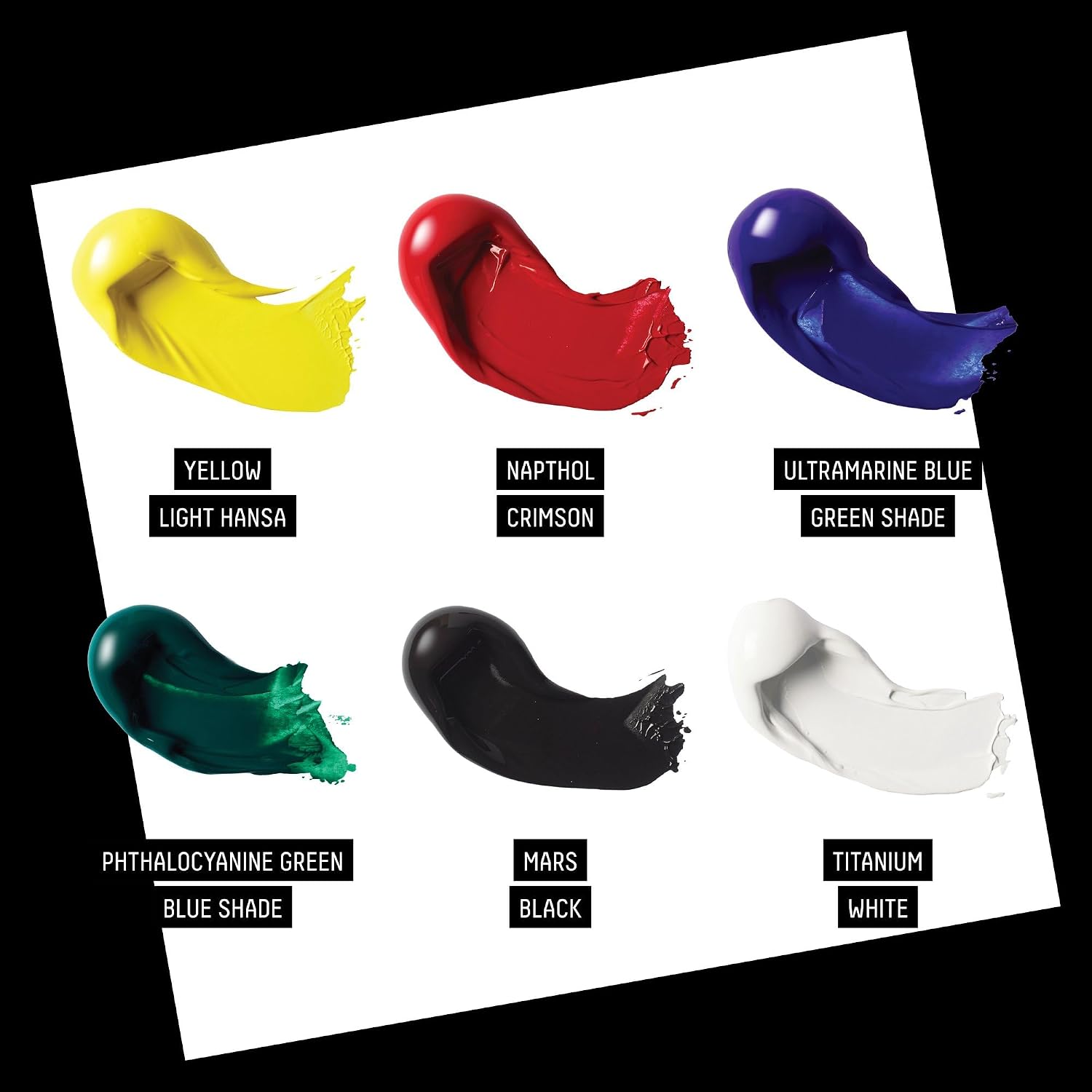
You’ve been painting with acrylics for a while now. You’ve moved past the anxiety of blank canvas, you’re building color instincts, and you have a style beginning to emerge. But something keeps nagging: the colors look muddier than the work you admire, you’re fighting your paint more than working with it, and you’ve noticed that professional painters seem to get more from fewer tubes. That gap usually isn’t about skill — it’s about pigment quality, the actual raw colorant packed into each tube. Student-grade paints (the ones that come in large, economical sets) are made with lower concentrations of pigment, more filler, and often blended pigments that limit your mixing range. Professional-grade paints use higher pigment loads, single-pigment formulations, and standardized lightfastness ratings — meaning colors that stay true on the canvas for decades. This guide will help you recognize exactly when you’ve outgrown starter kits, show you how to read a paint label like a spec sheet, and walk you through the upgrade path from Liquitex Basics territory all the way to Golden and Schmincke — with clear math on what it actually costs to make the switch.
| EDITOR'S PICKCharvin Extra-Fine Artists' Acr… | Mid-tierLiquitex Professional Heavy Bod… | Budget pickWinsor & Newton Galeria Acrylic… | |
|---|---|---|---|
| Tube count | 9 | 6 | 10 |
| Tube size | 60ml | 59ml | 60ml |
| Paint type | Extra-Fine | Heavy Body | — |
| Set type | Basic | Classic | — |
| Series | — | Professional | Galeria |
| Price | $95.89 | $47.31 | $34.07 |
| See on Amazon → | See on Amazon → | See on Amazon → |
The Signal You’ve Outgrown Student Paint
The clearest sign isn’t frustration — it’s a specific pattern of frustration. If any of these sound familiar, you’re there:
Your mixed colors go muddy fast. Student-grade sets frequently include multi-pigment formulas — a single “Cadmium Red Hue” tube might contain three or four different pigments blended to approximate the hue cheaply. When you mix two of these together, you’re actually combining six or eight pigments. The result is optical chaos: dull, grayish mixes that don’t respond the way color theory says they should.
You’re using a lot of paint to get coverage. Lower pigment load means you need more paint to achieve opacity or saturation. Artists Network’s overview of acrylic grades notes that student paints typically run 10–30% lower in pigment concentration than professional lines — which means you’re essentially paying for water and filler.
Your darks look flat and your lights look chalky. This often comes from relying on pre-mixed blacks and whites that don’t have the undertone control that single-pigment options give you. Titanium White (PW6) and Phthalo Blue (PB15) behave very differently than a generic “Cool White” that’s already been nudged toward blue by the manufacturer.
You’re working more intentionally now. This is the subtler signal. If you’re starting to plan palettes, think about archival quality, or sell work, you need lightfastness data — and student sets rarely publish it clearly. Handprint.com’s acrylic brand comparisons point out that many budget-tier manufacturers use ASTM lightfastness ratings loosely or not at all on their student lines.
How to Read the Label: Pigment Codes and Lightfastness
Before you spend a dollar on new paint, learn to read what’s already on the tube. This is the skill that separates intermediate buyers from advanced ones.
Pigment codes are standardized abbreviations for the actual colorant in the paint. They look like PB29 (Pigment Blue 29, a.k.a. Ultramarine Blue), PR254 (Pigment Red 254, a.k.a. Pyrrole Red), or PY150 (Pigment Yellow 150, a.k.a. Nickel Azo Yellow). A tube listing a single code is a single-pigment paint — predictable, clean-mixing, and easy to control. A tube listing PB29, PR101, PBk9 is a blend that will behave differently under every lighting condition and mixing scenario. Jackson’s Art’s acrylic buying guide consistently recommends single-pigment paints as the foundation of any serious palette, regardless of brand.
Lightfastness ratings tell you how a color resists fading under light exposure. The ASTM system rates paints I (Excellent) through V (Very Poor). For any work you’re selling, gifting, or keeping long-term, ASTM I or II is the minimum you should accept. Golden Artist Colors publishes this data for every color in their line; Liquitex Professional does as well. Many student-grade lines either omit the rating or use the manufacturer’s own internal scale, which is not independently standardized.
By the Numbers
| Grade | Typical Pigment Load | Lightfastness Data Published? | Price Range (60ml) |
|---|---|---|---|
| Student (Basics, Galeria) | Low–Medium | Rarely standardized | $3–$6 |
| Mid-tier (Meeden, Arteza Pro) | Medium | Sometimes | $5–$10 |
| Professional (Golden, Liquitex Pro) | High | Always (ASTM I–II) | $9–$22 |
| Extra-fine (Old Holland, Williamsburg) | Very High | Always | $18–$40+ |
The Upgrade Paths: What to Actually Buy
You don’t have to replace everything at once. The smartest approach is to upgrade strategically — start with your most-used colors and buy professional grade from the first tube. Here’s how the landscape breaks down in 2026.
The Mid-Tier Bridge: Meeden and Similar Sets
Sets from Meeden and comparable brands occupy an honest middle ground that doesn’t get enough credit. For painters who aren’t ready to commit $15+ per tube but find Liquitex Basics limiting, a Meeden professional-style set offers improved pigment transparency and a wider palette out of the box, typically in the $40–$70 range for 24–36 colors. Reviewers across aggregated art forums note that Meeden’s labeling has improved — pigment codes appear on most colors — though lightfastness documentation is still inconsistent compared to the professional tier.
The tradeoff is real: you’re getting better paint than student grade, but you’re still likely working with some multi-pigment hues and moderate pigment loads. For practice work, studies, or high-volume studio use where you’re burning through paint quickly, this tier makes sense. For anything you plan to sell or exhibit, the gaps in archival documentation matter.
If you’re in this tier: use Meeden or equivalent for backgrounds, grounds, and exploratory mixing sessions. Upgrade your five most critical colors — your primary triad, your most-used neutral, and your black — to professional grade immediately. That single swap will change your experience dramatically.
The Professional Standard: Liquitex Professional and Golden Heavy Body
These are the two brands that come up most consistently in intermediate-to-advanced painter conversations, and for good reason. Both publish full ASTM lightfastness data, both maintain single-pigment formulations across most of their lines, and both have been industry benchmarks long enough that their behavior is thoroughly documented.
Liquitex Professional is the more accessible entry point. Individual 59ml tubes run approximately $9–$14 depending on pigment series (cadmiums and cobalts cost more because the raw pigments do), and the paint has a slightly softer consistency that many painters find easier to work with straight from the tube. Liquitex’s technical data sheets, published on their site, break down each color’s pigment code, lightfastness, opacity, and vehicle type — exactly the information you need to build a deliberate palette. The Liquitex Professional line’s consistency and pricing make it a strong “build-your-palette-tube-by-tube” option for intermediate painters coming off student sets.
Golden Heavy Body is the benchmark that professional painters, muralists, and illustrators return to across decades of work. Golden’s acrylic product information guide — one of the most detailed manufacturer documents in the industry — provides pigment data, archival guidance, and mixing notes that go well beyond what most brands offer. Heavy Body has a buttery, high-viscosity consistency that holds brush texture and palette knife marks distinctly. Owners and long-term users consistently note that the pigment load is noticeably higher than Liquitex at comparable price points, though the difference is most visible in transparent and semi-transparent colors. Individual 59ml Heavy Body tubes range from approximately $11 to $22 in 2026.
The cost-per-use math favors Golden if you’re mixing frequently and losing paint to student-grade dullness — higher pigment load means you use less to achieve the same saturation. Over a year of regular painting, reviewers in long-run forum discussions consistently report that the premium pays back in reduced paint consumption.
The Advanced Tier: Schmincke and Old Holland
Once you have a stable professional practice and a palette you understand deeply, the extra-fine tier becomes relevant. Schmincke’s acrylic PRIMAcryl line and Old Holland’s Classic Acrylics are formulated at pigment concentrations that approach the density of oil paint — you are paying for extraordinarily high pigment loads and extremely fine-ground particles that produce luminosity that’s visible even in thin glazes.
These are not upgrade-everything propositions. Most advanced painters fold one or two extra-fine-tier colors into an otherwise professional-grade palette — a single tube of Old Holland Titanium White or Schmincke Cadmium Yellow can anchor an otherwise standard Golden setup. Jacksons Art’s product comparisons note that extra-fine acrylics are particularly valued for portrait and botanical work where subtle color transitions and archival longevity are both critical.
At $18–$40+ per 60ml tube, this is a considered purchase. But if you’re selling work, entering competitions, or creating pieces intended to last generations, the archival standard justifies the price.
Building Your Transition Palette
Rather than buying a full set at the professional tier upfront, most intermediate painters benefit from building a limited palette of eight to twelve colors — often called a “split primary” palette — using professional-grade single-pigment tubes. The logic is simple: a disciplined eight-color palette in Golden Heavy Body costs less than a 24-color set in the mid-tier, and it will teach you more about color mixing than a large set ever will because you’re forced to understand what each pigment actually does.
A functional transition palette for intermediate acrylic painters typically includes:
- A warm and cool yellow (PY74 and PY150, or PY83)
- A warm and cool red (PR254 and PV19, or PR122)
- A warm and cool blue (PB29 Ultramarine and PB15 Phthalo Blue)
- Titanium White (PW6)
- A single transparent dark (PBk11 Mars Black or a phthalo-based neutral)
Artists Network’s palette-building guides for acrylics consistently recommend this structure for painters moving from student to professional materials — the constraint accelerates understanding.
The Decision Rule
If you paint casually and burn through a lot of paint on practice work: A Meeden or equivalent mid-tier set is a reasonable bridge. Focus your professional-grade spending on your three most-used colors.
If you’re building a serious practice, selling work, or frustrated that your technique isn’t translating: Stop buying sets. Spend that money on eight to twelve professional-grade tubes — Golden Heavy Body or Liquitex Professional — built around a split primary palette. You will mix better, waste less, and finally have the control your skills are ready for.
If you’re already working in Golden or Liquitex Professional and hitting ceilings in transparency or luminosity for fine detail work: One or two extra-fine tubes from Schmincke or Old Holland, dropped into your existing palette, will show you immediately whether the top tier changes your results in ways that justify the cost.
The upgrade isn’t about spending more. It’s about spending where the pigment actually is.