
Acrylic paint is one of those mediums where every price tier delivers a genuinely different experience, but the spec labels don’t always tell you where the real differences live. Opacity is the measure of how completely a paint covers what’s underneath it. A fully opaque stroke of red hides the pencil line below; a transparent stroke lets it show through like a glaze. Most artists need both behaviors at different moments, but only one of them is consistently strong across all paint grades — and it’s not what you’d guess. Whether you’re covering a dark underpainting or building thin, luminous layers, understanding where your paint sits on the opacity scale will save you from the frustrating experience of applying coat after coat of what you thought was a “solid” color and still seeing the canvas grin back at you.
This article maps the opacity behavior of four widely-purchased acrylic tiers — Shuttle Art (value/craft), Liquitex BASICS (entry-to-mid student), Winsor & Newton Galeria (mid-level artist), and Liquitex Heavy Body (professional) — using published manufacturer documentation and named editorial sources. We’ll cover the tradeoffs, the coverage math, and the honest decision rules for each stage of your practice.
| EDITOR'S PICKLiquitex BASICS Acrylic Paint S… | Mid-tierWinsor & Newton Galeria Acrylic… | Budget pickWinsor & Newton Galeria Acrylic… | |
|---|---|---|---|
| Tube count | 48 | 10 | 6 |
| Tube size | 22ml | 60ml | 60ml |
| Total volume | 1056ml | 600ml | 360ml |
| Price | $61.85 | $34.07 | $22.90 |
| See on Amazon → | See on Amazon → | See on Amazon → |
What “Opacity” Actually Means on a Paint Label (and Why It’s More Complicated Than It Looks)
Most paint labels use a simple icon system: a filled square for opaque, a half-filled square for semi-transparent, and an empty square for transparent. That rating is set by the manufacturer and reflects the pigment’s inherent hiding power at full strength, straight from the tube. It does not account for how thin the paint film is, how heavily loaded with binder the formula is, or how much filler has been added in place of actual pigment.
Winsor & Newton’s Galeria Acrylic colour chart and technical documentation describes opacity assessments as being performed under standardized conditions — a specific film thickness applied over a black-and-white checkerboard ground. That controlled environment doesn’t map perfectly onto how most painters actually work. The practical result: a paint marked “opaque” in a student-grade line may cover noticeably less than a paint marked “opaque” in a professional line, because the professional paint contains more pigment per milliliter of binder.
The other variable is pigment chemistry itself. Some pigment families — specifically yellow and orange families built on pigments like PY74, a common student-grade yellow — have inherently lower hiding power than earth tones, whites, or blues built on high-density mineral pigments. Jackson’s Art Supplies, in their guide to acrylic paint grades published at jacksonsart.com, notes that this is why yellows and some reds consistently read as “weaker” even within the same product line. It’s not a formulation failure — it’s physics.
Tier by Tier: Where the Opacity Actually Lives
Shuttle Art: Bright, Generous, and Transparent in Practice
Shuttle Art sets — typically 60 to 100 or more tubes in the $20–$30 range — are aimed squarely at crafters, beginners, and mixed media artists. The color range is extensive and the value-per-tube proposition is genuinely strong for high-volume practice work. The brightness reads well on decorative surfaces, which is why these sets perform well for decoupage, rock painting, and school projects.
The opacity story is more complicated. Shuttle Art paints use binder-heavy, pigment-light formulas that keep manufacturing costs predictable across a massive color range. Painters working with these sets consistently report needing two to three coats for solid coverage on canvas, particularly with mid-range hues. On dark grounds, full coverage often requires a white basecoat first. The paint is not marketed as professional-grade, and its opacity ratings shouldn’t be evaluated as though it were — that’s a mismatch of expectations, not a product defect.
Artists Network, in editorial coverage of entry-level acrylic grades published at artistsnetwork.com, describes this tier as well-suited for painters who are still developing their layering intuition and who benefit from a large color selection over high pigment density. That framing is accurate: Shuttle Art rewards painters who plan for layers rather than painters who expect single-pass coverage.
Where Shuttle Art works: Mixed media, journaling, decorative painting, student practice, any application where coverage is built gradually or where transparency is acceptable.
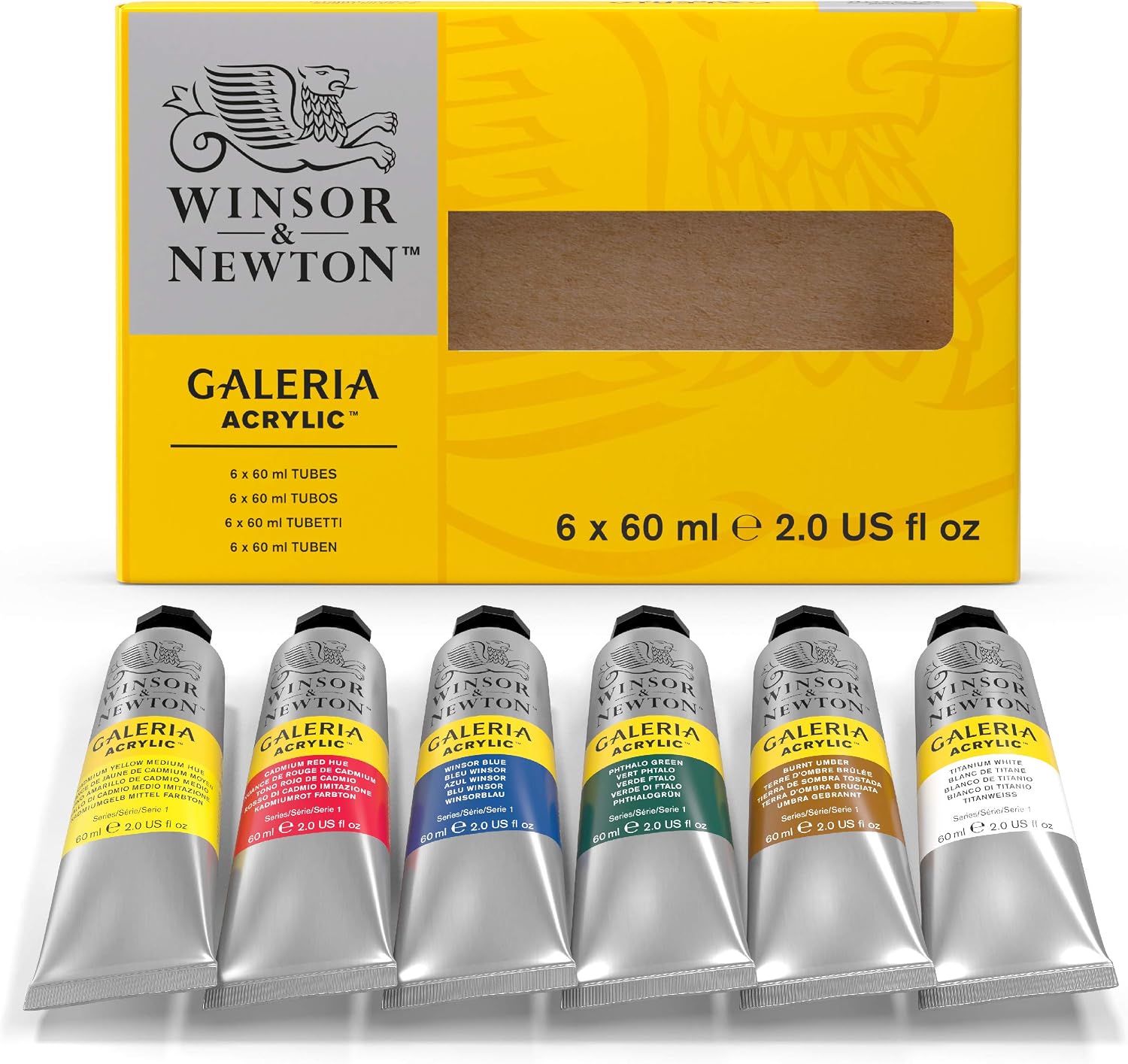
Winsor
$22.90
In stock on Amazon
Check price on AmazonLiquitex BASICS: The Smart Student-Grade Choice, With Known Limits
Liquitex BASICS occupies a well-understood position in the market. Per Liquitex’s published BASICS product specification sheets, these paints are formulated with lower pigment loads than the Heavy Body line, using a thinner binder system suited to high-volume use in educational and practice contexts. The opacity ratings on individual BASICS tubes are generally accurate — colors marked opaque do cover reasonably well — but the ceiling is lower than it appears on the label.
One pattern worth naming directly: experienced painters transitioning from craft-grade paints to BASICS sometimes carry over heavy-dilution habits that reduce opacity further than the formula’s pigment load already does. BASICS rewards a slightly different approach — less water, shorter strokes, and a willingness to let each layer fully cure before adding the next. Applied that way, the opaque-rated colors in BASICS cover acceptably on white grounds. On toned or dark grounds, expect two coats minimum.
The practical advantage of BASICS is consistency: every tube behaves similarly, which makes color mixing predictable. For intermediate painters building intuition about acrylic mixing ratios, that uniformity has genuine instructional value. Artists Network’s coverage of student-grade acrylics at artistsnetwork.com frames this tier as appropriate for painters who need to accumulate a large number of practice hours without burning through expensive paint — a sound judgment that reflects how most working painters describe their own BASICS experience.
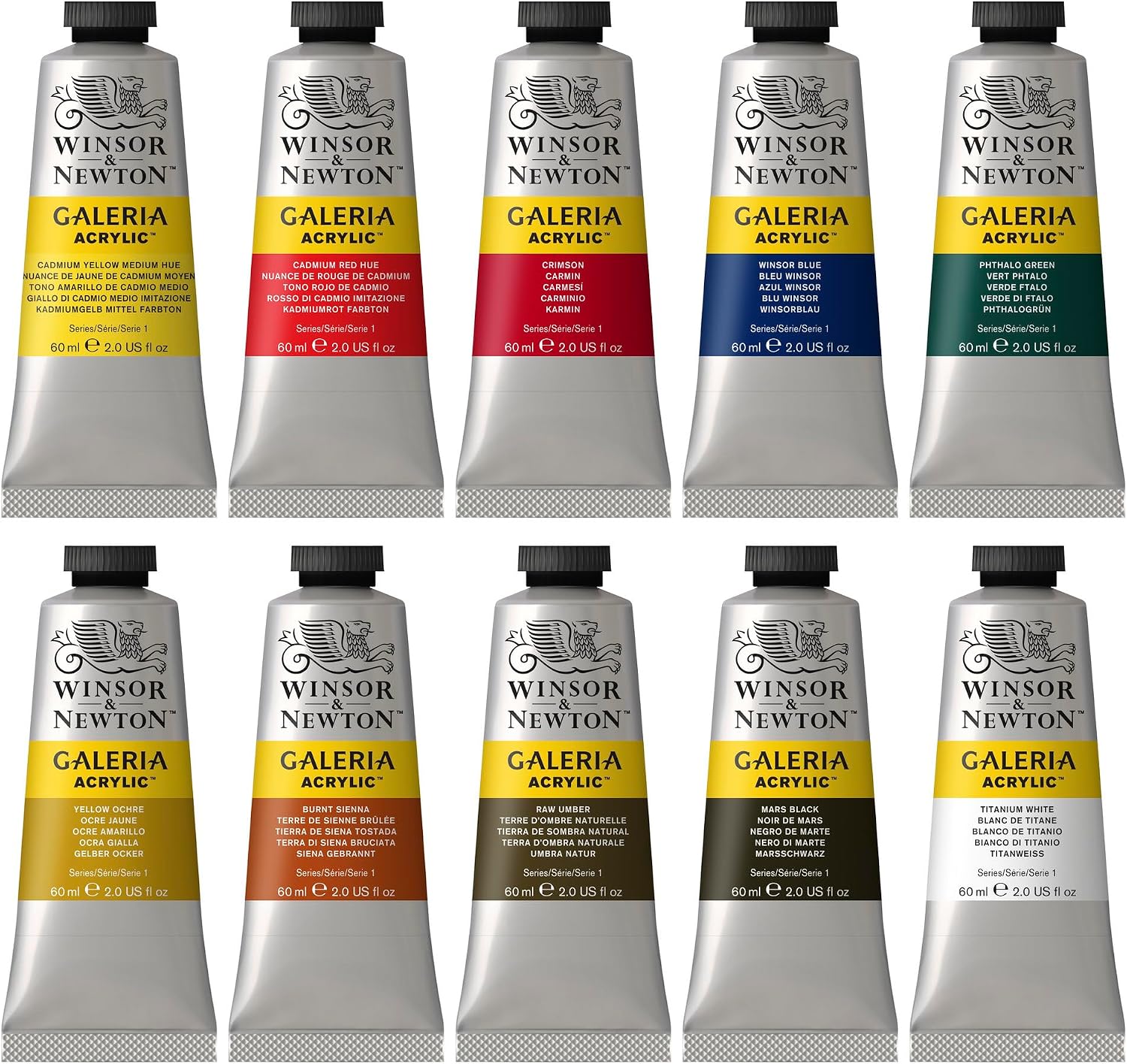
Winsor
$34.07
In stock on Amazon
Check price on AmazonWinsor & Newton Galeria: Where Smooth Coverage Becomes a Differentiator
Galeria sits at an interesting price point — noticeably more expensive than BASICS per ounce, but still below professional Heavy Body pricing. What painters at this level consistently return to is surface finish. Galeria self-levels in a way that reduces visible brushstroke texture, which matters for fine blending work and smooth tonal transitions — a meaningful distinction for anyone whose work gets viewed at close range.
Per Winsor & Newton’s Galeria colour chart and technical documentation, the opacity ratings in this line track reliably: opaque-rated colors genuinely cover in fewer coats than comparable BASICS shades, because the pigment load is higher and the formula is more consistent across the color range. Artists Network’s editorial coverage of mid-range acrylics at artistsnetwork.com describes the smoother finish at this tier as the result of a binder system that holds the paint film more evenly during dry-down — a functional advantage for portrait and commission work.
Galeria also flows acceptably straight from the tube for most applications. Artists doing very fine detail work or smooth gradient blending sometimes add a small amount of retarder medium to extend wet time, but the paint is usable as-packaged for standard opaque coverage without any additional medium purchase.
Winsor
$34.07
In stock on Amazon
Check price on AmazonLiquitex Heavy Body: Investment Paint, Investment Behavior
Heavy Body paints carry significantly higher pigment concentration than any of the tiers above. Liquitex’s published Heavy Body product specification sheets show formulas built on pigment-to-binder ratios designed for professional fine art production, with single-pigment options across much of the color range. The opacity behavior follows directly: a single pass of an opaque-rated Heavy Body color covers almost all grounds cleanly, including mid-toned and moderately dark surfaces.
Painters who make the switch to Heavy Body consistently use investment language — noting that they use far less per session than they expected. This reflects a real shift in working economics. A 2oz tube of Heavy Body applied at standard professional working thickness covers roughly the same surface area as a significantly larger tube of student-grade paint applied for equivalent visual opacity, because the pigment does more work per milliliter of binder.
Golden Artist Colors’ Heavy Body line, frequently discussed alongside Liquitex Heavy Body by professional painters comparing options, similarly emphasizes pigment saturation and mixing depth. Golden Artist Colors’ published technical data sheets note that their Heavy Body formulas are designed for archival permanence, with ASTM lightfastness ratings listed for every color — a consideration that matters directly for anyone selling finished work or exhibiting in environments with variable lighting.
Jackson’s Art Supplies’ grade guide at jacksonsart.com frames the Heavy Body tier as the point at which paint stops functioning as a disposable consumable and starts behaving as a true fine art material — meaning the per-painting cost calculation changes because coverage efficiency compensates for the higher sticker price.
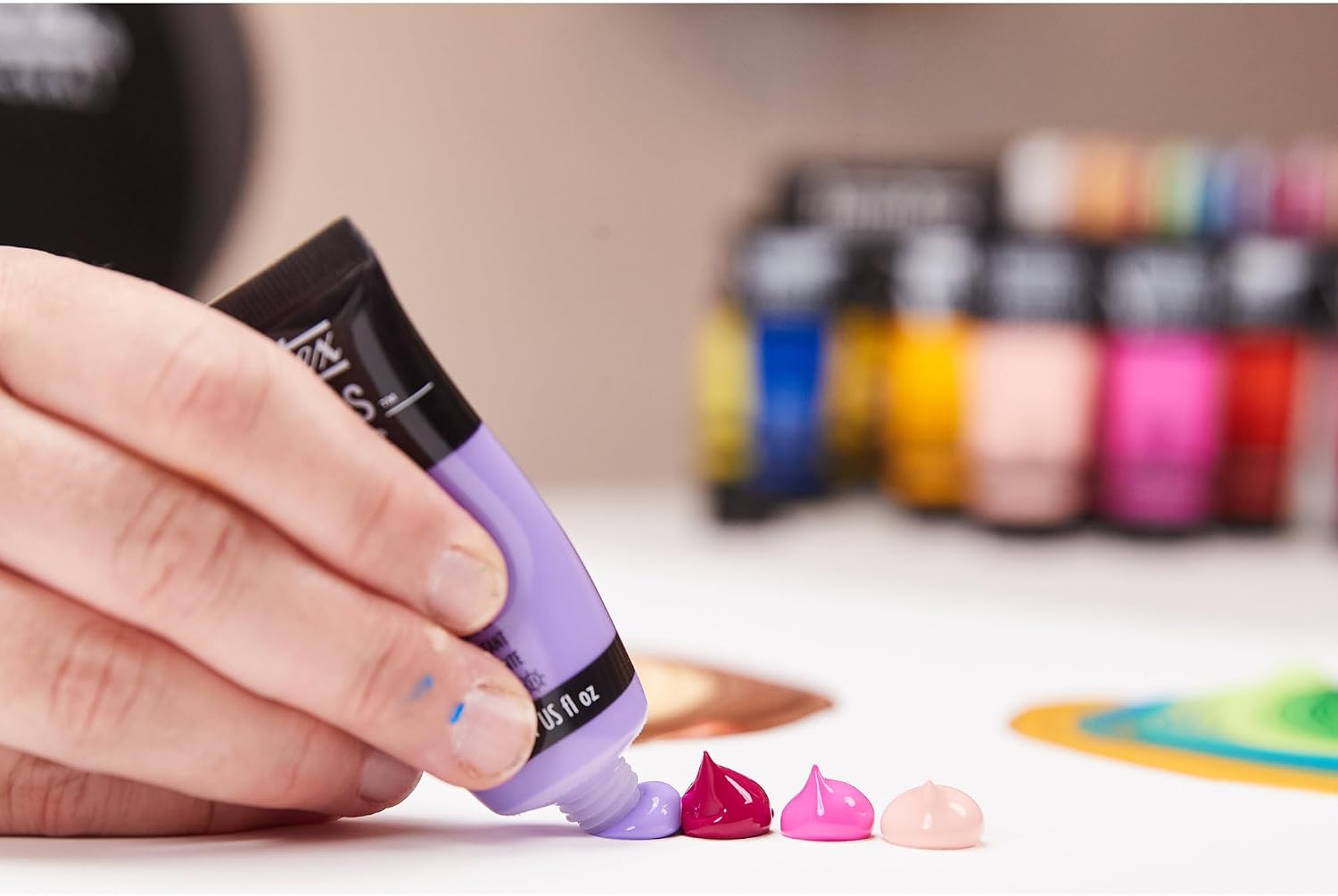
Liquitex
$61.85
In stock on Amazon
Check price on AmazonCoverage at a Glance
| Tier | Typical Pigment Density | Opaque Coverage (dark ground) | Coats for Full Coverage |
|---|---|---|---|
| Shuttle Art | Low | Partial | 3–4+ |
| Liquitex BASICS | Medium-low | Moderate | 2–3 |
| Winsor & Newton Galeria | Medium | Good | 1–2 |
| Liquitex Heavy Body | High | Excellent | 1 (most colors) |
Sources: Liquitex BASICS and Heavy Body product specification sheets (plain-text reference, no URL); Winsor & Newton Galeria colour chart and technical documentation (plain-text reference, no URL); Golden Artist Colors Heavy Body technical data sheets (plain-text reference, no URL); Jackson’s Art Supplies, ‘A Guide to Acrylic Paint Grades,’ jacksonsart.com (plain-text reference, no URL).
Frequently Asked Questions
Why are yellow acrylics less opaque than other colors across almost every brand?
This is pigment chemistry, not manufacturer error. Bruce MacEvoy’s pigment and paint behavior reference notes at handprint.com explain that yellow pigments — particularly the synthetic organic yellows like PY74, PY3, and PY97 used across most acrylic lines — have inherently low hiding power because their molecular structure scatters rather than absorbs light. Earth yellows like yellow ochre (PY43) are notably more opaque because they are iron oxide-based minerals with much higher mass and density. If you need a truly covering yellow, look for cadmium yellow or Naples yellow formulations in your preferred line, or accept that any synthetic yellow will need multiple passes regardless of brand and price tier.
At what skill level does the jump from Liquitex BASICS to Heavy Body actually make a noticeable difference?
The honest answer: when you start making deliberate decisions about paint application thickness, mixing ratios, and color accuracy under different lighting conditions. If you’re still working out how to build layers and control water ratios, the BASICS line gives you room to practice without burning through expensive paint. The moment you find yourself frustrated that your mixed colors don’t hold their saturation after drying, or that two seemingly identical mixtures produce different results across sessions, that’s when Heavy Body’s higher pigment load starts translating directly into better outcomes. Most intermediate painters hit that threshold somewhere between twelve and twenty-four months of consistent studio practice.
Can Shuttle Art acrylics be used on canvas for finished paintings, or are they better suited to crafts and mixed media?
Technically yes — Shuttle Art paints adhere to canvas and dry to a stable film. The constraint is coverage and pigment saturation. For finished paintings intended for display or sale, the lower pigment density means colors may appear duller at viewing distance compared to professional-grade equivalents, and coverage on dark grounds requires significant layering. For personal work, practice canvases, underpaintings, or any application where the surface will be reworked, Shuttle Art is entirely functional. For paintings leaving the studio as finished pieces intended for sale or exhibition, the investment in at least Galeria-grade paint is worth making.
Does Winsor & Newton Galeria need a medium to improve flow, or is it workable straight from the tube?
Galeria is formulated to be workable straight from the tube for most standard applications — flat coverage, blending, and moderate impasto work. Artists who want extended wet time for smooth blending transitions sometimes add a small amount of retarder medium; artists doing very fine detail work or watercolor-style washes add water or a flow medium. But for opaque coverage, portraiture, and general painting, Galeria does not require an additional medium purchase to perform as labeled. The out-of-tube consistency is one of the reasons painters at this stage find the upgrade from BASICS immediately noticeable.
How much paint do you actually get from a Liquitex Heavy Body 2oz tube compared to a larger BASICS tube?
Coverage math changes the comparison significantly. Because Heavy Body contains substantially more pigment per milliliter, painters consistently use less paint per session to achieve the same visual result. A reasonable working estimate based on painter-reported experience documented in Artists Network’s coverage of professional acrylic grades at artistsnetwork.com: a 2oz Heavy Body tube covers comparable area to a 4oz BASICS tube when both are applied for equivalent opacity on a mid-tone ground. The per-ounce cost gap between the two lines narrows considerably once coverage efficiency is factored in, making the upgrade less expensive in practice than the sticker price implies.
The Decision Rule
If you’re painting for practice, mixed media, or craft projects with no archival intent: the value tier — Shuttle Art or Liquitex BASICS — is the financially sensible choice. Spend your budget on quantity of canvas time, not paint quality.
If you’re painting portraits, pet commissions, or any finished work where blending quality and surface finish matter but you’re not yet ready for professional-grade pricing: Winsor & Newton Galeria is the clear upgrade. The self-leveling finish and reliable opacity ratings justify the step up, and most painters working at this level notice the difference within their first session.
If you’re selling finished paintings, working with dark grounds regularly, or find yourself constantly fighting your paint to achieve saturation in mixed colors: Liquitex Heavy Body — or Golden Artist Colors Heavy Body for a single-pigment-focused alternative — is where the coverage math starts working in your favor. The cost-per-coverage-unit closes the gap faster than the sticker price suggests, and your mixed colors will hold their character in ways student-grade formulas simply cannot match.
Yellow will still give you trouble at every tier. That’s physics. Prime white, layer patiently, and don’t blame the paint.