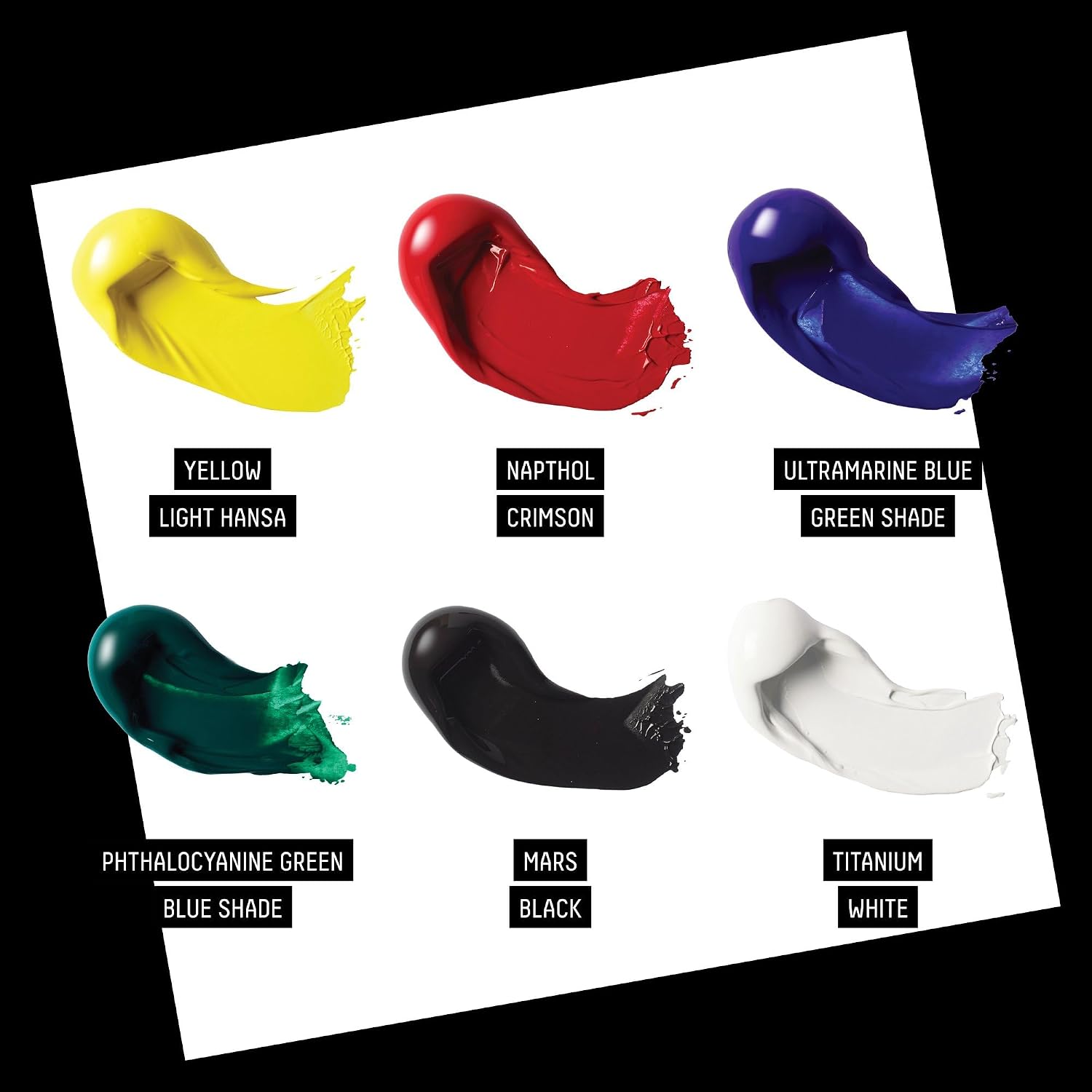
Acrylic paint — a water-based medium where pigment is suspended in an acrylic polymer binder — comes in wildly different textures right out of the tube or bottle. That texture is what artists mean when they say “body.” A heavy body paint holds stiff peaks like butter; a soft body flows like yogurt; a fluid or craft-grade bottle pours almost like ink. These aren’t just feel differences — they affect how you layer, blend, texture, and mix, which means choosing the wrong consistency for your technique is one of the fastest ways to fight your materials instead of your painting. This guide breaks down the three main tiers — heavy body, soft body, and budget craft — maps them to real products you’ve probably already considered, and gives you a clear framework for deciding which one belongs on your palette.
What “Body” Actually Means — and Why It’s Not Just About Thickness
Body refers to the rheology (flow and deformation behavior) of the paint, which is controlled by the ratio of pigment load to binder, plus any added thickeners or fillers. This matters more than the word “thick” or “creamy” suggests.
Heavy body acrylics have a high viscosity — they don’t slump or self-level. When you pull a brush through them, they retain brushstrokes and impasto texture. The stiff consistency comes from a high pigment-to-binder ratio combined with rheological additives. Golden Heavy Body and Liquitex Professional Heavy Body are the canonical examples at the professional tier. Owners reviewing Golden consistently note that the tubes are smaller than expected for the price — a signal, per Jackson’s Art Blog’s overview of acrylic grades, that buyers are paying for pigment density, not volume. The cost-per-use math actually favors heavy body once you account for the fact that you use less paint per square inch.
Soft body acrylics sit in the middle. Same pigment quality as heavy body in the professional lines, but with more binder and less viscosity. They self-level slightly, which makes them excellent for smooth washes, fine brush detail, and mixed-media work where you want consistent film thickness without brushstroke texture. Liquitex Professional Soft Body is the benchmark here.
Budget craft bottles — Shuttle Art, Apple Barrel, FolkArt — are a different category entirely. The lower price reflects a lower pigment load, more filler, and in many cases multi-pigment formulations that affect mixing predictability. They’re not reformulated heavy body; they’re a separate product designed for craft applications, not fine art.
The distinction between student grade and professional grade cuts across all three body types. Student-grade acrylics (Liquitex BASICS, Winsor & Newton Galeria) use lower pigment concentrations and sometimes substitute cheaper pigments — which is why they can sell a larger tube for less money. Professional-grade paints (Liquitex Professional, Golden, Schmincke Akademie at the upper end) use single-pigment or carefully selected multi-pigment formulas with higher pigment load and specified lightfastness ratings.
The Three Tiers, Side by Side
Here’s the honest comparison at a glance:
| Tier | Example Products | Pigment Load | Best For | Cost Signal |
|---|---|---|---|---|
| Professional Heavy Body | Golden, Liquitex Professional | High, often single-pigment | Impasto, canvas, texture, serious mixing | $8–$18 / 2 fl oz tube |
| Student Heavy/Soft Body | Liquitex BASICS, Galeria, Meeden | Moderate | Learning, class use, sketching | $2–$5 / tube |
| Budget Craft Bottles | Shuttle Art, Apple Barrel | Low, multi-pigment | Crafts, decoupage, backgrounds | $0.50–$1 / bottle |
Golden Heavy Body is the professional benchmark that artists’ network forums and Jackson’s Art Blog consistently hold up for color mixing fidelity. The published pigment codes on every tube (Golden lists the exact pigment on the label — a transparency practice that’s worth paying attention to) let you predict mixing behavior before it hits the palette. Owners note that Golden’s consistency is unmistakably buttery and holds impasto ridges without slumping, even in humid conditions.
Liquitex Professional Heavy Body occupies similar territory with a slightly more accessible price point and a broader color range, including some colors not in Golden’s catalog. Reviewers consistently describe the texture as creamy rather than stiff — slightly easier to move than Golden but still holding texture. Liquitex’s own product education materials explain that their heavy body formulas use the same pigment grades as their soft body line, just in a different vehicle ratio — so switching between them within the Professional range doesn’t sacrifice color quality.
Meeden Heavy Body has earned a specific niche among art educators — reviewers, including an art teacher who cited it explicitly, praise it for classroom use where students need a paint that behaves professionally without the per-tube cost of Golden. The caveat worth understanding: yellows in many acrylic lines (Meeden included) are more transparent than other hues. This is pigment physics, not a product defect — explained more in the FAQ below.
Winsor & Newton Galeria is a 10-tube set that shows up frequently in intermediate buyer research. Reviewers report fast drying and strong pigmentation for the price. Galeria sits firmly at the upper end of student grade — better pigment load than craft bottles, but below the professional lines in single-pigment purity and lightfastness documentation. It’s a solid bridge purchase.
Shuttle Art and similar budget bottle sets are priced as craft supplies and perform accordingly. Reviewers who describe adding water to thin Shuttle Art are essentially compensating for a viscosity that was designed for brushed-on craft surfaces, not canvas. Thinning with water works for coverage but reduces the already-modest binder content further — which can affect film adhesion on flexible surfaces. For canvas fine art meant to last, this matters.
The Cost-Per-Use Math You Should Run Before Buying
Let’s be direct about this because it’s where intermediate buyers most often miscalculate.
By the numbers:
- Golden Heavy Body 2 fl oz tube: ~$14 street price / ~15–20ml of paint per session coverage → roughly $0.70–$0.93 per use at a serious painting session
- Liquitex BASICS 4 fl oz tube: ~$6 / same coverage area requires more paint due to lower pigment load → comparable cost-per-session, less color intensity
- Budget craft 2 fl oz bottle: ~$1 / requires significantly more paint for opacity on canvas → cost advantage erodes on larger work
The pattern that aggregated reviews of Golden reflect — buyers noting small tubes and squeezing out every last drop — isn’t a complaint about value. It’s evidence that users feel the quality justifies the price, but are correctly tracking that high-pigment paint is denser per milliliter and goes further than the tube size suggests. Per handprint.com’s notes on acrylic paint vehicle and pigment ratios, higher pigment load means less paint moves more color, which is exactly what you want when you’re mixing precise colors on a limited palette.
Matching Consistency to Technique
If you’re working on impasto or textured canvas, heavy body is non-negotiable. Soft body will settle into a flatter film. Budget bottles will likely crack or peel under heavy application — Artecho owners specifically note that their paint doesn’t crack, which implies this is a known failure mode for lower-grade acrylics under thick application.
If you’re doing fine detail, illustration, or mixed media, soft body is your native format. It loads a brush evenly, flows without flooding, and doesn’t require thinning to get into tight lines. Liquitex Professional Soft Body is the editorial standard here for good reason.
If you’re teaching, sketching, or doing studies, student-grade heavy body (BASICS, Galeria, Meeden) is the right call. You’re not producing archival work; you’re building muscle memory. Save the Golden for paintings that go on a wall.
If your work is purely decorative craft — painted signs, decoupage, hobby projects where longevity isn’t a concern — budget bottles are appropriate tools. Using them for fine art canvas is a mismatch of application and material.
Frequently Asked Questions
Can you thin heavy body acrylics with water to get soft body behavior? You can, up to a point. Adding up to 30% water by volume is generally safe without compromising the acrylic binder film. Beyond that, you start diluting the polymer to the point where the dried film may be chalky, less adhesive, or prone to flaking — especially on flexible canvas. If you regularly need soft body behavior, buying actual soft body paint is the better answer. Acrylic mediums (fluid medium, glazing liquid) thin viscosity without sacrificing binder integrity.
Why are yellows often more transparent than other acrylic colors? Pigment opacity is an intrinsic physical property of the pigment itself, not a mixing error. Yellow pigments — particularly Hansa yellows (PY3, PY74) and organic yellows common in acrylic lines — have lower inherent opacity than, say, titanium white (PW6) or iron oxides. Manufacturers can’t fully overcome this with higher pigment load. The Meeden yellow transparency complaint reviewers mention is the same reason professional-grade yellows behave this way. Understanding pigment codes (listed on Golden and Liquitex Professional labels) helps you anticipate this: PY74 will always be more transparent than PY42 (yellow ochre).
Is Winsor & Newton Galeria closer to student grade or professional grade? Student grade, clearly — but the better end of it. Galeria uses some multi-pigment mixes and lower lightfastness ratings than Winsor & Newton’s Professional line. Artists Network’s overview of acrylic grades places Galeria squarely as a high-quality student formulation suitable for serious study work, not archival exhibition pieces. For work you plan to sell or exhibit, the Professional line is the appropriate step up.
What is the difference between Liquitex BASICS and Liquitex Heavy Body beyond price? Three things: pigment load, pigment quality, and binder ratio. BASICS uses lower pigment concentrations (which is why you get a bigger tube for less money — more filler), sometimes multi-pigment formulas where the Professional line uses single pigments, and a formulation optimized for affordability rather than archival longevity. The consistency differs too — BASICS is softer and slightly less opaque than Professional Heavy Body at the same film thickness. Per Liquitex’s own product education materials, the Heavy Body Professional line is their archival-grade formula with the highest pigment load in their range.
Can Shuttle Art or budget bottle paints be used for canvas fine art, or only crafts? Technically yes; archivally, probably not. The pigment load, lightfastness ratings (rarely specified on budget lines), and binder quality in craft-grade acrylics are not designed for works meant to last decades. For a painting you plan to sell, gift, or preserve, the investment in at least student-grade paint from a manufacturer who publishes lightfastness data is worth making. Budget bottles are excellent for underpainting, practice canvases, and anything where permanence isn’t the point.
How do Golden Heavy Body paints compare to Liquitex Professional for color mixing? Both are excellent — the choice mostly comes down to specific colors and personal handling preference. Golden’s color mixing reputation is built on their single-pigment commitment and very precise pigment documentation, which makes predictable mixing behavior (per handprint.com’s pigment notes) easier to achieve. Liquitex Professional offers a broader catalog with some unique formulations. Owners of both lines note that Golden’s consistency is slightly stiffer, which some mixers prefer because it holds position on the palette. For color mixing specifically, either line rewards using single-pigment colors and understanding the pigment codes — that discipline matters more than brand loyalty.
The decision rule, plainly stated: If you’re making work that lives on a wall or sells, buy professional grade — Golden or Liquitex Professional — and match body type to your technique. If you’re studying or teaching, student heavy body like Galeria or Meeden gives you professional handling at a fraction of the cost. If you’re crafting, budget bottles are the right tool. The error to avoid is using craft-grade paint and expecting archival results, or buying heavy body when your technique actually wants fluid behavior. Match the material to the job, and the cost-per-use math takes care of itself.